

Experiment Name: Wide-Field Magneto-Optical Kerr Microscopy Imaging Based on White Light Source and High-Sensitivity Camera
Experiment Unit: Ultrafast Optics Laboratory, Department of Physics, Tsinghua University
Experiment Date: April 2024
Experimental Application Background and Practical Significance
Magnetic domains are regions within magnetic materials where the spontaneous magnetization direction is uniform. They serve as the physical basis for understanding material magnetic properties such as coercivity, magnetic anisotropy, and magnetization reversal dynamics. Direct observation of magnetic domain structures is a key means to study magnetic interactions, domain wall dynamics, the origin of magnetic noise, and novel magnetic effects like skyrmions and magnetic vortices.
Limitations of Traditional Methods
Classical magneto-optical Kerr microscopes typically rely on highly coherent laser light sources and precision optical platforms. These systems are complex, costly, and laser speckle effects can degrade imaging quality. Furthermore, extremely high camera sensitivity is required, especially when observing weak magneto-optical signals (e.g., from samples with low perpendicular anisotropy) or during dynamic observations, where the imaging signal-to-noise ratio becomes a bottleneck.
Task Description
Utilize a wide-field magneto-optical Kerr microscopy optical path, observe the static magnetic domain structures (labyrinth domains) of magnetic thin film samples with weak perpendicular magnetic anisotropy under zero-field and room temperature (300K). Obtain magnetic domain images with high signal-to-noise ratio and clear contrast by adjusting polarizing optical components and image processing parameters, to verify the feasibility of the imaging scheme based on white light source and high-sensitivity camera.
Significance of the Experiment: Promotion to Relevant Industries and Products
- Spintronics and Novel Memory Device R&D: Magnetic domains are the core physical carriers of information storage and processing units such as magnetic random-access memory (MRAM), racetrack memory, and spin logic devices. Fast, sensitive, and low-cost magnetic domain imaging technology will significantly accelerate the prototype verification, failure analysis, and performance optimization processes of new principle devices, facilitating the development of next-generation non-volatile and high-energy-efficiency computing technologies.
- Magnetic Materials and Sensor Industry: For the R&D of high-performance permanent magnets, magnetic recording media, magnetostrictive materials, and magnetic sensors (e.g., TMR/GMR sensors), direct observation of their magnetic domain structure, domain wall pinning, and motion is a direct means to optimize material microstructure and improve product performance (e.g., sensitivity, stability). This scheme can lower the detection threshold for R&D departments in enterprises.
- Basic Scientific Research and High-End Instruments: This scheme provides a stable and reliable alternative for static reference imaging in ultrafast magnetic dynamics research such as pump-probe technology. Meanwhile, it verifies the great potential of AttosTek high-sensitivity cameras as core imaging components in high-end scientific instruments such as spectrometers and cryogenic optical systems.
Experimental Principle
This experiment is based on the polar magneto-optical Kerr effect. When linearly polarized light is incident perpendicularly or nearly perpendicularly on the surface of a magnetic sample with perpendicular magnetization components, the polarization plane of the reflected light undergoes a slight rotation (Kerr rotation angle, typically on the order of 0.01°–0.1°). Regions where the magnetization direction is perpendicular to the film surface upward and downward will cause opposite and equal-magnitude rotations of the polarization plane.
By using an analyzer nearly in the cross-polarized state, the slight rotation of the polarization plane can be converted into light intensity changes of light and shade. Specifically:
- Assume the initial setup completely extinguishes the reflected light from non-magnetized samples via the analyzer.
- When a sample region has perpendicular magnetization upward, the reflected light’s polarization plane rotates by +θ_k, increasing the light intensity passing through the analyzer, appearing as a bright region in the image.
- Correspondingly, for a region with perpendicular magnetization downward, the polarization plane rotates by -θ_k, also increasing the transmitted light intensity (though often with slightly different contrast from the upward region due to system asymmetry), appearing as a gray or dark region with contrast different from the bright region in the image.
For thin films with small perpendicular anisotropy, to reduce magnetostatic energy, labyrinth magnetic domains with winding, interleaved bright and dark patterns form, which are the subject of observation in this experiment.
Testing Equipment and Main Parameters
- Imaging Camera: AttosTek UVISI064BU High-Sensitivity Camera
Core Advantages: Extremely high quantum efficiency, very low read noise and dark current. This ensures high signal-to-noise ratio images under low-light conditions and is key to detecting the weak magneto-optical Kerr signal.
- Light Source: Smiling Shark Polaris Series White Light LED Flashlight
Features: Incoherent light source, effectively avoids laser speckle interference, uniform spot, low cost.
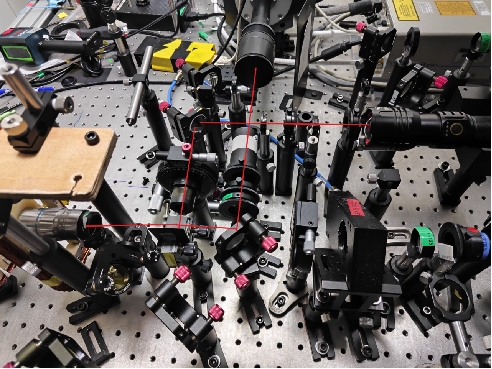
- Core Optical Components: Objective lens, polarizer, 1/2 wave plate, 1/4 wave plate, sample stage, etc.
- Sample: Magnetic thin film with weak perpendicular magnetic anisotropy.
Experimental Process
Optical Path Collimation and Light Source Switching: First, use a laser for optical path collimation to ensure normal incidence of the optical path. Then turn off the laser and switch to a white light LED flashlight as the illumination source.
Extinction Adjustment of Polarization System: In the absence of a sample or in a sample region without a magnetic signal, finely adjust the azimuth angles of the 1/2 wave plate and 1/4 wave plate to bring the system to maximum extinction (darkest background). At this point, the system is most sensitive to polarization rotation.
Magnetic Domain Imaging: Move the sample into the optical path. Slightly rotate the 1/2 wave plate (deviating from the complete extinction position by a small angle) to introduce a bias point. This linearly converts the polarization plane rotation caused by magnetic domains into intensity modulation, allowing the observation of magnetic domain patterns with bright/dark contrast in the camera’s field of view.
Image Acquisition and Processing: Select areas with uniform illumination as Regions of Interest (ROI). Appropriately adjust the contrast and gamma value of the image through camera software or post-processing software to optimize the visual display effect of magnetic domain structures and highlight their characteristics.
Experimental Results and Analysis

- Successful Verification of Imaging Quality: The experiment successfully obtained clear labyrinth-like magnetic domain images. The magnetic domain lines are continuous and winding with obvious light-dark contrast. The typical magnetic domain width is on the order of 1–3 micrometers. This directly proves the effectiveness of the combined scheme of “white light LED + AttosTek UVISI064BU high-sensitivity camera”.
- Analysis of the High-Sensitivity Camera’s Role: The white light LED has a wide spectrum, so the light intensity per unit wavelength is much lower than that of monochromatic lasers. Moreover, the magneto-optical Kerr signal itself is extremely weak. The ability to obtain clear images under such conditions is primarily attributed to the excellent sensitivity and low-noise characteristics of the UVISI064BU camera. Its high quantum efficiency ensures efficient photon capture, and low readout noise prevents signals from being overwhelmed by electronic noise. Thus, high signal-to-noise ratio raw images are output even under low-light conditions, providing a high-quality foundation for subsequent image processing.
- Demonstration of White Light Source Advantages: The overall imaging field is uniform, showing no obvious interference fringes or speckle noise. This benefit stems from the incoherent nature of the white light LED. This simplifies image interpretation and avoids interference of coherent noise with the real magnetic domain structure, making it particularly suitable for high-fidelity imaging of static domain structures.
- Analysis of Physical Connotation: The observed labyrinth domains are typical equilibrium structures resulting from the competition between thin film perpendicular magnetic anisotropy and demagnetization energy. The width and undulation degree of magnetic domains are directly related to the material’s intrinsic parameters such as magnetic anisotropy constant, exchange stiffness, and film thickness. This clear static image lays the foundation for further quantitative analysis such as calculating domain wall energy density or serving as the initial state reference for dynamic research.
Conclusion
This experiment successfully built and verified a set of wide-field magneto-optical Kerr microscopy imaging systems based on white light LED illumination and the AttosTek UVISI064BU high-sensitivity scientific camera. The system successfully observed clear labyrinth magnetic domain structures in magnetic thin films with weak perpendicular anisotropy.
The experiment shows that:
- The ultra-high sensitivity and low-noise performance of the AttosTek UVISI064BU camera are the decisive factors to overcome the low light intensity of white light sources and successfully extract weak magneto-optical signals.
- The use of an incoherent white light source effectively avoids coherent noise, resulting in uniform and clear magnetic domain images, while significantly reducing system complexity and cost.