
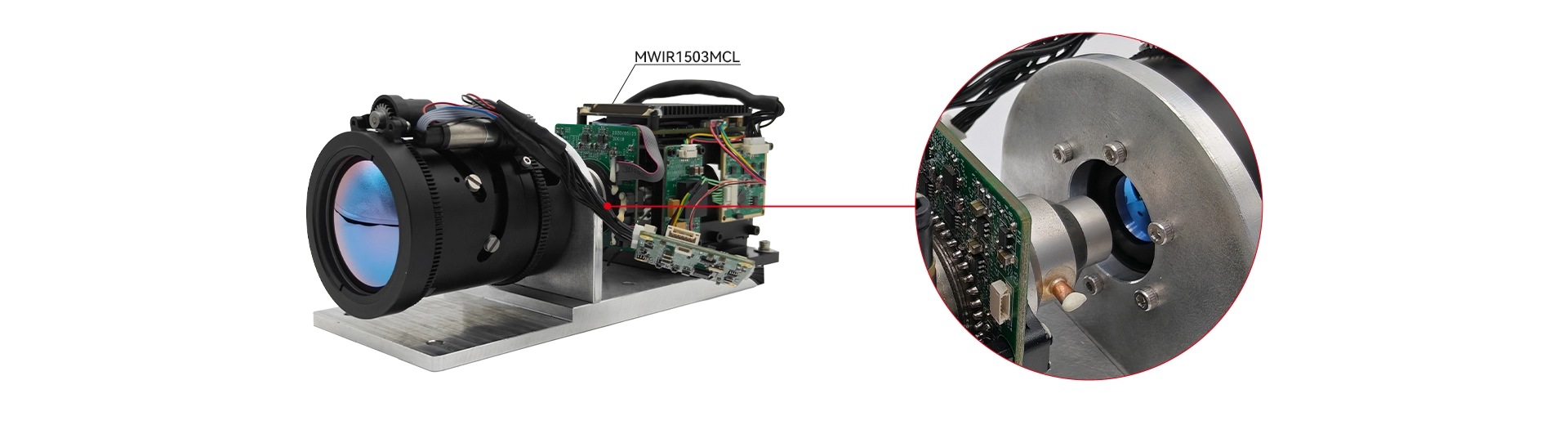
This cooled MWIR camera core features a high-performance MCT detector with 640×512 resolution and 15 μm pixel pitch, delivering crisp thermal imagery. It achieves a fast cool‑down time of ≤8 minutes at 20 °C and ≤12 minutes at 60 °C, ensuring rapid operational readiness even in elevated ambient temperatures. With a dead pixel rate of ≤0.5 %, the core provides excellent image uniformity and reliability.
| Features |
| 3.7 – 4.8 µm spectral range |
| 640 × 512 resolution |
| 15 μm × 15 μm pixel size |
| Linear Stirling Cryocooler |
| With RS422/RS232 interface |
| Digital output is provided via Camera Link |
Attostek’s MWIR thermal imaging modules are engineered for demanding defense and industrial applications. They are widely deployed in long-range surveillance systems, enhanced flight vision systems, and multi-sensor payloads. Key use cases include soldier night vision solutions, thermal imaging sights, weapon identification, airspace monitoring, and infrared signature recognition. With reliable MCT detector technology and efficient linear Stirling cooling, MWIR1503MCL deliver critical thermal intelligence for mission-critical operations around the clock.
| Detector Type | MCT |
| Resolution | 640×512 |
| F-Number | 4.0 |
| Pixel Size | 15 μm×15 μm |
| Response Band | 3.7 μm~4.8 μm |
| Cold Shield Distance | 20.0±0.2mm |
| Cooling Method | Linear Stirling Cryocooler |
| Cool-Down Time | ≤8min@20℃,≤12min@60℃ |
| Mean Time To Failure (MTTF) | ≥15000h (lifespan of cooler-related components) |
| NETD | ≤20 mk |
| Dead Pixels | ≤0.5% |
| Frame frequency | Default 50Hz, user-selectable range |
| Electrical Interfaces | Camera Link video; RS422/RS232 communication; BT656 power supply |
| Stable Power Consumption | ≤ 16W @ 20°C |
| Peak Power Consumption | ≤ 24W @ 20°C |
| Maximum Power Consumption | ≤ 32W |
| Power Supply | DC 12-32V |
| Video Output | PAL (resolution 720×576, effective 640×512) BT656 (progressive or interlaced, default interlaced) Camera Link (14-bit Base mode) |
| Expandable Video | Network, SDI |
| Common Functions | Auto/Manual AGC, Two-point Correction, Shutter Correction, Scene Correction, Zoom, Image Freeze, Polarity & False Color, DDE, Defect Correction, External Sync, Image Flip |
| Operating Temperature | -40°C ~ +70°C |
| Storage Temperature | -50℃~+70℃ |
| Vibration (Random Vibration) | 5Hz ~ 28Hz, 0.0036 g²/Hz ~ 0.08 g²/Hz 28Hz ~ 250Hz, 0.08 g²/Hz 250Hz ~ 2000Hz, 0.08 g²/Hz ~ 0.0012 g²/Hz 3 axes (x, y, z), 1 hour per axis |
| Shock | Half-sine, 50g, 6ms (3 axes, 3 shocks per axis) Half-sine, 40g, 18ms (3 axes, 3 shocks per axis) Half-sine, 25g, 6ms (3 axes, 3 shocks per axis) |
| Dimensions | L148mm×W75mm×H98mm |
| Weight | ≤1150g |
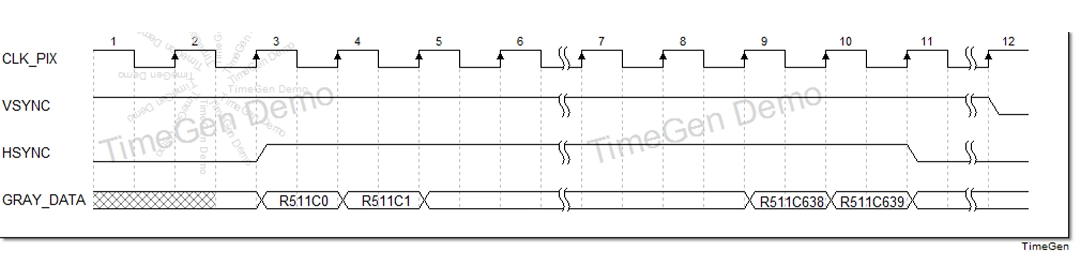
The Cameralink interface timing is shown in the following Figure; When the parameter line is enabled, the digital video transmission size is 640*513, where the parameter line is the last line, with 16bits per pixel. The camerlink parameter line information is shown in the following Table:
Cameralink timing diagram
Parameter row Correspondence Table
| Pixels | Data (bit15-0) | Notes |
| pix0 | 55AA | Frame header |
| pix1 | AA55 | |
| pix2 | AAAA | |
| pix3 | 5555 | |
| pix4 | Low position | Frame number |
| pix5 | High position | |
| pix6 | DATA | Synchronous mode (Bit8:0 inside, 1 outside) + system mode (bit1-0) |
| pix7 | DATA | Current base range (Bit15-12) + total temperature range (Bit11-8) + current integral range (Bit7-4) + total integral range (Bit3-0) |
| pix8 | Low position | Integral clock count |
| pix9 | High position | |
| pix10 | DATA | Focal length |
| pix11 | DATA | Detector power-on status (bit0:0: power-off, 1 power-on) |
| pix12 | DATA | This cooling completion time unit: s |
| pix13 | DATA | Ambient temperature, magnified 10 times, signed number |
| pix14 | DATA | Focal plane temperature, magnification 10 |
| pix15 | DATA | Polarity/pseudo-color (bit2-0) |
| pix16 | DATA | Digital video mode (BIT1-0, 0: Y14, 1: Y8, 2: X14) |
| pix17 | DATA | Frame rate, magnify 100 times |
| pix18 | DATA | Electronic doubling (bit1-0) |
| pix19 | DATA | Sharpening level (bit3-0) |
| pix20 | DATA | Mirror mode (bit1-0) |
| pix21 | DATA | Time-domain filtering mode (bit0, 0: off, 1: on) |
| pix22 | DATA | Time-domain filtering parameters |
| pix23 | DATA | Airspace filter switch (bit0, 0: off, 1: on) |
| pix24 | DATA | Spatial filtering threshold |
| pix25 | DATA | Brightness (Bit 7-0) |
| pix26 | DATA | Contrast (bit7-0) |
| Pixels | Data (bit15-0) | Notes |
| pix0 | 55AA | Frame header |
| pix1 | AA55 | |
| pix2 | AAAA | |
| pix3 | 5555 | |
| pix4 | Low position | Frame number |
| pix5 | High position | |
| pix6 | DATA | Synchronous mode (Bit8:0 inside, 1 outside) + system mode (bit1-0) |
| pix7 | DATA | Current base range (Bit15-12) + total temperature range (Bit11-8) + current integral range (Bit7-4) + total integral range (Bit3-0) |
| pix8 | Low position | Integral clock count |
| pix9 | High position | |
| pix10 | DATA | Focal length |
| pix11 | DATA | Detector power-on status (bit0:0: power-off, 1 power-on) |
| pix12 | DATA | This cooling completion time unit: s |
| pix13 | DATA | Ambient temperature, magnified 10 times, signed number |
| pix14 | DATA | Focal plane temperature, magnification 10 |
| pix15 | DATA | Polarity/pseudo-color (bit2-0) |
| pix16 | DATA | Digital video mode (BIT1-0, 0: Y14, 1: Y8, 2: X14) |
| pix17 | DATA | Frame rate, magnify 100 times |
| pix18 | DATA | Electronic doubling (bit1-0) |
| pix19 | DATA | Sharpening level (bit3-0) |
| pix20 | DATA | Mirror mode (bit1-0) |
| pix21 | DATA | Time-domain filtering mode (bit0, 0: off, 1: on) |
| pix22 | DATA | Time-domain filtering parameters |
| pix23 | DATA | Airspace filter switch (bit0, 0: off, 1: on) |
| pix24 | DATA | Spatial filtering threshold |
| pix25 | DATA | Brightness (Bit 7-0) |
| pix26 | DATA | Contrast (bit7-0) |
The core’s external interfaces include: power interface, RS422 external control interface, analog video interface, digital video CameraLink interface, BT656 interface, and control lens interface. The first four physical interfaces are connected via a 25-pin connector, while the BT656 interface is connected via a 20-pin 0.5mm pitch FPC connector (pull-down type). The model of the 25-pin connector on the circuit board is J30JZLN25ZKWA000, and the corresponding mating connector’s model and definitions are shown in Table 1. The FPC connector pin definitions are shown in Table 2.
Table 1: J30JZ/XN25TJCAL01
| Pin Number | Name | Definition |
| 1,2 | POWER+ | Power Positive |
| 14,15 | POWER- | Power Ground |
| 3 | RS422_A1 | Core Receive + |
| 4 | RS422_B1 | Core Receive – |
| 5 | RS422_Y1 | Core Transmit + |
| 6 | RS422_Z1 | Core Transmit – |
| 7 | GND | RS422 Serial Port Ground |
| 8 | RS422_A2 | External Sync Receive + |
| 9 | RS422_B2 | External Sync Receive – |
| 10 | PAL_OUT1 | Analog Video |
| 11 | AGND_ADV7179 | Analog Video Ground |
| 12 | PAL_OUT2 | Backup Analog Video |
| 13 | AGND_ADV7179 | Backup Analog Video Ground |
| 16 | Tx285OUT0+ | Digital Video |
| 17 | Tx285OUT0- | |
| 18 | Tx285OUT1+ | |
| 19 | Tx285OUT1- | |
| 20 | Tx285OUT2+ | |
| 21 | Tx285OUT2- | |
| 22 | Tx285OUT3+ | |
| 23 | Tx285OUT3- | |
| 24 | Tx285CLK+ | |
| 25 | Tx285CLK- |
Table 2: 20-Pin FPC Pull-Down Connector
| Pin Number | Name | Definition |
| 20 | BT656_CLK | Clock |
| 19 | BT656_D0 | Data Bit 0 |
| 18 | BT656_D1 | Data Bit 1 |
| 17 | BT656_D2 | Data Bit 2 |
| 16 | BT656_D3 | Data Bit 3 |
| 15 | BT656_D4 | Data Bit 4 |
| 14 | BT656_D5 | Data Bit 5 |
| 13 | BT656_D6 | Data Bit 6 |
| 12 | BT656_D7 | Data Bit 7 |
| 11/10/9 | DGND | Ground |

The control serial port of the upper computer for the infrared movement is “SSCOM_INF_EN English new version.exe” (referred to as the control serial port). Double-clicking the file will generate the control interface.
The software operation steps are:
1) : Correctly select the port number of the serial port (depending on the computer being used), set the baud rate (115200 BPS), and then click “Open Serial Port”. After the correct Settings, the control serial port interface changes to the one shown in the figure on the right. The green box in the figure turns green, indicating that the control serial port is working properly.
2) Introduction to the control serial interface, with the red box representing quick commands, users can control the MWIR1503MCL infrared movement by clicking the buttons inside the box.
| Quick Commands | Meanings | Quick Commands | Meanings |
| Menu | User menu, with only a few control functions | Expert Menu | Unavailable |
| Parameter + | Forward adjustment of parameters in the image | Parameter | Reverse adjustment of parameters in the image |
| Menu left shift | Move the parameters in the image left and right | Move the menu right | Move the parameters in the image left and right |
| FAR | Focus close | NEAR | Focus far |
| ZOOM_IN | Zoom in length | ZOOM_OUT | Push out the focal length |
| Serial pass-through | Click this command to release the serial communication to the lens serial port | Set the focal length | The focal length can be set manually |
| Focal length Query | Query lens focal length |
MWIR technology is an infrared imaging technology that operates in the 3–5 μm waveband. It is widely used in advanced defense imaging systems, providing critical capabilities such as surveillance, target detection, and data collection.
Under certain conditions, MWIR cameras can detect objects up to approximately 2.5 times farther than LWIR cameras. Additionally, MWIR is less sensitive to atmospheric effects, making it particularly effective in environments with good visibility and favorable weather conditions.
MWIR is highly sensitive to temperature differences and excels at detecting high-temperature targets such as engines or missile plumes. Its strong thermal contrast enhances imaging performance, making it well‑suited for precise detection in highly dynamic scenarios.
Our Mid-Wave Infrared (MWIR) lens offers a wide range of optical solutions to enhance your thermal imaging system. They are designed to meet a wide range of detection, recognition, and identification requirements . Available as optional accessories, the lineup includes continuous zoom lenses covering ranges from 15‑300mm up to 60‑1200mm with aperture options of f/4.0 or f/5.5 depending on the model.