10MP 4.5μm Pixels, 300-1000nm High Speed Camera
| Features |
|---|
| Equipped with GSPRINT4510 CMOS image sensor |
| Maximum frame rate up to 1401 fps |
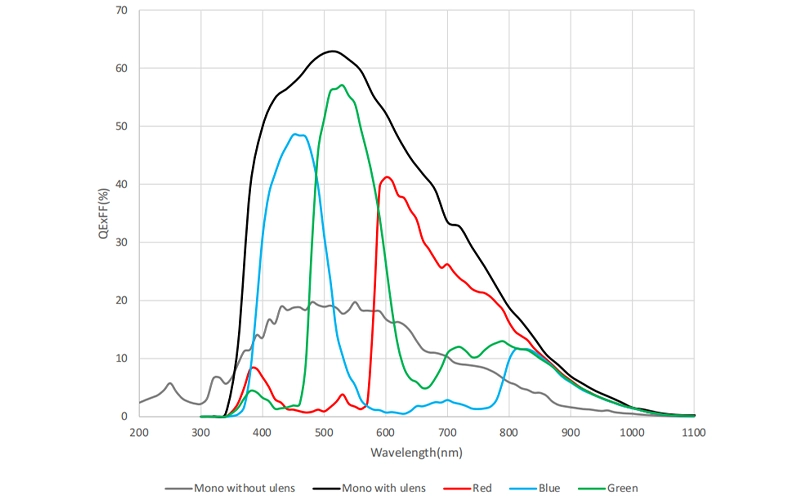
| Quantum Efficiency: 63% @ 550nm |
| Global shutter to suppress motion distortion |
| Dual interfaces: USB 3.0 + CoaXPress |
| Multiple data bit depths: 8/10/12-bit |
| Large 1024 MB (8 Gb) image buffer |
| Hardware ROI and external trigger |
| CE/FCC certified with multi-platform SDK provided |
The SDK supports development languages such as C/C++, C #/VB.net, Python, Java, etc,
Third-party support including LabVIEW, MATLAB, Micro-Manager, DirectShow, and TWAIN.
| Item | Specification |
| Model | VIS0410CUCXP, VIS0410MUCXP |
| Sensor Type | GSPRINT4510 |
| Spectral Range | 300nm–1000nm |
| Pixel Size | 4.5μm × 4.5μm |
| Sensor Format | 1.44″ |
| Frame Rate & Resolution | 397 fps @ 4608×2176; 1401 fps @ 2304×1088 |
| Memory | 1024MB (8Gb) |
| Conversion Gain | 0.52 e⁻/ADU @ 12-bit |
| Dynamic Range | 68dB (12-bit) |
| Read Noise | 4 e⁻ (12-bit) |
| Full Well Capacity | 30k e⁻ (12-bit), 120k e⁻ (Binned) |
| SNR | 44.7dB (12-bit) |
| Sensitivity | -86dB |
| Dark Current | 11.4 e⁻/s/pixel @ 50℃ |
| QE | 63% @ 550nm |
| Exposure Time Range | 1μs ~ 10s |
| Gain Range | 1.0x, 2.0x, 4.0x |
| Shutter Mode | Global Shutter |
| Binning | Software: 2×2, 3×3, 4×4; Hardware FPGA: 2×2 |
| Data Interface | USB 3.0 / CXP |
| Digital I/O | 1 optical-coupling isolated input, 1 optical-coupling isolated output, 2 non-isolated input and output |
| Data Bit Depth | 8-bit / 10-bit / 12-bit |
| Cooling Temperature | -20℃ (ambient temperature 20℃) |
| Optical Interface | TBD |
| Power Supply | 19V 4A power adapter |
| Power Consumption | < 25W |
| Dimensions | 110mm × 110mm × 126.4mm |
| Weight | TBD |
| Software | AttosView; SDK development kit; CLView software for Delsa frame grabbers |
| Operating System | Windows / Linux |
| Temperature | Operating: -30℃ ~ 60℃; Storage: -40℃ ~ 80℃ |
| Humidity | 20%–80% RH, non-condensing |
| Certifications | CE, FCC |
| Parameter | Specification |
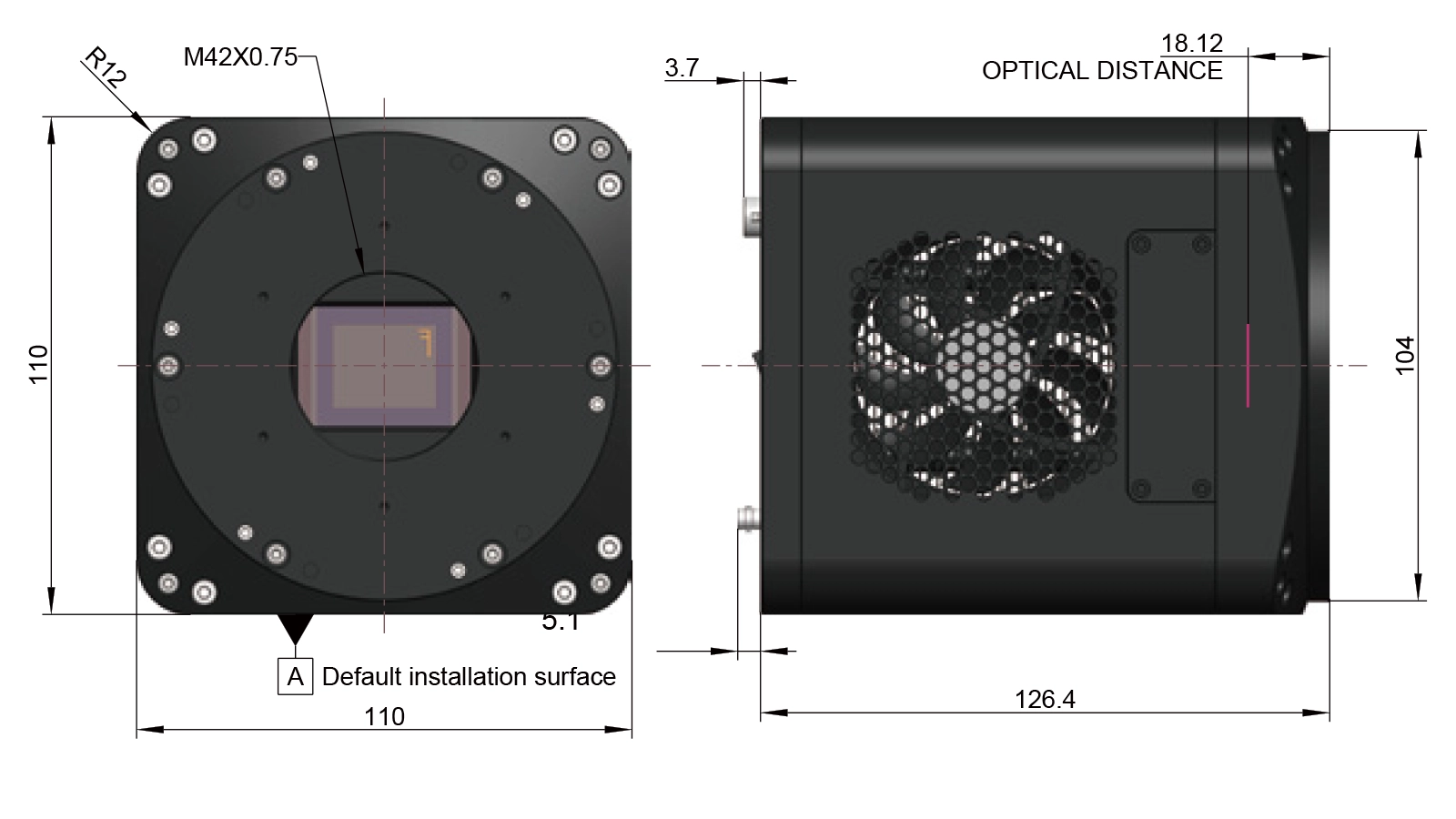
| Dimensions | 110mm×110mm×126.4mm |
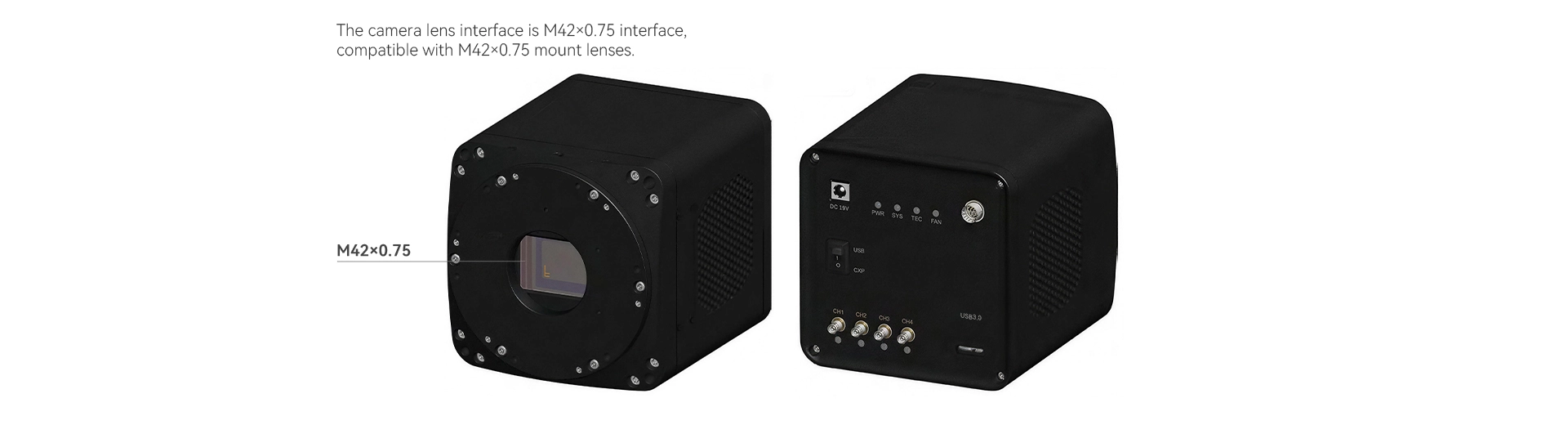
| Lens Interface | M42×0.75 |
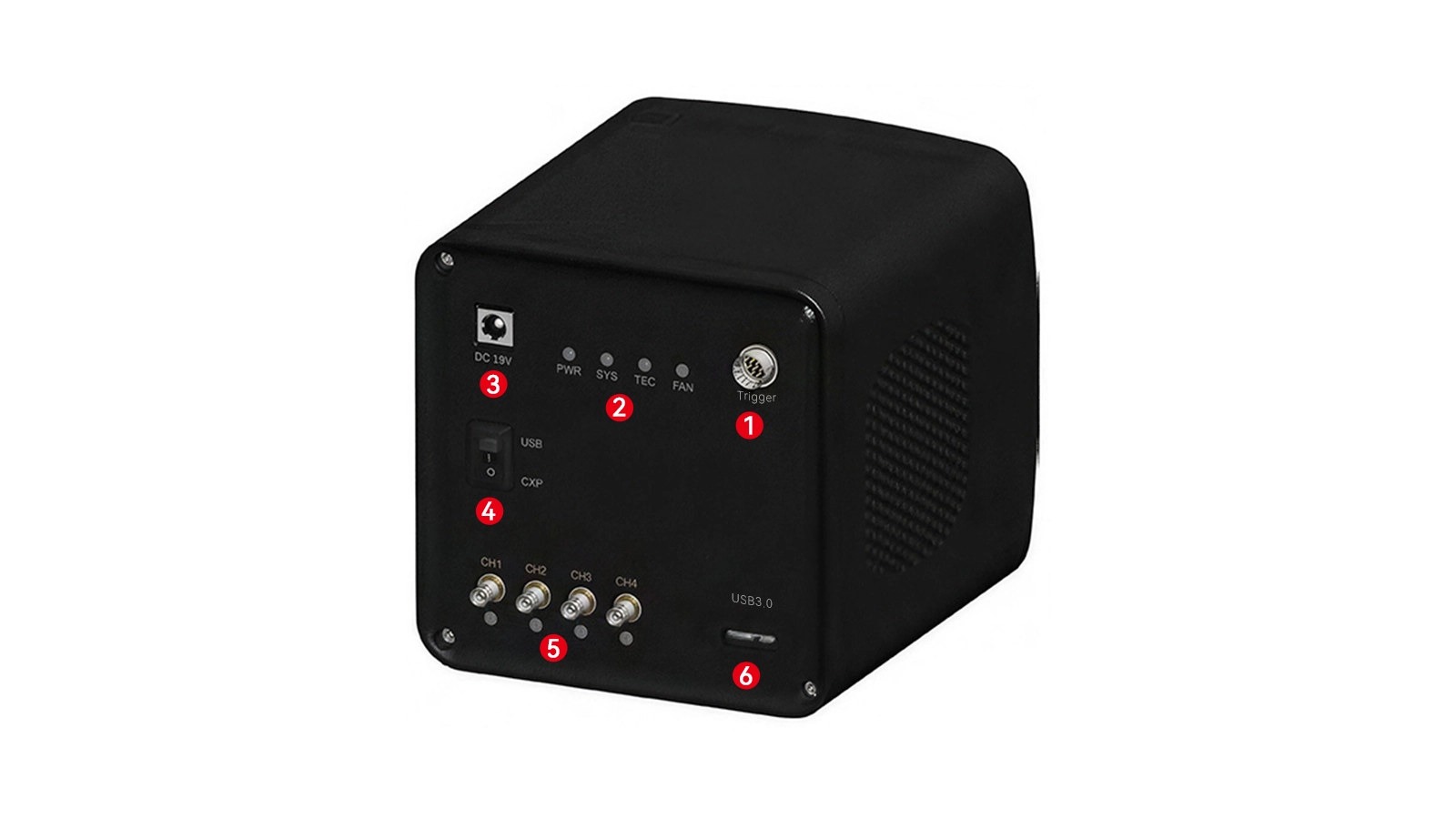
| No. | Specification |
| 1 | 7-Pin Trigger Interface |
| 2 | Indicators for Power, System, Cooling and Fan |
| 3 | DC 19V Power Port |
| 4 | USB / CXP Interface Toggle Switch |
| 5 | 4 × CXP Interfaces |
| 6 | USB 3.0 Port |
| Table1: USB port, GigE port, CL port refrigerated camera pin signal definitions | |||||
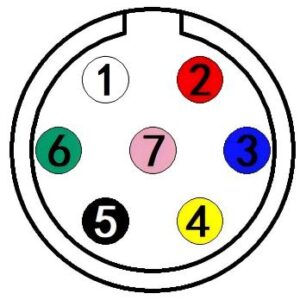 |
Color | Pin | Signal | Description of the signal | |
| White | 1 | GDN | Direct-coupled signal ground | ||
| Red | 2 | 12V | 12VDC power input | ||
| Blue | 3 | OPTO_GND | Opto-isolated signal ground | ||
| Yellow | 4 | DIR_GPIO0 | Direct-coupled General Purpose I/O (Software configurable input/output) (line2) | ||
| Black | 5 | DIR_GPIO1 | Direct-coupled General Purpose I/O (Software configurable input/output) (line3) | ||
| Green | 6 | OPTO_IN | Opto-isolated input signal (line0) | ||
| Pink | 7 | OPTO_OUT | Opto-isolated output signal (line1) | ||


The electrical characteristics of the opto-isolated output (external voltage 5V, external resistor 1K) are shown in Table 2.
| Table 2: Opto-isolated output signal’s electrical characteristics | ||
| Parameter name | Parameter notation | Parameter value |
| Output logic low | VL | 742mV |
| Output logic high | VH | 4.134V |
| Output rise time | TR | 4us |
| Output fall time | TF | 1.8us |
| Output rise delay | TDR | 12us |
| Output fall delay | TDF | 2us |
The output of the corresponding output current and VL when using different voltages and resistors in externalcircuit are shown in Table 3.
| Table 3:Opto-isolated output logic’s low levels parameters | |||
| External voltage | External resistor | VL | Output current |
| 3.3V | 1KΩ | 510mV | 2.82mA |
| 5V | 1KΩ | 742mV | 4.31mA |
| 12V | 2.4KΩ | 795mV | 4.68mA |
| 24V | 4.7KΩ | 850mV | 4.97mA |
To prevent damage to the GPIO pins, please connect the pin GND first, and then input voltage to the Line2 pin.
Input rise delay (TDR): 0.02us
Input fall delay (TDF): 0.02us
2. Line2/line3 are set as output pins
The maximum current allowed through this pin is 25mA.
The external pull-up voltage is 5V, the pull-up resistor is 1KΩ, and the GPIO is configured to output the logic level and electrical characteristics as shown in Figure 4.


When the ambient temperature is 25 degrees Celsius, the relationship between the external voltage, resistance and low-level voltage output is shown in Table 4.
| Table 4:Non-isolated output Logic’s low level parameters | ||
| External voltage | External resistor | VL(GPIO) |
| 3.3V | 1KΩ | 0.11V |
| 5V | 1KΩ | 0.167V |
| 12V | 2.4KΩ | 0.184V |
| 24V | 4.7KΩ | 0.385V |
| Table 5: Non-isolated output electrical characteristics | ||
| Parameter name | Parameter notation | Parameter value |
| Output rise time | TR | 0.08us |
| output fall time | TF | 0.02us |
| Output rise delay | TDR | 0.1us |
| Output fall delay | TDF | 0.04u |
ascamsdk support a variety of APIs, including: Native C/C++,.NET/C#/VB.NET, Python, Java, DirectShow, Twain, LabView, Matlab, etc. Compared with other APIs, Native C/C++ API as a low-level API is characterized by using pure C/C++ development without relying on other runtime libraries. The interface is simple and the control is flexible.
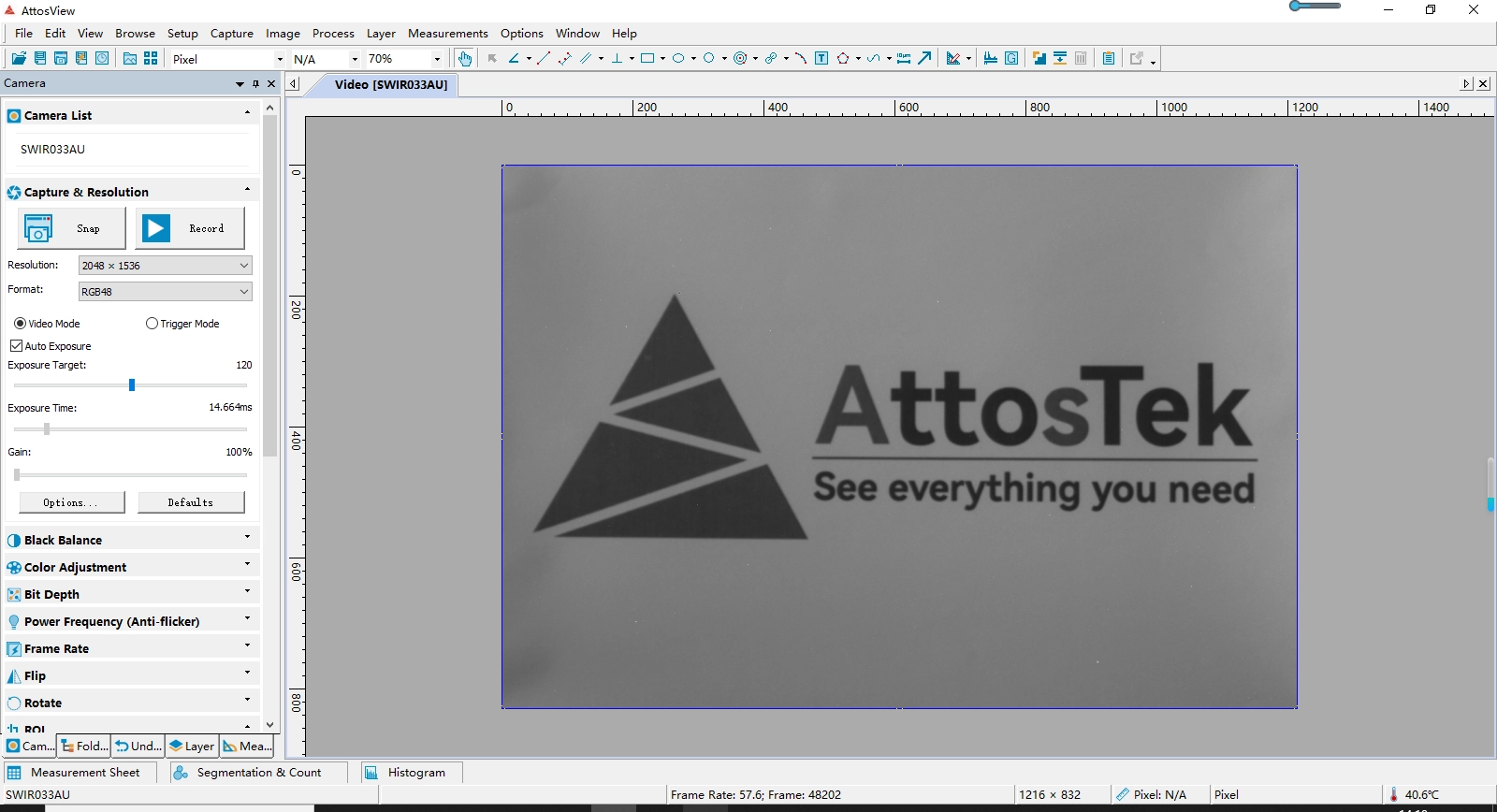
AttosTek provides extensive third-party software support for its UV-Vis cameras and SWIR cameras, facilitating rapid integration and use in various development environments. This includes SDK and demo programs for LabVIEW and MATLAB, as well as DirectShow drivers, Micromanager, and TWAIN SDK drivers. These features enable seamless compatibility with mainstream development environments and third-party software, greatly simplifying the workflow for system integration and secondary development.
|
AttosView Recommended System Requirements |
|
|
Operating System |
Microsoft® Windows® XP / Vista / 7 / 8 /10 /11(32 & 64 bit), Mac OSX, Linux |
|
Processor (CPU) |
≥3.0 GHz Intel Core i5 or Higher |
|
Memory (RAM) |
≥8 GB |
|
Hard Drive |
NVMe Solid State Drive (SSD) |
|
Graphics Card |
Dedicated Adapter with ≥256 MB RAM |
|
Motherboard |
USB 3.0 (-USB) Cameras: Integrated Intel USB 3.0 Controller or One Unused One Unused PCle3.0*16 Slot |
|
Connectivity |
Internet Connectivity for Driver Installation |
Q1: What are the core imaging advantages of the high-speed camera with a 4608 × 2176 large-format global shutter sensor?
This series of cameras covers the 300–1100 nm spectral range, spanning UV, visible, and near-infrared bands. The 1.44-inch large sensor format enables single-frame large-area panoramic imaging without the need for image stitching. The global shutter eliminates motion artifacts in high-speed scenes, while the camera delivers 397 fps at full resolution and up to 1401 fps in ROI mode, balancing wide field of view with ultra-high-speed acquisition. The –20°C deep TEC cooling suppresses dark current at elevated temperatures, and the 1 GB onboard image buffer ensures long-duration continuous capture without frame loss.
Q2: Which application scenarios are suitable for the color (VIS0402CUCXP) and monochrome (VIS0402MUCXP) models, respectively?
This series is available in two models: color (VIS0402CUCXP) and monochrome (VIS0402MUCXP). Both models share identical core hardware specifications, including pixel size, resolution, frame rate, and spectral range. Selection recommendations are as follows:
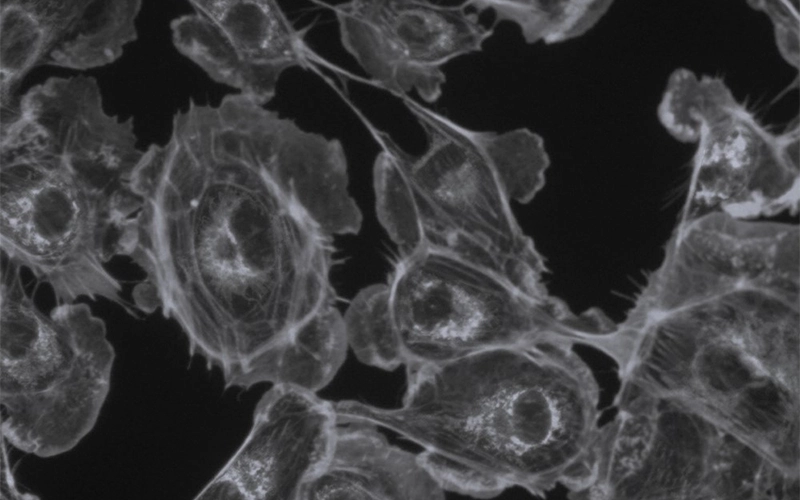
- Color camera: If your application requires extracting critical information from color—such as color recognition in product quality inspection or analysis of stained samples in medical imaging—the color camera is the preferred choice.
- Monochrome camera: If your experiment needs to capture extremely weak signals (e.g., fluorescence imaging) or perform precise morphological measurements and quantitative analysis, the monochrome camera offers higher sensitivity due to the absence of a Bayer filter and its associated light loss.
Q3: What software and hardware optimization measures can be taken when frame loss occurs during ultra-high-frame-rate acquisition?
-
Camera-side optimization: Enable hardware 2×2 binning, reduce the hardware ROI (region of interest), and rely on the 1 GB onboard buffer to handle burst data streams.
-
Hardware cabling: For extreme 1401 fps scenarios, prioritize CoaXPress shielded cables; avoid USB extension cables and USB hubs.
-
System optimization: Set the image storage path to an NVMe SSD, close background applications with high resource usage, and assign high priority to the acquisition process in the system.
-
10MP CMOS high-speed camera, available in monochrome or color.
VIS0410CUCXP
10MP Color CMOS Camera with 4.5µm Pixel, Global Shutter, USB 3.0 & CXP Interface
VIS0410MUCXP
10MP Monochrome CMOS Camera with 4.5µm Pixel, Global Shutter, USB 3.0 & CXP Interface
Optional accessories – lenses
AttosView offers an optional YLGD series continuous zoom optical system for visible light cameras, designed specifically for high-precision imaging scenarios. The YLGD series continuous zoom optical system series provides multiple focal length options and is suitable for various professional applications such as security surveillance, industrial vision inspection, and scientific observation, ensuring excellent image clarity, operational flexibility, and environmental adaptability. For inquiries, please contact sales@attostek.com