1280×1024 MWIR Motorized Zoom Lens

This MWIR motorized zoom lens series is purpose-built for high-resolution 1280×1024 detector cores with 10 μm pixels, operating across the 3.7–4.8 μm waveband. Three focal length ranges are available — 15–330 mm, 30–660 mm and 45–900 mm — all supporting RS232/RS422 communication. Each lens delivers motorized continuous zoom, combining wide short-focal-length search coverage with ultra-long-range telephoto reach, transmittance of up to ≥80% and short-focal-length distortion as low as ≤|3.3|%, with options ranging from compact lightweight units to large-aperture designs.
- Matched to 1280×1024 resolution, 15 μm pixel MWIR detector cores
- Focal length coverage of 15–330 mm, 30–660 mm and 45–900 mm supports applications ranging from long-range detection to wide-area search.
- Average transmittance ≥83% to preserve thermal imaging sensitivity
- Capable of imaging objects as close as 5 m
- Stable operation from -40 °C to +70 °C for reliable performance across temperature swings
- IP67-rated front element for harsh weather conditions
| Model | MW330H | MW660H | MW900H | |||
| S.R | 3.7-4.8μm | |||||
| FPA | 1280×1024 (10μm) | |||||
| E.F.L | f15mm | f330mm | f30mm | f660mm | f45mm | f900mm |
| F.NO | 4.0 | |||||
| REL.ILL | ≥72% | >73% | ||||
| Distortion | ≤|7.1|% | ≤|5.6|% | ≤|3.3|% | ≤|5.5|% | ≤|5|% | ≤|5|% |
| F.R | 1m/30m~Infinity | 5m/50m~Infinity | 10m/30m~Infinity | |||
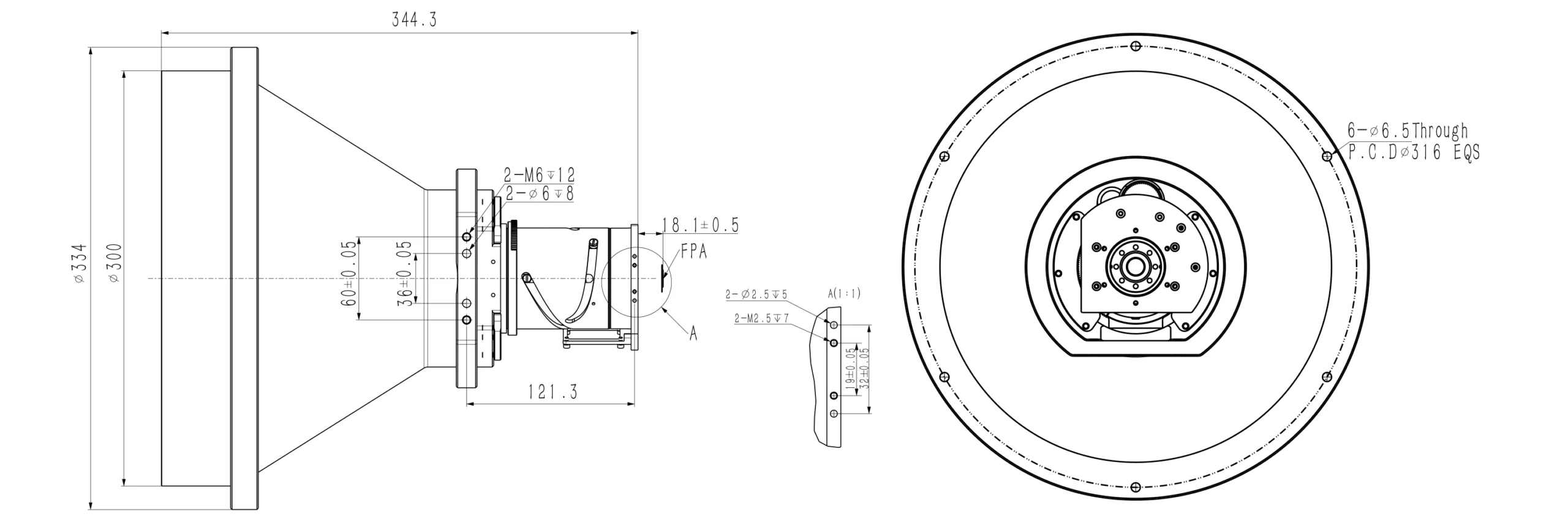
| TTL | 147mm | 243mm | 290mm | |||
| Tave | ≥72% | ≥80% | ≥69% | |||
| MD | 82mm | 210mm | 290mm | |||
| Weight | 189.9g | 1650 g | 3896.99g | |||
| B.F.L | 29.05mm | 30.06mm | ||||
| Cold stop distance | 20mm | 19.95mm | ||||
| Cold stop CA | Ø5mm | |||||
| Thermal adjust | Motorized Adjustment | |||||
| O.T.R | -40℃~+80℃ | |||||
| Sealing | IP67(front only) | |||||
| Model | E.F.L | FOV H | FOV V |
| MW330H | f15mm | 46.2° | 37.6° |
| f330mm | 2.2° | 1.7° | |
| MW660H | f30mm | 24.09° | 19.37° |
| f660mm | 1.11° | 0.89° | |
| MW900H | f45mm | 16.18° | 12.98° |
| f900mm | 0.81° | 0.65° |


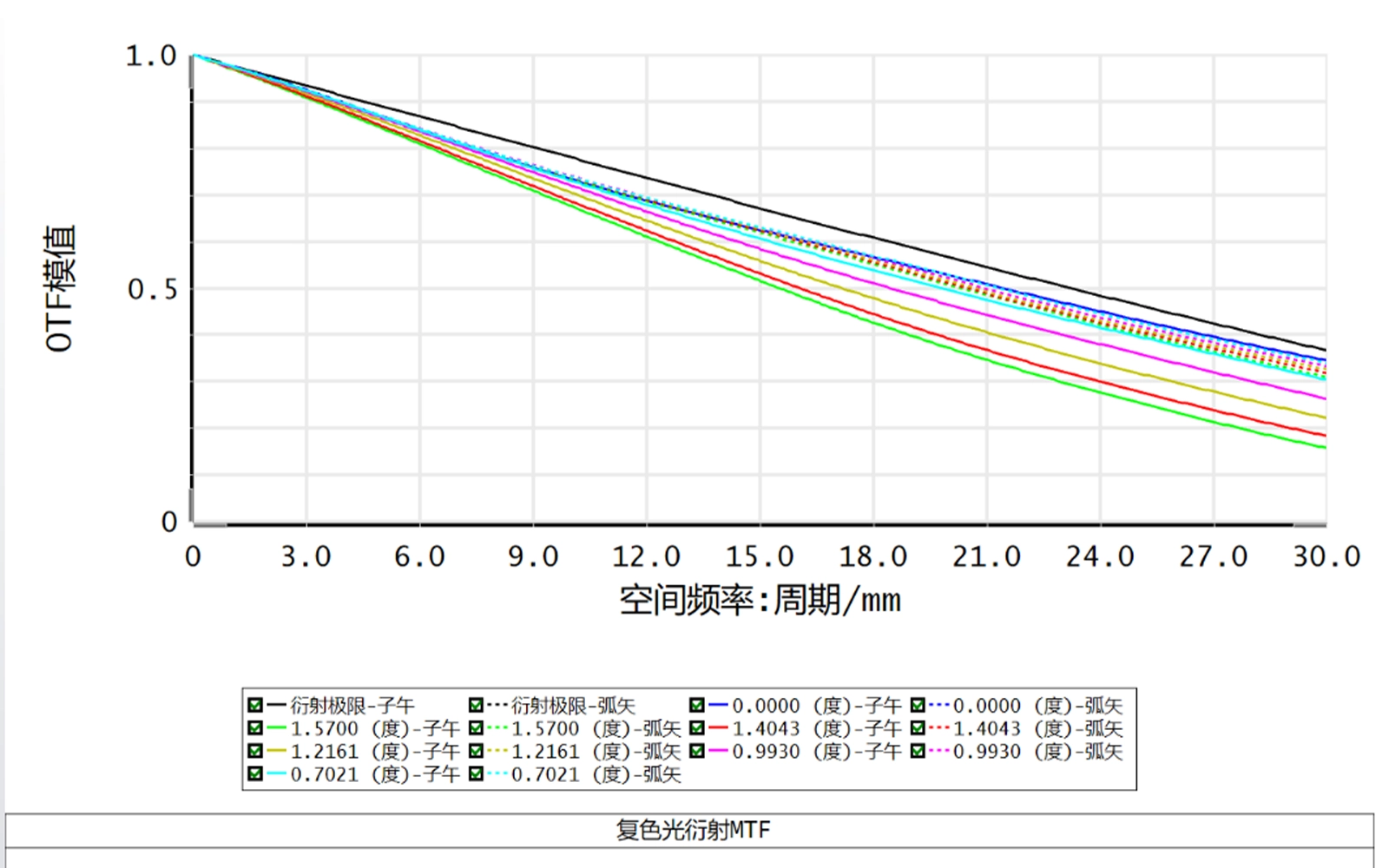


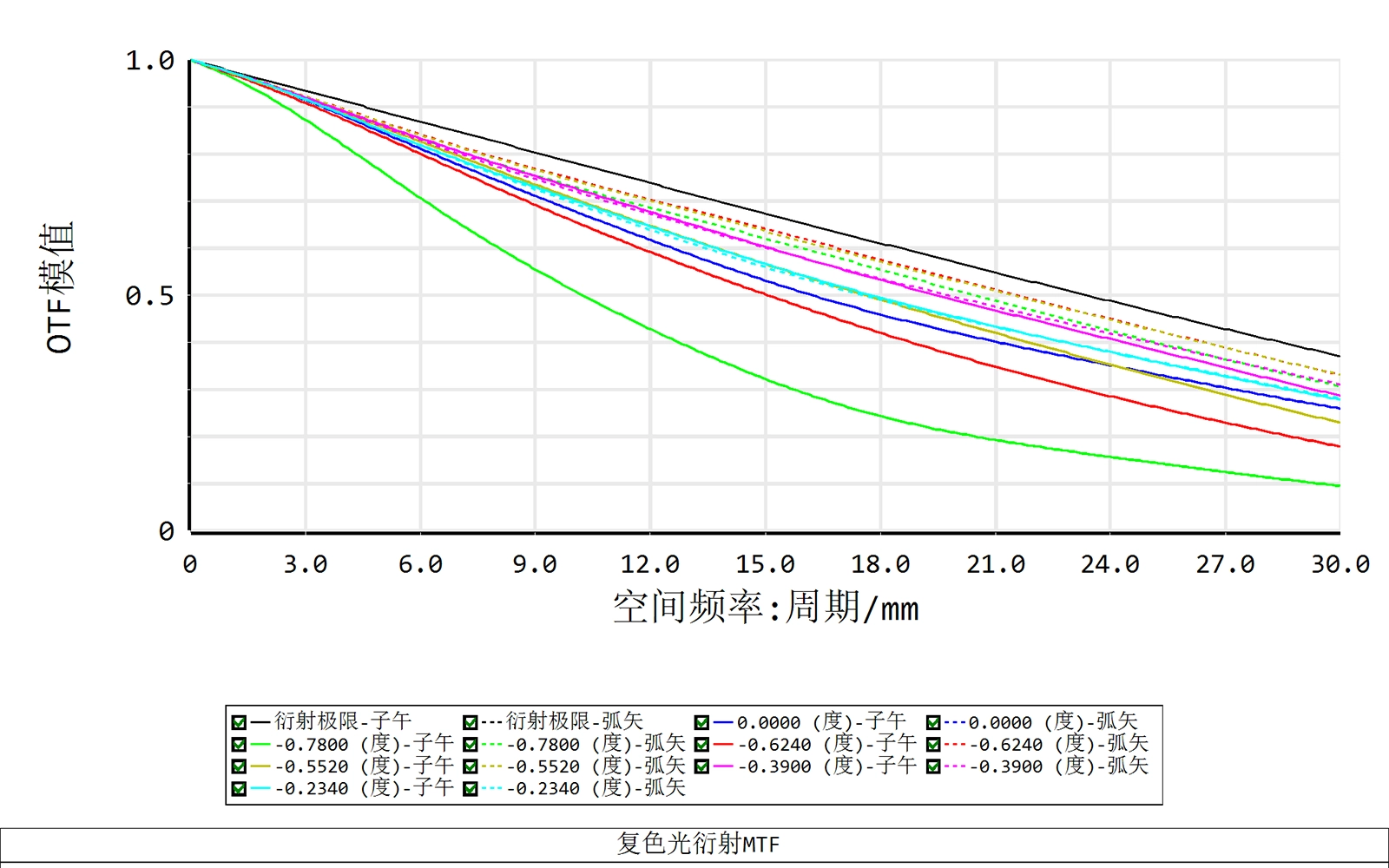


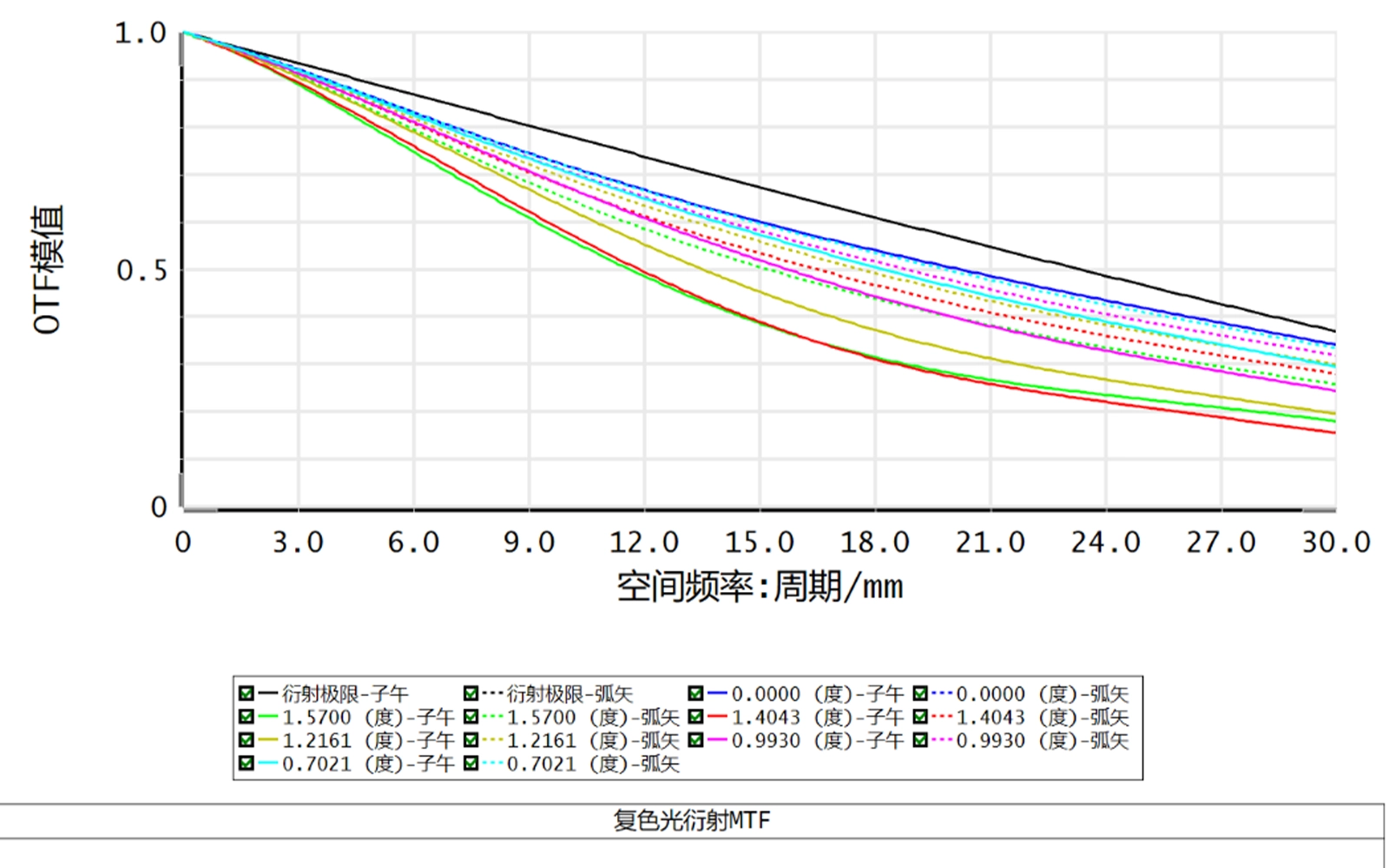


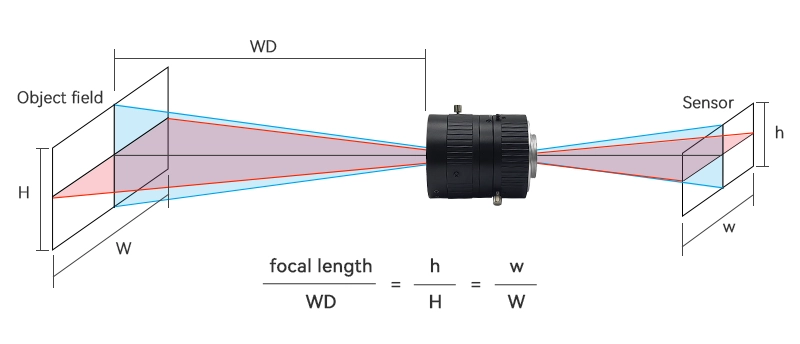
Focal length is the distance between the optical centre of the lens (rear principal point) and the image focal point, and it is a key performance parameter. It defines the viewing angle: a shorter focal length gives a wider field of view and broader coverage, while a longer focal length narrows the field of view and concentrates the observed area.
This series covers 330–900 mm focal lengths and focuses from 1 m to infinity, spanning near-focus to long-range observation.
The f-number is a key parameter for MWIR light-gathering capability, defined as the ratio of focal length to clear aperture. It directly governs system sensitivity, signal-to-noise ratio and image quality: a lower f-number means a larger aperture, more incoming light and a shallower depth of field.
This series uses an f/4.0 aperture, which limits light throughput and is typically chosen for long-focal-length, long-range observation.
At a fixed focal length, a smaller f-number requires a larger lens diameter, which increases size, weight and cost. This series is optimised for medium- to long-range observation.
- AFOV: angular field of view
- H: detector format (horizontal or vertical length)
- f: focal length of the lens
Average transmittance for MWIR (3–5 μm) lenses typically falls between 70% and 95%.
As motorized zoom lenses with multiple moving groups and optical surfaces, this series achieves transmittance ≥69%, with the MW660H reaching ≥80%.
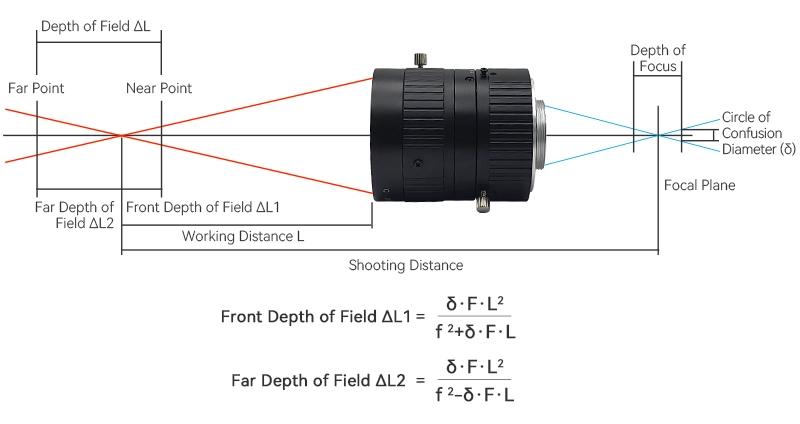
Three factors mainly affect depth of field: aperture, working distance and focal length. Depth of field can be increased by:
- stopping down the aperture (using a larger f-number)
- increasing the working distance
- using a shorter focal length lens
1. If my imaging range is short — only a few metres — which lens should I choose?
Choose the MW330H. With a 15–330 mm focal length and a 1–30 m imaging range, it suits MWIR motorized zoom applications that need a wide short-focal-length field of view and close-range imaging.
2. How to Choose Among the MW330H, MW660H, and MW900H MWIR Lenses?
The MW330H has a 15–330 mm focal length, a maximum element diameter of 82 mm and an element weight of 189.9 g, making it the smallest and lightest of the three. Its 46.2° horizontal FOV at the short end is also the widest, making it ideal where space and payload are limited and wide-search, close-range imaging is required.
The MW660H offers a 30–660 mm focal length, ≥80% transmittance and short-focal-length distortion of ≤|3.3|%. Its size and weight sit between the other two, suiting balanced medium- to long-range applications that are sensitive to transmittance and distortion.
The MW900H covers 45–900 mm with a 0.81° horizontal FOV at the long end, built for ultra-long-range telephoto observation. With a maximum diameter of 290 mm and an element weight of 3896.99 g, it is the largest and heaviest of the three.
3. What is the practical imaging impact of an f/4 aperture?
F/4 is a conventional value in cooled MWIR systems. The f-number is the ratio of focal length to entrance pupil diameter: a smaller f-number means a larger clear aperture, more light and a faster system. The correspondingly smaller entrance pupil helps control element diameter, size and cost, while the larger depth of field eases focusing during long-range observation and temperature changes. Choosing f/4 across these three lenses balances size, weight, sensitivity and cold-stop matching.
MWIR Thermal Imaging Zoom Lenses
AttosTek supplies MWIR motorized continuous zoom lenses for 1280×1024 (10 μm) detectors, covering 15–330 mm, 30–660 mm and 45–900 mm focal ranges with a 3.7–4.8 μm waveband, f/4 aperture, -40 °C to +80 °C operation and IP67 front sealing. Combining compact lightweight construction, high transmittance and ultra-long-range telephoto reach, they provide motorized focusing and wide short-focal-length search capability for border and coastal defence, perimeter security, forest fire prevention, EO/IR gimbals and long-range target search, recognition and tracking.
MW330H
3.7-4.8 μm MWIR motorized zoom lens for 1280 × 1024 (10 μ m) detectors, 15-330mm focal length, F/4
MW660H
3.7–4.8 μm MWIR motorized zoom lens for 1280 × 1024 (10 μm) detectors, 30–660 mm focal length, F/4
MW900H
3.7–4.8 μm MWIR motorized zoom lens for 1280 × 1024 (10 μm) detectors, 45–900 mm focal length, F/4