900–2500 nm C-Mount Extended SWIR Fixed Focal Lens

AttosTek high-performance C-mount SWIR fixed focal lenses are optically optimized for the 900–2500 nm spectral band. Available in 25 mm and 50 mm focal lengths with a fast F2.0 aperture, the lenses support working distances from 1 m to infinity. Featuring a standard C-mount, lockable focus ring and iris ring, they offer full mechanical and optical compatibility with AttosTek’s complete lineup of C-mount SWIR cameras.
- Focal Length: 25 mm, 50 mm
- Spectral Range: Optimized for 900–2500 nm SWIR
- Aperture: F2.0, manually adjustable
- Compatible Sensor Format: 1″
- Mount: Standard C-Mount
| Item | SWIR2520C-2.5 | SWIR5020C-2.5 |
| Model | SWIR2520C-2.5 | SWIR5020C-2.5 |
| Focal Length | 25 mm | 50 mm |
| F# | 2 | |
| Spectral Range | 0.9–2.5 μm | |
| Focus Type | Fixed Focus | |
| Athermalized | Yes | |
| Image Circle | 12.3 mm | |
| Average Transmittance | ≥84% | |
| Field of View (H×V×D) | 21.74°×17.46°×27.63° | 10.97°×8.78°×14.02° |
| Relative Illumination | ≥95% | ≥91% |
| Resolution | >0.6 mrad | >0.3 mrad |
| Distortion | ≤|3.8%| | ≤|1.7%| |
| Back Focal Distance (BFD) | 12.526 mm | 12.523 mm |
| Rear Focal Length | 14.558 mm | 19.498 mm |
| Flange Focal Distance (FFD) | 17.526 mm | |
| Working Distance | 1 m ~ ∞ | |
| Mount Type | C-mount | |
| Detector Format | 640*512-15 μm | |
| Weight | 70.32 g | 92.41 g |
| Front Coating | AR Coating | |
| Sealing Protection | First Lens IP67 | |
| Housing Material | 6061 Aluminum | |
| Operating Temperature | -40°C ~ 80°C | |
| Storage Temperature | -40°C ~ 80°C | |
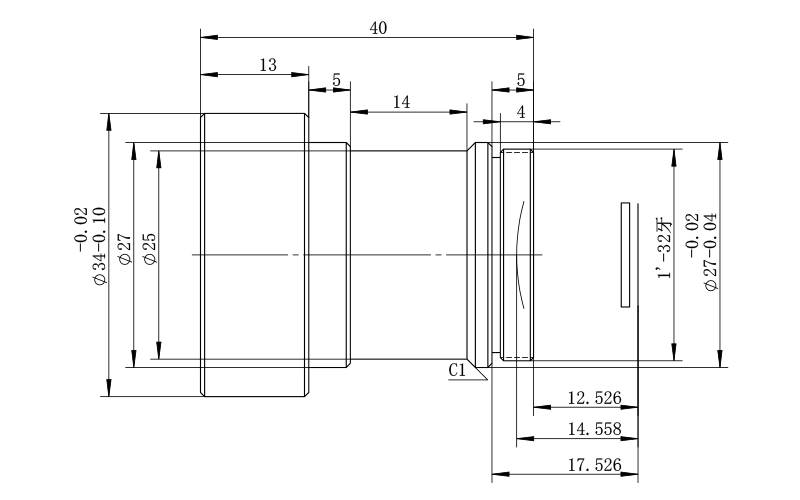
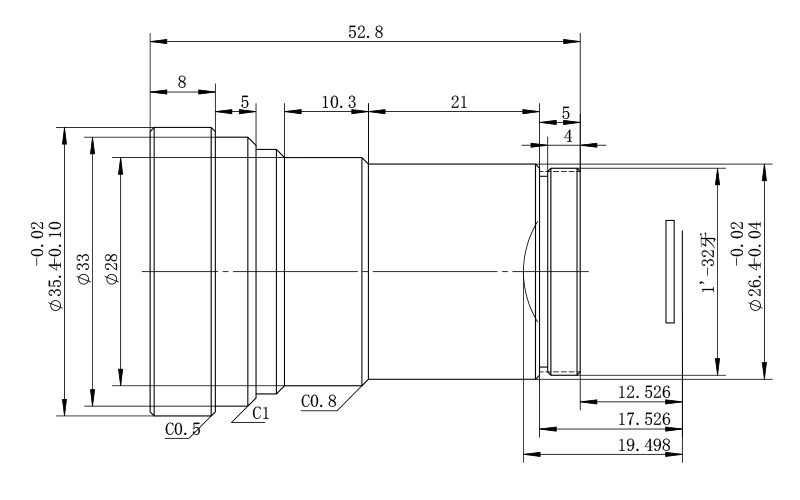
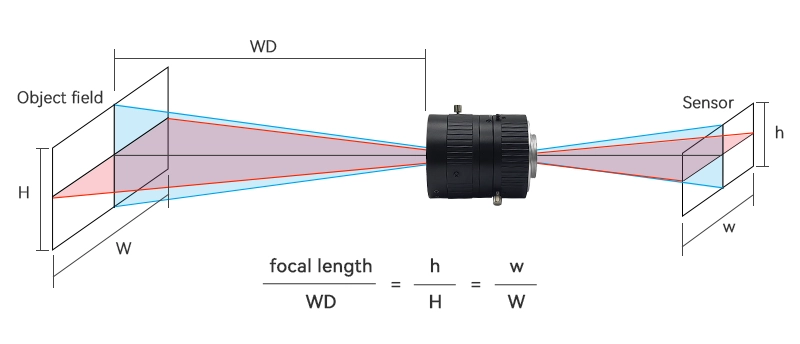
Focal length refers to the distance between the optical center (rear principal point) of a lens and its imaging focal point, serving as a key performance parameter of the lens. It determines the angle of view: the shorter the focal length, the wider the field of view and the broader the observable range; the longer the focal length, the narrower the field of view and the more concentrated the observation area.
The aperture controls the amount of light entering the lens—a larger aperture results in a brighter image. This parameter directly affects exposure time and, consequently, the camera’s response speed. In daytime shooting, if the light is too strong, the aperture can be narrowed to prevent overexposure; at night or in low‑light conditions, the aperture can be widened to increase light intake, ensuring optimal imaging performance under varying lighting conditions.
The optical lens interface refers to the standardized mechanical mount connecting a lens to a camera body, determining compatibility and ensuring precise alignment for correct optical focus onto the image sensor. In industrial applications, C-mount and CS-mount are generally employed with cameras featuring smaller sensor sizes, while F-mount is typically used for larger sensors. Additional interfaces commonly found in line-scan cameras include M42, M58, and M72 mounts—essentially threaded connections of specified diameters.
C-mount lenses represent the established standard in machine vision, compatible with cameras housing image sensors up to approximately 20 mm (1.5 inches) in diagonal dimension. This interface supports a wide array of specifications across focal lengths, resolutions, and working distances.
When used with a larger sensor, the edges of the sensor extend beyond the lens’s image circle, resulting in dark corners or black borders around the photo.
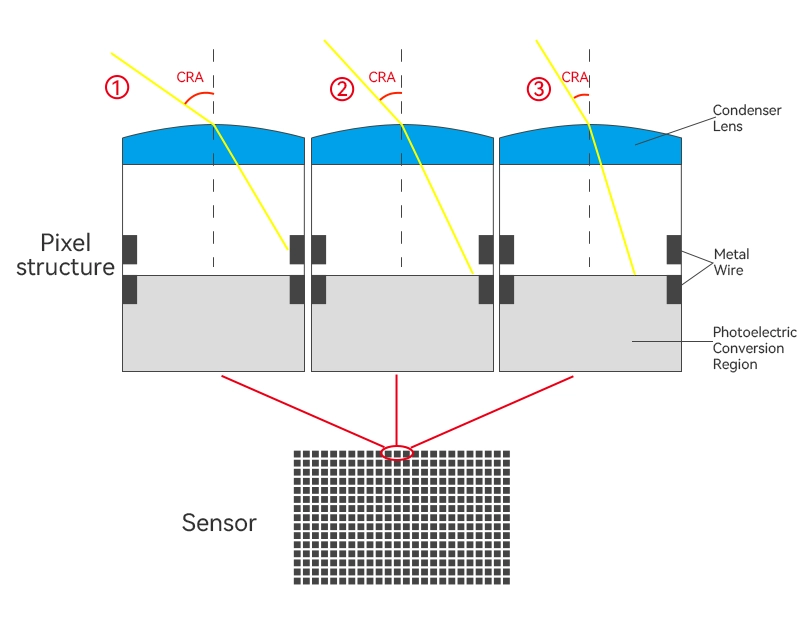
To ensure optimal imaging performance, it is generally required that the lens CRA should match the sensor CRA, with the lens CRA not exceeding that of the sensor.
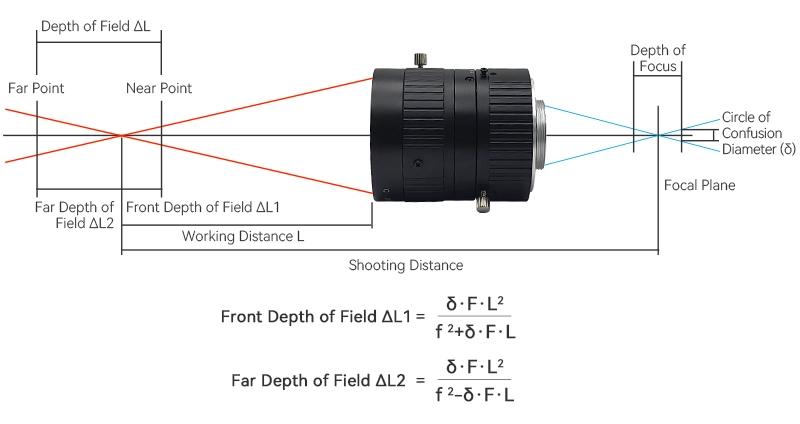
Three primary factors influence depth of field: aperture size, working distance, and lens focal length. Increasing the depth of field can be achieved by:
- Reducing the aperture size (i.e., using a larger f-number)
- Increasing the working distance
- Using a lens with a shorter focal length
Q1: How to choose between these two lenses?
Both lenses share the same mount, working distance range, and are compatible with the same type of SWIR cameras. The core difference is focal length, so selection depends on your field-of-view and detail requirements.
The SWIR2520C-2.5 (25 mm focal length) delivers a wider field of view, ideal for wide-area inspection and mid-range imaging.
The SWIR5020C-2.5 (50 mm focal length) is better suited for long-range observation to capture fine details.Q2: Can this lens series be used directly with C-mount SWIR cameras?
Yes, they can be mounted directly onto C-mount SWIR cameras. Both lenses adopt the C-mount standard with a 12.3 mm image circle, matching SWIR cameras with 640×512 resolution and 15 μm pixel pitch. The flange focal distance is 17.526 mm, conforming to the C-mount standard.
Q3: Are these lenses suitable for agricultural moisture detection and food sorting applications?
A3: Yes, this lens series works well for agricultural moisture monitoring and food sorting. Water features characteristic absorption peaks at 1450 nm and 1900 nm within the SWIR spectrum. Covering the 900–2500 nm band, these lenses maintain high transmittance at 1450 nm and 1900 nm. Paired with extended-band SWIR cameras, they are ready for agricultural moisture inspection and food sorting tasks.
Fixed Focal Lenses for SWIR Cameras, 900–2500 nm
To meet the imaging requirements of extended-band SWIR at 900–2500 nm, AttosTek offers high-performance extended-band SWIR fixed focal lenses.
Models SWIR2520C-2.5 and SWIR5020C-2.5 cover the extended 900–2500 nm SWIR band with focal lengths of 25 mm and 50 mm respectively, compatible with cameras featuring 640×512 resolution and 15 μm pixel pitch.
Users can select the appropriate model flexibly based on field of view, working distance and other requirements.
Capable of capturing richer spectral information and delivering superior penetration in low-light, smoky and dusty conditions, these lenses are well suited for scientific research, industrial inspection and spectroscopy applications.
SWIR2520C-2.5
900-2500nm spectral range, 25mm fixed focus, F2.0 aperture, C-mount SWIR lens
SWIR5020C-2.5
900-2500nm spectral range, 50mm fixed focus, F2.0 aperture, C-mount SWIR lens