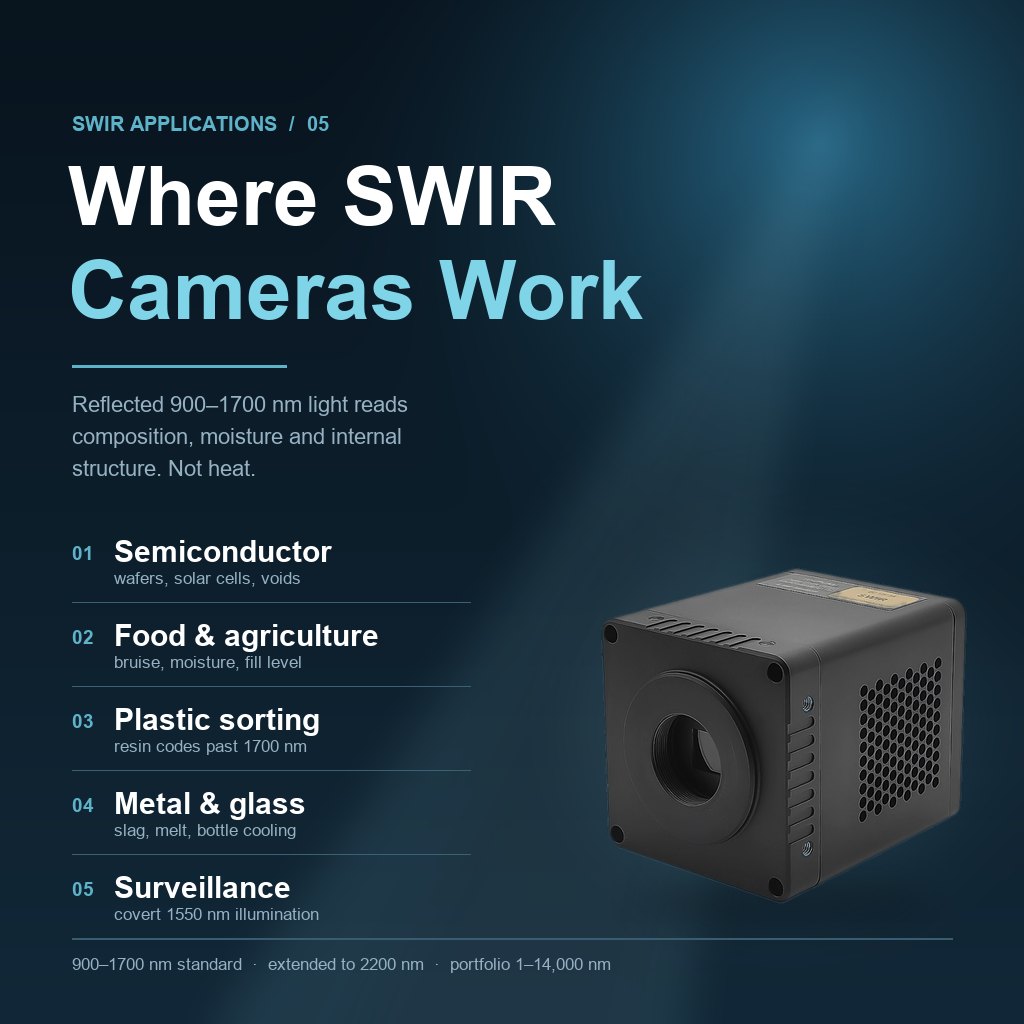
In the field of short-wave infrared (SWIR) imaging, pixel size is one of the important parameters affecting camera imaging performance. It is a trade-off among spatial resolution, sensitivity, and frame rate, and ultimately determines the imaging quality of the camera. Different pixel sizes have their own characteristics in spatial sampling capability and single-pixel optical signal collection capability, so selection should be made based on detection accuracy, lighting conditions, frame rate, and application requirements.
This article compares eight common representative pixel sizes from 3.45 μm to 30 μm and introduces the corresponding SWIR camera products and typical applications, providing a reference for scenarios such as industrial vision, semiconductor inspection, and scientific imaging.
SWIR Camera Pixel Size Ranking: 3.45–30 μm
Below is a ranking of pixel sizes from smallest to largest, covering everything from the 3.45μm small pixel for ultimate resolution to the 30μm large pixel designed for extremely weak-light detection.
| Pixel Size | Brand | Model | Resolution | Frame Rate | Key Features |
|---|---|---|---|---|---|
| 3.45 μm | AttosTek | SWIR033AU | 2048 × 1536 | 93 fps | High pixel density, suitable for fine-detail imaging |
| 5 μm | AttosTek | SWIR051AU | 1280 × 1024 | 200 fps | Balanced spatial resolution and system integration |
| 10 μm | Teledyne | SCION 1280 | 1280 × 1024 | 175 Hz | Megapixel resolution with large pixels |
| 12.5 μm | Sensors Unlimited | 1280JSX | 1280 × 1024 | 60 fps | Low-noise design |
| 15 μm | AttosTek | SWIR1503BU | 640 × 512 | Up to 724 fps | Balanced signal capture and dynamic imaging |
| 20 μm | Xenics | Bobcat 640 | 640 × 512 | 100 Hz | Large pixel photosensitive area |
| 25 μm | FLIR | Tau SWIR 25 | 640 × 512 | 30 fps | Large pixels, compact integration design |
| 30 μm | Allied Vision | Goldeye G-008 SWIR Cool TEC1 | 320 × 256 | Up to 344 fps | Large pixels for specific low-light signal imaging tasks |
The selection of pixel size for SWIR cameras is a trade-off between spatial resolution and light-intensity resolution. As pixel size increases, spatial resolution decreases, but the ability of a single pixel to collect optical signals becomes stronger, and sensitivity increases. This shows that spatial resolution and light-intensity resolution need to be balanced. Therefore, when selecting a model, factors such as detection accuracy, lighting conditions, and frame rate should be considered, and it should be clarified whether the application values detail resolution or low-light sensitivity more.
Representative Products with Different Pixel Sizes
3.45 μm AttosTek SWIR033AU
The AttosTek SWIR033AU uses a Sony IMX993 SenSWIR InGaAs image sensor, with a pixel size reaching the industry-leading 3.45 μm level. It is one of the products with the smallest pixel size among current SWIR area-scan cameras and is suitable for SWIR imaging tasks that have relatively high requirements for spatial detail.
A smaller pixel pitch helps increase the spatial sampling density of the image. The SWIR033AU achieves 3-megapixel-class resolution within a 1/2-inch optical format. This means that in semiconductor wafer surface defect inspection, it can capture smaller particle contamination or bonding defects, and in beam spot detection for optical communication modules, it can provide a finer beam cross-sectional profile. For microscopy imaging and precision industrial inspection that pursue ultimate spatial resolution, the SWIR033AU is the option that sees the finest detail in the SWIR band.
Explore the product: AttosTek SWIR033A Series SWIR Cameras
5 μm AttosTek SWIR051AU
The AttosTek SWIR051AU uses a 5 μm × 5 μm pixel and has a resolution of 1280 × 1024. It is a balanced choice among SWIR cameras that combines resolution and system integration.
The 5 μm pixel occupies a delicate technical balance point in the SWIR band. It is much smaller than a traditional 15 μm pixel, meaning that higher pixel density and spatial resolution can be achieved on the same optical format; at the same time, it has a larger per-pixel photosensitive area than a 3.45 μm pixel. The SWIR051AU is suitable for industrial vision and scientific research scenarios that require relatively high resolution while keeping overall system cost and size under control.
Explore the product: AttosTek SWIR051A Series SWIR Cameras
10 μm Teledyne SCION 1280
The Teledyne SCION 1280 uses a 10 μm × 10 μm pixel and has a resolution of 1280 × 1024. The product specifications described in the original text include a peak quantum efficiency of 85% at 1300 nm and read noise of 30 e⁻. The 10 μm pixel is a milestone size in the SWIR field. It makes megapixel-class resolution possible on an optical format of about 1 inch while retaining higher per-pixel sensitivity than a 5 μm pixel.
The SCION 1280 has a peak quantum efficiency as high as 85% @ 1300 nm and read noise of only 30 e⁻. Combined with its wide spectral response, it makes an ideal platform for industrial material sorting and wide-band imaging. For users who need relatively high resolution and a good signal-to-noise ratio, 10 μm is a choice worth serious consideration.
12.5 μm Sensors Unlimited 1280JSX
The Sensors Unlimited 1280JSX uses a 12.5 μm × 12.5 μm pixel and has a resolution of 1280 × 1024.
The 1280JSX is known for low read noise (35 e⁻) and low power consumption (3 W), and it has unique advantages in security surveillance, defense target detection, and industrial inspection. Compared with a 10 μm pixel, 12.5 μm goes a step further in sensitivity and is suitable for area-scan imaging scenarios that have certain requirements for signal-to-noise ratio and also require a relatively large field of view.
15 μm AttosTek SWIR1503BU
The 15μm pixel has a relatively mature application foundation in SWIR cameras and achieves a near-optimal balance among sensitivity, resolution, and system cost. In industrial automation, 15μm pixel cameras offer several times higher sensitivity than the commonly used 5μm solution in the industry and are suitable for large-field-of-view, low-light, or high-speed inspection scenarios. For applications that do not require extremely high spatial sampling density but value signal collection and imaging speed, this model should be a key candidate for evaluation.
Explore the product: AttosTek SWIR1503B Series SWIR Cameras
20 μm Xenics Bobcat 640
The Xenics Bobcat 640 uses a 20 μm × 20 μm pixel and has a resolution of 640 × 512. It provides GigE and Camera Link interfaces, consumes as little as 2.8 W, and weighs only 285 g.
The core value of the 20 μm pixel lies in sensitivity. A 20 μm pixel collects 80% more light than a 15 μm pixel and 4 times as much as a 10 μm pixel. This characteristic makes 20 μm pixel cameras stand out in scenarios that need to capture weak signals, such as laser beam analysis and internal defect inspection of silicon semiconductors. With a positioning of low cost and high performance, the Bobcat 640 targets industrial applications that have relatively high requirements for sensitivity but moderate requirements for resolution, and it has mature applications in sorting and recycling and laser wavefront sensing.
25 μm FLIR Tau SWIR 25
The FLIR Tau SWIR 25 uses a 25 μm × 25 μm pixel, has a resolution of 640 × 512, and has a full-resolution frame rate of 30 fps. The 25 μm pixel has a larger per-pixel photosensitive area and can better match C-mount lenses and low-cost lenses, reducing the overall system requirements on the optical system.
The Tau SWIR 25 adopts a compact design and is specially designed for OEM integration in space-constrained applications. It is suitable for low-light imaging, laser spot analysis, and scenarios requiring miniaturized SWIR modules.
30 μm Allied Vision Goldeye G-008 SWIR Cool TEC1
The Allied Vision Goldeye G-008 SWIR Cool TEC1 uses a 30 μm × 30 μm pixel, has a 320 × 256 resolution, and can reach a full-frame frame rate of up to 344 fps.
30 μm is the “ceiling” for pixel size among common SWIR area-scan cameras. Such a large pixel means ultimate single-pixel sensitivity; the photosensitive area of each pixel is 4 times that of a 15 μm pixel. The Goldeye G-008 SWIR Cool TEC1 achieves a high frame rate of 344 fps at 0.1 MP resolution, and its design orientation is very clear: to capture signals quickly under extremely low-light conditions. This size is suitable for imaging faint celestial bodies in astronomical observation, long-exposure fluorescence microscopy, and process monitoring that requires extremely high temporal resolution while lighting conditions are harsh.
Conclusion
From 3.45 μm to 30 μm, different pixel sizes correspond to different imaging design orientations. Small pixels are more suitable for tasks that focus on spatial detail under sufficient lighting and pursue high spatial resolution; large pixels are more suitable for tasks that pursue high signal-to-noise ratio and sensitive detection under weak light, short exposure, high speed, or a large field of view, providing advantages for single-pixel signal collection.
When actually selecting a SWIR camera, comprehensive evaluation should be made based on target size, required detection accuracy, lighting conditions, frame rate, spectral range, and lens configuration, rather than simply judging by pixel size alone.
If you are selecting SWIR cameras for industrial inspection, semiconductor imaging, or scientific measurement projects, you are welcome to contact AttosTek to further understand the applicable scenarios of different pixel sizes and product configurations.