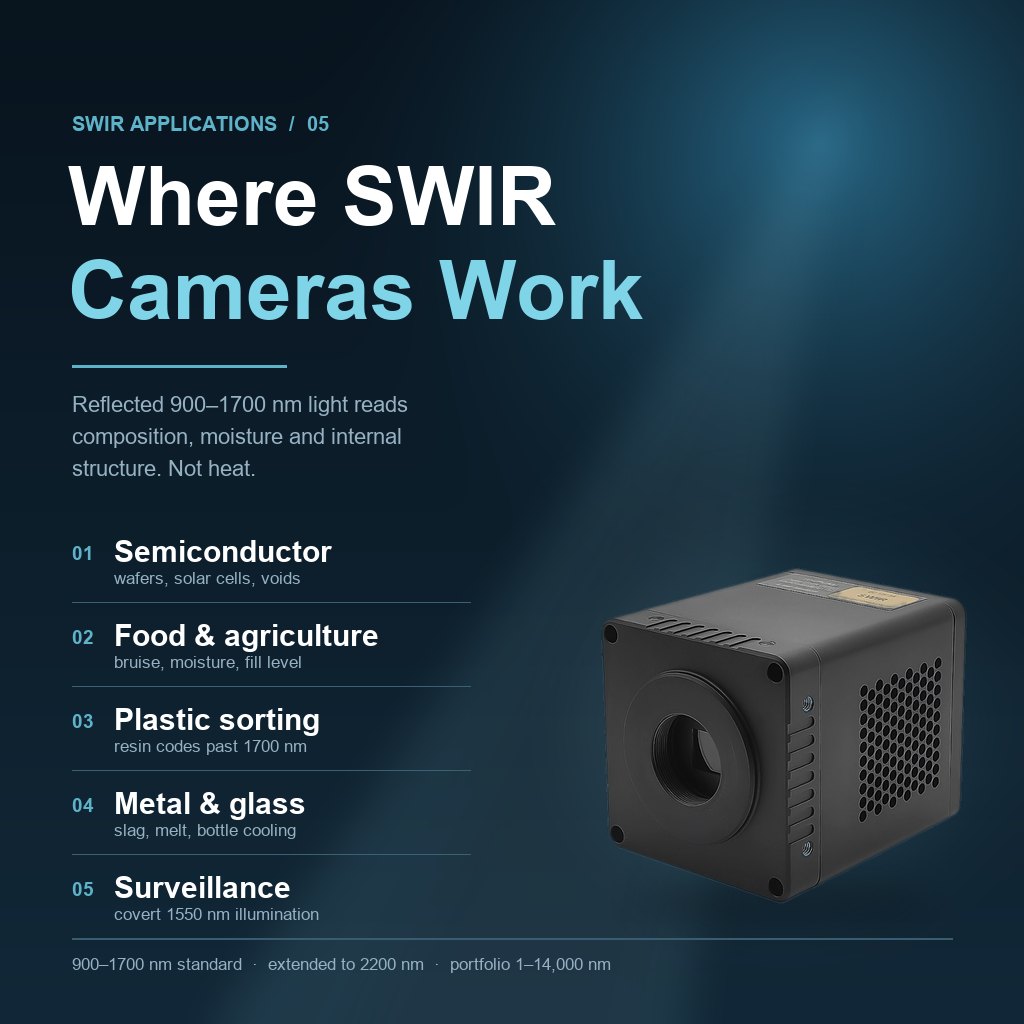
SWIR cameras are used to inspect what reflected short-wave infrared light exposes and visible light hides: cracks inside silicon wafers, bruises under apple skin, resin types in shredded plastic, temperature uniformity in hot glass, and detail at long range on a dark night. The band runs from 900 to 1700 nm, and extended sensors reach 1900 or 2200 nm. A SWIR camera photographs a lit scene instead of a heat map, so it returns sharp, familiar-looking images. Five job families account for most of the work, and each is easier to judge against the thermal or visible alternative it replaces.
Key Takeaways
- Silicon goes transparent at about 1100 nm, and SWIR work starts there. Past that line the camera images through wafers, coatings and many plastics, which visible inspection cannot do at any magnification.
- Water absorbs hardest near 1450 nm. That one band turns moisture into contrast, so food grading, bread freshness and fill-level checks run in the short-wave infrared rather than in colour.
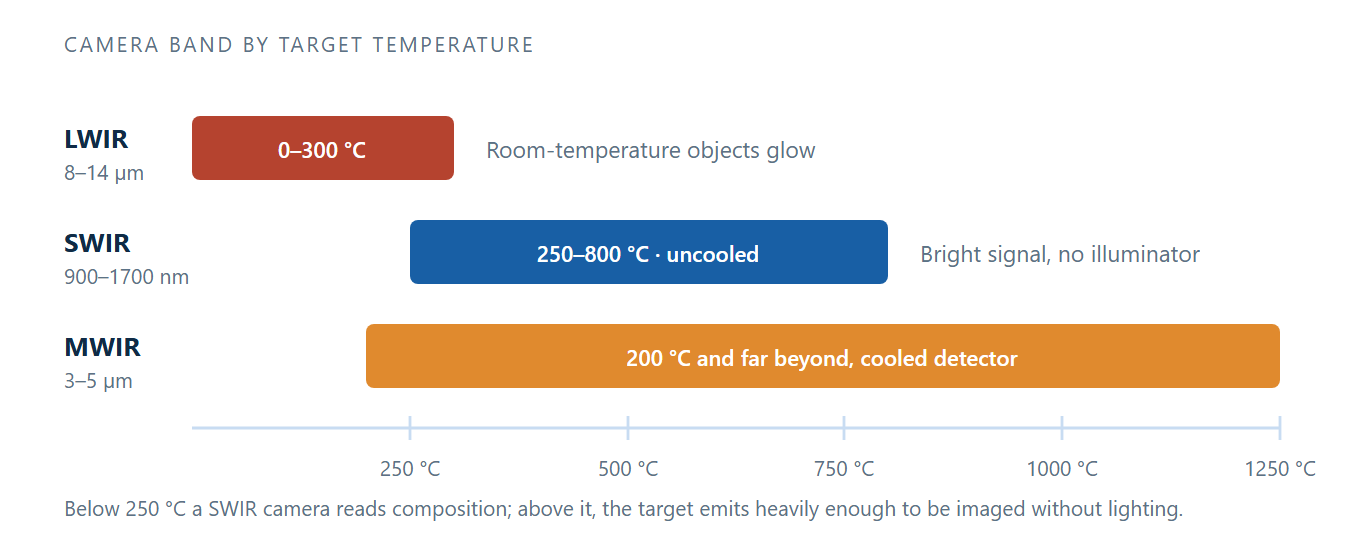
- Targets above roughly 250 °C emit enough SWIR to image without a cooler. Below that threshold the camera reads composition, not temperature, and an LWIR Camera takes over the thermography job.
- Extended sensors reach 1900 and 2200 nm. Standard 900–1700 nm InGaAs separates most packaging resins, while telling PVC from PET needs the longer window and a cooled detector.
- Resolution stays photographic, not scanner-like. A 0.33 MP sensor delivers 640 × 512 pixels at 15 µm pitch, enough to hold focus on a conveyor at production speed.
Semiconductor and Solar Cell Inspection
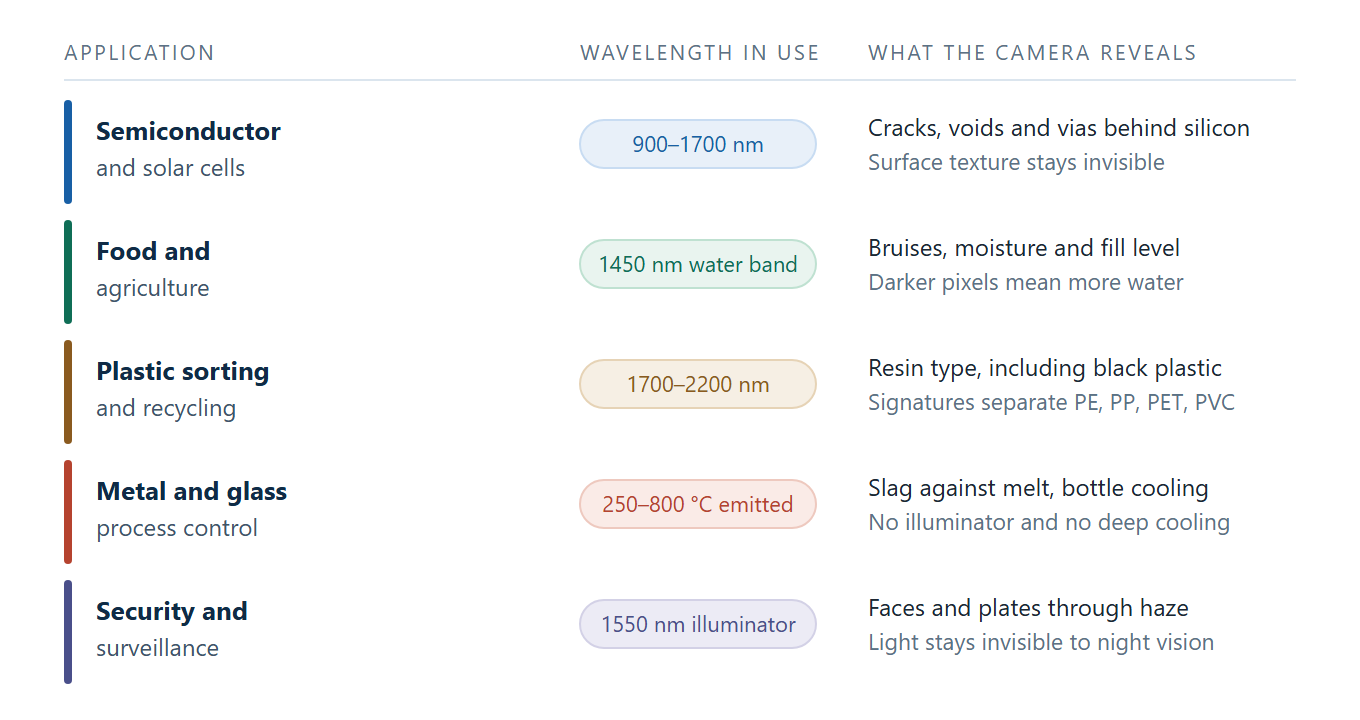
A silicon wafer is opaque to the eye and transparent to SWIR, and that reversal is the most valuable property the band has in electronics. Micro-cracks, solder voids, layer delamination and misaligned features appear as contrast rather than surface texture, so a die can be checked from the front while the image shows the back surface and the through-silicon vias at the same time.
Solar lines use the same physics for electroluminescence and photoluminescence imaging. Finger interruptions, shunt defects and cracked edges read as dark lines, and an InGaAs sensor covering 900–1700 nm captures the whole signal rather than the sliver a silicon sensor reaches. A 1.3 MP SWIR camera running 1280 × 1024 at 200 fps, or 8000 fps on a reduced region of interest, keeps up with production rather than laboratory pace.
The alternatives fall short in different ways: a visible camera sees only the top metallisation, and X-ray reaches the interior slowly and without material contrast. The detector chain behind the difference is set out in how SWIR cameras work.
Food and Agricultural Inspection
Fresh produce is mostly water, and water absorbs short-wave infrared light strongly around 1450 nm. Anything holding more water looks darker, which turns an invisible property into plain image contrast: bruises on apples, pressure damage on potatoes and freeze damage in citrus all appear before they are visible on the skin.
The same band answers process questions. Bread freshness tracks moisture migration through the crumb, fill level in an opaque white bottle can be read through the wall, and fat, sugar and protein distributions separate at longer wavelengths. A production run with a 1.3 MP SWIR camera, grading fruit by internal condition instead of appearance, is written up in the orange quality inspection report.
One limit deserves stating plainly: this is not a thermometer. In a food plant the camera measures water and composition, not core temperature, and a line that needs a temperature reading belongs in a thermal band. Industrial Automation teams usually start here anyway, because a grading result pays for itself inside one season.
Plastic Sorting and Recycling
Two bottles can look identical and be different polymers, which is the whole problem in recycling. Between roughly 1.7 and 2.2 µm each resin carries its own absorption signature, so polyethylene, polypropylene, PET, polystyrene and PVC separate cleanly. A SWIR camera over a conveyor reads each flake, software assigns a resin code, and an air-jet array ejects the target a few centimetres downstream.
Standard 900–1700 nm InGaAs handles most packaging waste, including the black plastics that defeat near-infrared sorting. PVC and PET sit further out and usually need a detector reaching 1900 or 2200 nm; SWIR applications between 900 and 1900 nm maps the trade-offs. A 640 × 512 sensor at 15 µm pitch, matched to a wide conveyor, is a common starting point.
Metal and Glass Process Monitoring
Above roughly 250 °C a target emits enough radiation in the short-wave infrared to be imaged with no illuminator and no cooled detector, which is why foundries and glass plants adopted the band early. Molten metal, slag and a glass gob leaving a furnace all glow brightly, and temperature differences between them resolve at video rate.
The gain is contrast between materials at similar temperature. Molten steel and floating slag differ in emissivity, so they separate even when both are white-hot. On a bottle line the same camera checks wall thickness, mould marks and the cooling profile that decides where stress cracks appear later. Because the sensor is uncooled or lightly cooled, it fits in a housing on the machine.
This is where the band decision becomes a purchase: room-temperature thermography, a motor at 60 °C or a wall at 18 °C, belongs to an LWIR Camera, while gas detection and long-range targeting belong to MWIR cameras. The comparison of LWIR and MWIR bands works through that split.
Security and Surveillance
The security case rests on one component: a 1550 nm illuminator. Light at that wavelength is invisible to the eye and to image-intensifier night vision, so a perimeter can be lit covertly while the camera records faces, clothing and vehicle plates. It is also eye-safe at power levels far above visible illumination, which extends range without creating a hazard.
Haze, fog and smoke scatter visible light but pass short-wave infrared more readily, so a SWIR camera holds contrast where a colour camera washes out. In Security and Surveillance work this changes identification rather than detection: an LWIR Camera finds a person in total darkness from body heat but returns a warm silhouette, while the SWIR camera lit at 1550 nm returns the detail needed to say who it is. The two are complements on one mast, not substitutes.
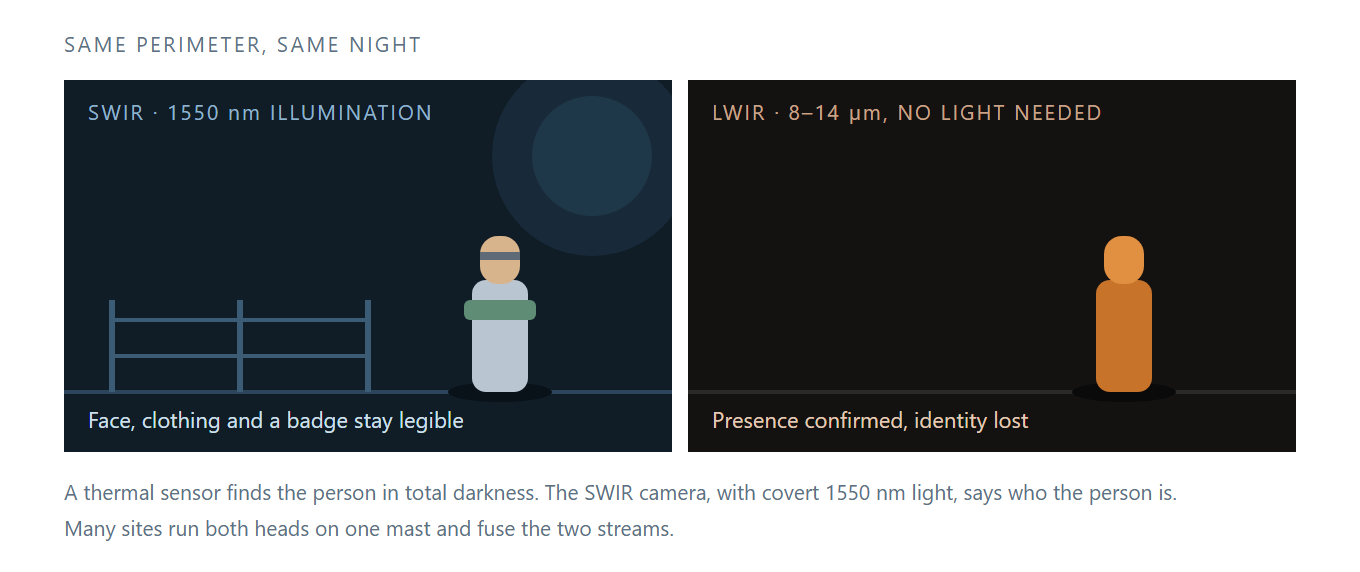
In Security and Surveillance, border, rail and utility sites run the pair for exactly this reason, and 1550 nm is also harder to blind with a handheld laser than a visible-band camera.
Industrial Automation, Automotive and Aerospace
Industrial Automation carries the volume. Robot cells confirm a part is seated before a weld, verify adhesive beads that are transparent in colour, and read electrolyte fill level inside a battery cell before sealing. Boards are checked for hidden solder voids and glass panels for edge chips, and the camera arrives as a GigE Vision or USB3.0 device that drops into an existing vision pipeline. Automotive and Aerospace test benches use the same integration model.
Automotive and Aerospace groups borrow the sensor for different reasons. Automotive teams image 1550 nm LiDAR beams to check divergence, validate ADAS coverage in fog chambers and inspect bonded joints on battery modules. Aerospace inspection looks for delamination in composites, voids in thermal protection tiles and plume structure in static engine tests, where the brightness range would saturate a silicon sensor. For both, the camera records a physical quantity, reflectance or emission, rather than an appearance, and both specify MWIR cameras separately when plume or exhaust thermography is in scope.
SWIR, MWIR or LWIR: Which Camera Answers Which Question
The three infrared bands answer three questions, and the choice follows from the question rather than from the budget. SWIR reads reflected light and reports composition, moisture and internal structure. MWIR cameras read emitted heat from hot targets and gas absorption lines. LWIR reads everything at room temperature. Put the question that way and the band selects itself.
| Question | Band | Light source | What the image shows | Typical job |
|---|---|---|---|---|
| Is it the right material? | SWIR 900–1700 nm | Reflected: halogen, LED, daylight | Photographic detail, resin and moisture contrast | Sorting, wafer and fill-level inspection |
| What is it made of, beyond 1700 nm? | Extended SWIR 1900–2200 nm | Reflected: broadband illumination | Deeper absorption features, lower signal | PVC and PET separation, chemical identification |
| How hot is this target? | MWIR 3–5 µm | Emitted by the target | Calibrated temperature, gas absorption | Flare stacks, gas leaks, long-range defence |
| Is anything there at all? | LWIR 8–14 µm | Emitted by every object at room temperature | Heat silhouettes, no surface detail | Building and electrical thermography |
Two failure modes follow. A SWIR camera bought for a temperature job returns detailed images with no radiometric meaning, and an LWIR Camera bought for a material job returns a heat blob where a resin code was needed. Wavelength first, resolution second, cooling third, interface last: the guide to choosing an InGaAs SWIR camera works through the parameters in that order. The catalogue runs from 1 to 14,000 nm across SWIR, MWIR and LWIR cameras, so a project spanning two bands stays with one supplier.
Teams rarely buy one band in isolation. Industrial Automation groups run SWIR for material contrast and LWIR for heat, Automotive and Aerospace programs pair a SWIR camera for beam profiling with MWIR cameras for plume work, and Security and Surveillance sites mount a thermal head beside the 1550 nm unit. Buying from one catalogue keeps interfaces, software and calibration consistent across all three.
SWIR Cameras Matched to These Applications
The models below cover the splits that decide most projects: visible-plus-SWIR for wafer work, cooled 15 µm sensors for low light, extended response past 1700 nm for resin identification, and uncooled quantum-dot designs for embedded systems.
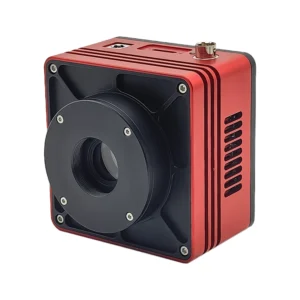 0.33 MP 5 μm 400–1700 nm SWIR camera 640 × 512 at 5 µm pitch
Visible and short-wave infrared in one sensor Wafer, solar cell and PCB inspection |
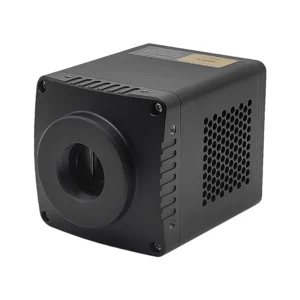 0.33 MP 15 μm 900–1700 nm SWIR camera 640 × 512, 15 µm pixels
B-series sensitivity for weak signal Surveillance and low-light inspection |
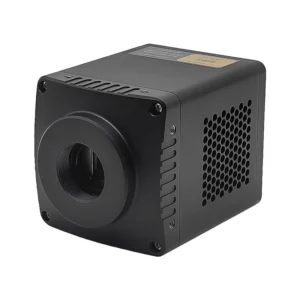 0.33 MP 900–1900 nm extended SWIR camera Extended InGaAs response
Reaches absorption features past 1700 nm Polymer and moisture identification |
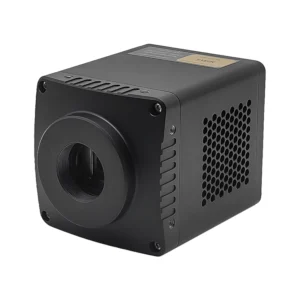 0.33 MP 900–2200 nm SWIR camera Longest standard window
PVC, PET and chemical separation Recycling and material verification |
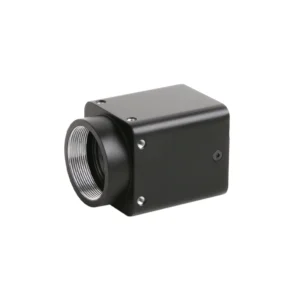 0.33 MP 300–1700 nm uncooled CQD camera Quantum-dot sensor on silicon readout
No cooler, wide 300–1700 nm coverage Embedded and cost-sensitive systems |
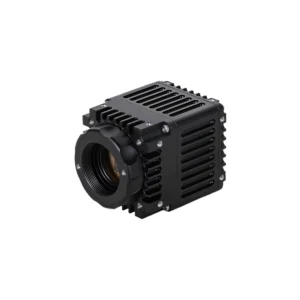 0.33 MP 900–1700 nm uncooled SWIR camera Instant start, no cooler to manage
Compact housing for machine integration Inline sorting and hot-object imaging |
Why Teams Work with AttosTek
| Complete product range | Quality excellence | Flexible customization | Timely service |
|---|---|---|---|
| Cameras, lenses and optical systems across 1–14,000 nm, so a multi-band program does not need a second vendor. | Every unit is factory-tested before shipment, with CE and FCC certification across the range. | Sensor, interface, cooling and housing changes are supported, including small orders. | 7 × 24 technical support, with pre-sales selection and after-sales service on the same channel. |
Frequently Asked Questions
How much does a SWIR camera cost?
It depends on the sensor, not the brand. Wavelength coverage, pixel count, cooling and interface drive the quote, so a cooled extended-range model costs more than an uncooled 900–1700 nm body. AttosTek quotes per configuration in CNY, USD or EUR, and returns a firm figure once the application and specification are fixed.
What is the lead time and how is delivery handled?
Lead time is confirmed with the quotation and depends on whether the camera is a catalogue model or a custom build. Shipments go by DHL or FedEx, with flat logistics of 50 USD inside Asia and 100 USD outside Asia. Quotes are CIF, covering freight and insurance but excluding destination duty, import tax and VAT.
Which wavelength range should I specify?
Start with 900–1700 nm for silicon inspection, moisture and most plastic sorting. Move to 400–1700 nm if you also need visible frames from the same camera, or to 1900–2200 nm when PVC, PET or chemical signatures must be separated. Every step past 1700 nm costs signal, so specify the narrowest window that answers the question.
Will a SWIR camera work on my sorting or inspection line?
Usually yes, provided the line can carry illumination and the defect has a reflectance or moisture difference. Send sample images or parts, the conveyor speed, the field of view and the smallest feature to be detected. AttosTek tests the sample where possible and recommends pixel pitch, lens and interface rather than leaving the match to trial and error.
What warranty and support comes with the camera?
Every camera ships with AttosView control software, an SDK for C/C++, C#/VB.NET, Python and Java, and compatibility with LabVIEW, MATLAB, Micro-Manager, DirectShow and TWAIN. Support runs 7 × 24 across pre-sales and after-sales, and warranty terms are stated in the quotation, with repair and replacement handled by the same technical team.