AttosTek has introduced C‑mount visible fixed focal lenses optimized for the 400–700 nm spectral range. Three fixed focal lengths are available—25 mm, 35 mm, and 50 mm—paired with large apertures of F2.0 and F2.8. The lenses have undergone rigorous full‑scale reliability testing, including temperature cycling, humidity, vibration, and drop tests, ensuring outstanding optical imaging performance and mechanical stability. They are suitable for high‑speed industrial line‑scan vision systems in applications such as lithium battery appearance inspection, print defect screening, and panel flaw detection.
C-mount Visible Fixed Lens
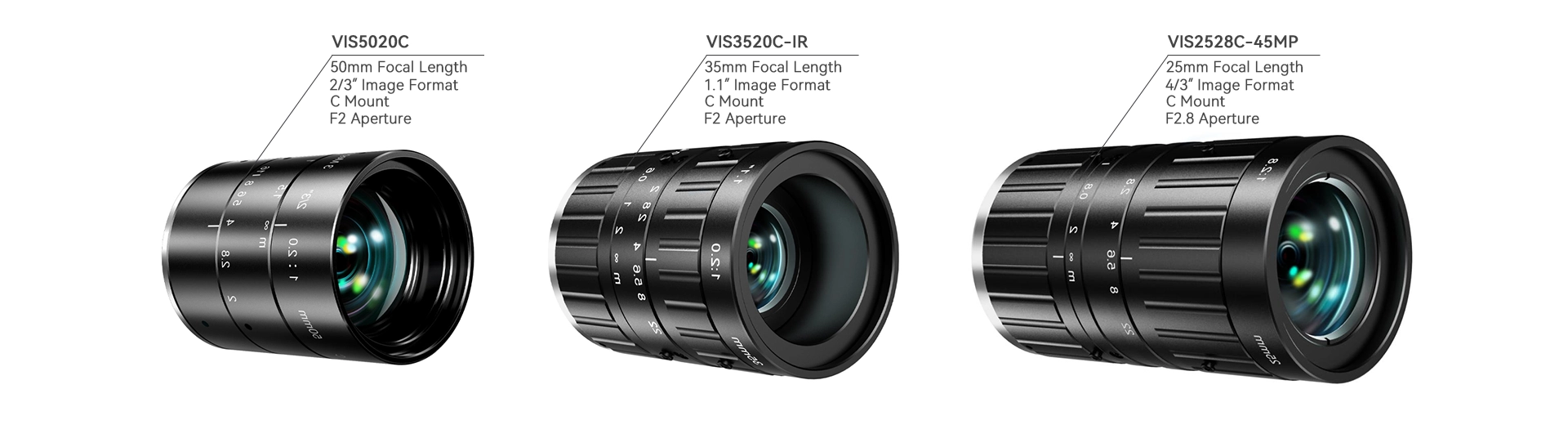
C‑mount Visible‑Light Fixed Focal Lens
-
Three focal length options: 25 mm, 35 mm, 50 mm
-
Two aperture options: F2.0, F2.8
-
Compatible sensor formats: 2/3″, 4/3″, 1.1″
-
Aperture control: manual adjustable iris
-
Standard C‑mount: directly compatible with our C‑mount visible‑light cameras
-
Spectral range: optimized for the 400–700 nm visible band
| Model | VIS2528C-45MP | VIS3520C-IR | VIS5020C |
| EFL | 25mm | 35mm | 50mm |
| F/NO | F2.8 | F2 | F2 |
| Image Format | 4/3″ | 1.1″ | 2/3″ |
| Mount | C | C | C |
| Distortion | ≤-0.4% | ≤-0.07% | ≤-0.07% |
| Working Distance | 0.15~∞m | 0.15~∞m | 0.4~∞m |
| Dimension | Φ45*80.3mm | Φ41*55mm | Φ36.5*44.6mm |
| Flange Focal Length | 17.526mm | 17.53mm | 17.53mm |
| Back Focal Length | 17.83mm | 11.6mm | 11.03mm |
| Operation | Manual Iris / Manual Focus | Manual Iris / Manual Focus | Manual Iris / Manual Focus |
| Design Wavelength | 400-700nm | 400-1200nm | 400-700nm |
| Filter Thread | M40.5*0.5mm | M37.5*0.5mm | M34*0.5mm |
| Resolution | 45MP | 20MP | 3MP |
| IR Correction | NO | NO | NO |
| Model | Image Format | D | H | V |
| VIS2528C-45MP | 4/3″ | 49.02° | 40.2° | 30.42° |
| 1″ | 35.14° | 29.53° | 19.92° | |
| 2/3″ | 28.35° | 25.15° | 13.52° | |
| VIS3520C-IR | 1.1″ | 27° | 22° | 16.6° |
| 1/2″ | 12.4° | 9.8° | 7.2° | |
| 1/3″ | 9.2° | 7.2° | 5.5° | |
| VIS5020C | 2/3″ | 12.6° | 10.1° | 7.4° |
| 1/2″ | 9.2° | 7.3° | 5.4° | |
| 1/3″ | 6.9° | 5.4° | 4° |
size
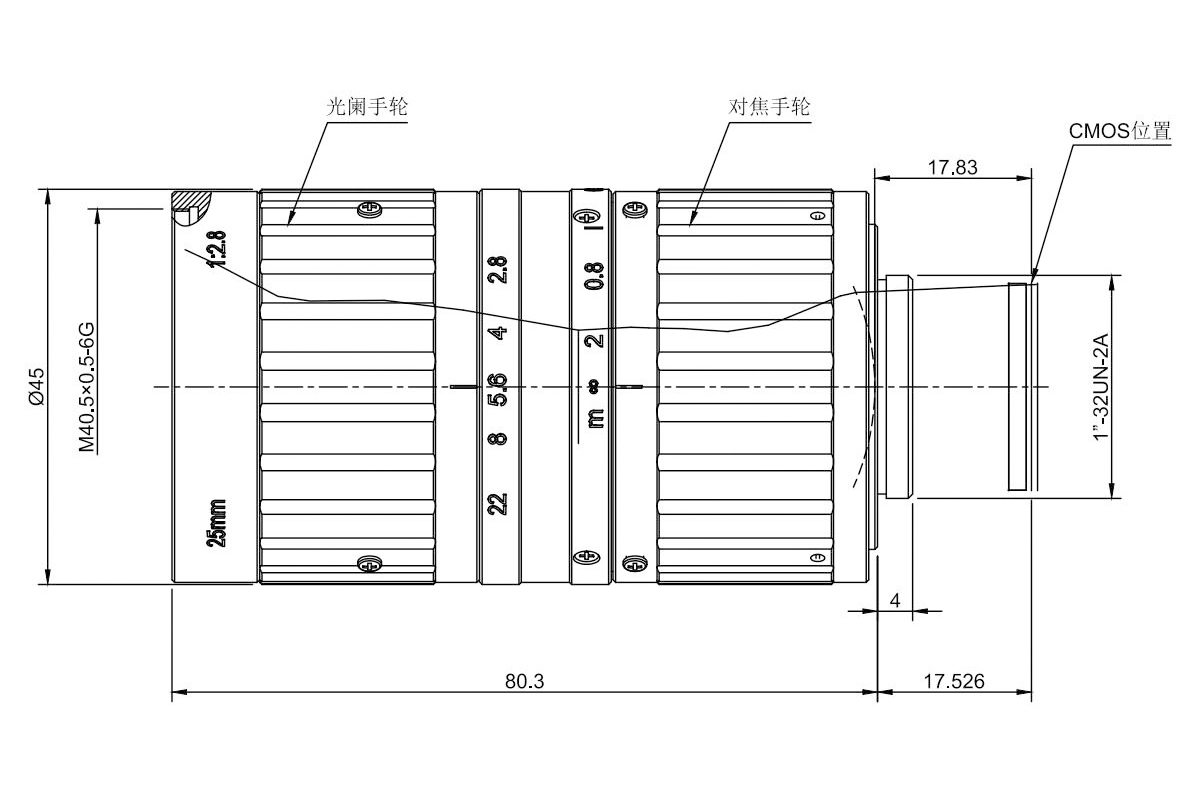
VIS2528C-45MP
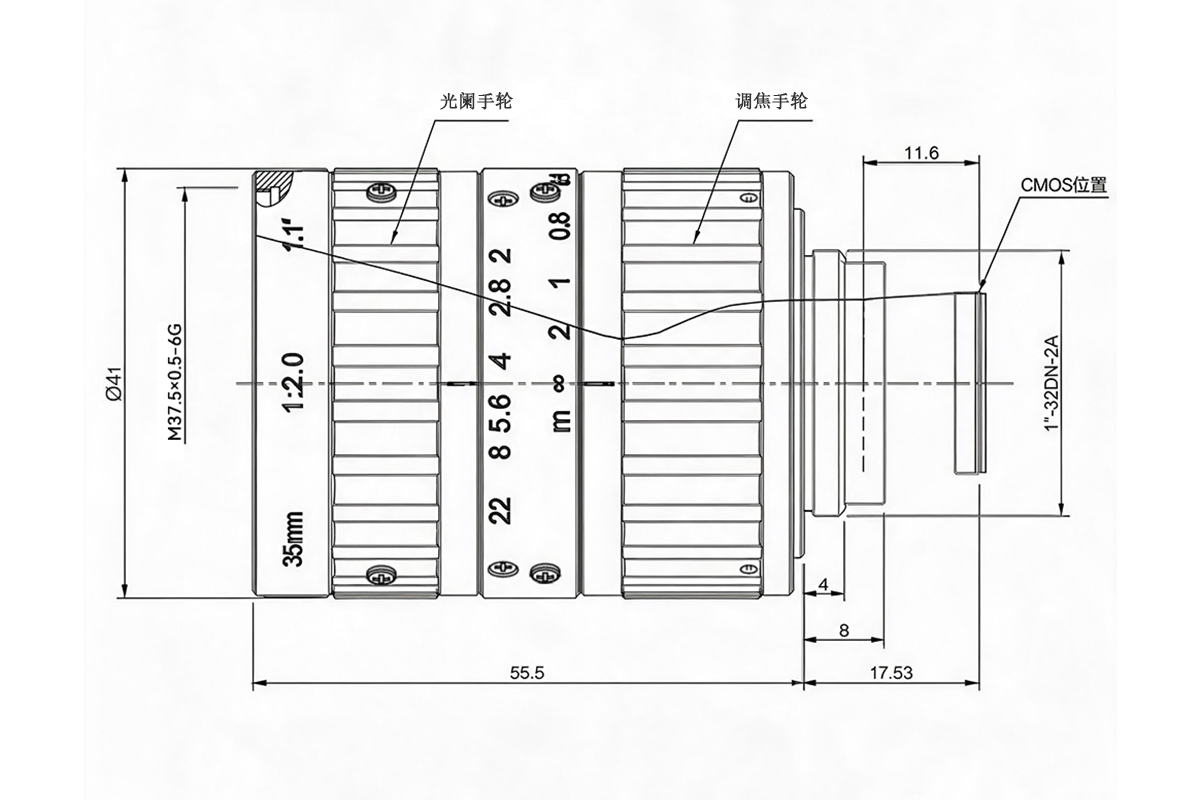
VIS3520C-IR
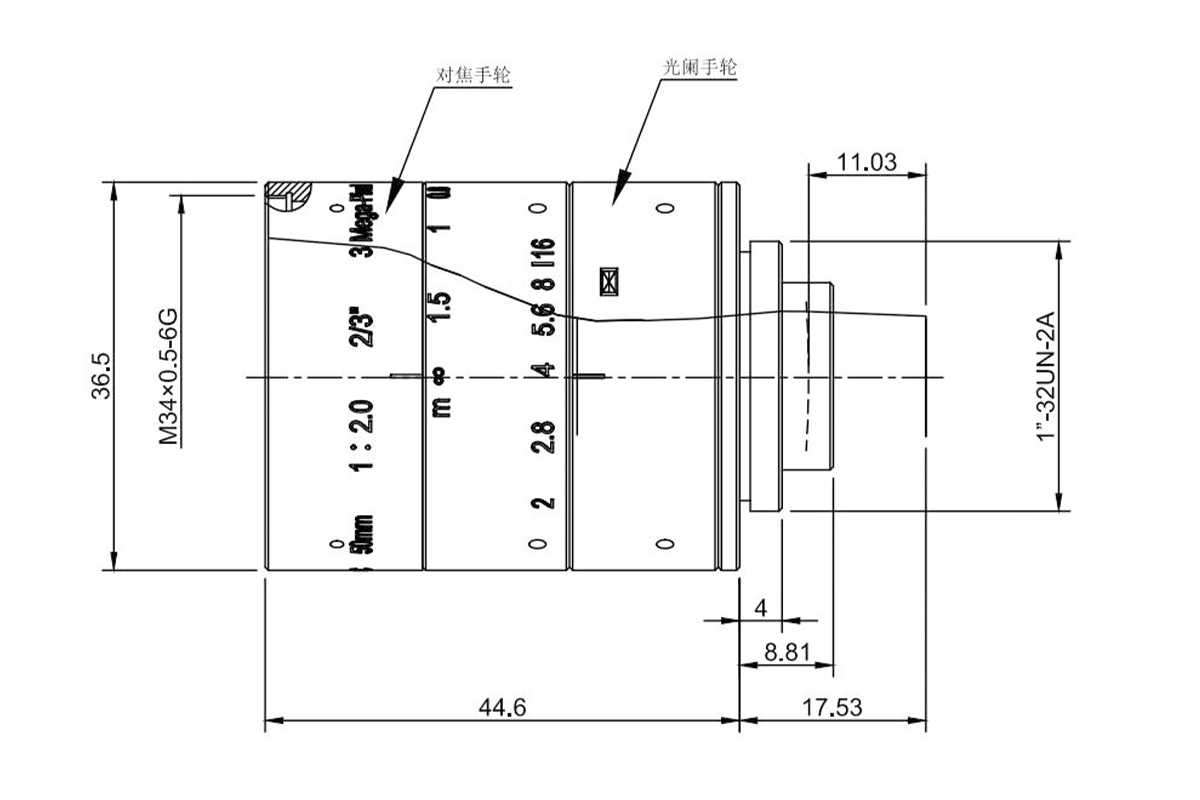
VIS5020C
Focal Length
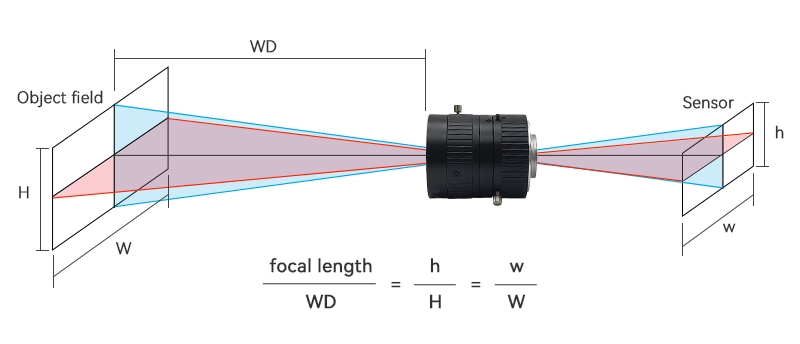
Focal length refers to the distance between the optical center (rear principal point) of a lens and its imaging focal point, serving as a key performance parameter of the lens. It determines the angle of view: the shorter the focal length, the wider the field of view and the broader the observable range; the longer the focal length, the narrower the field of view and the more concentrated the observation area.
Aperture
The aperture controls the amount of light entering the lens—a larger aperture results in a brighter image. This parameter directly affects exposure time and, consequently, the camera’s response speed. In daytime shooting, if the light is too strong, the aperture can be narrowed to prevent overexposure; at night or in low‑light conditions, the aperture can be widened to increase light intake, ensuring optimal imaging performance under varying lighting conditions.
Interface
The optical lens interface refers to the standardized mechanical mount connecting a lens to a camera body, determining compatibility and ensuring precise alignment for correct optical focus onto the image sensor. In industrial applications, C-mount and CS-mount are generally employed with cameras featuring smaller sensor sizes, while F-mount is typically used for larger sensors. Additional interfaces commonly found in line-scan cameras include M42, M58, and M72 mounts—essentially threaded connections of specified diameters.
C-mount lenses represent the established standard in machine vision, compatible with cameras housing image sensors up to approximately 20 mm (1.5 inches) in diagonal dimension. This interface supports a wide array of specifications across focal lengths, resolutions, and working distances. All SWIR fixed lenses provided by Attostek are designed with C-mount connectivity.
Resolution and MTF
Lens resolution, also known as resolving power, refers to its ability to distinguish between two closely spaced points. To achieve optimal performance, the lens resolution must be properly matched to the pixel size of the image sensor.
Lens resolution is commonly characterized using the Modulation Transfer Function (MTF) curve, which illustrates the relationship between spatial frequency and the transfer function value. The horizontal axis of the MTF curve represents spatial frequency in line pairs per millimeter (lp/mm), indicating how closely two points are spaced. The vertical axis represents the transfer function value, indicating the degree to which two adjacent points can be distinguished.
The MTF value at low spatial frequencies reflects the lens contrast performance, while the MTF at high spatial frequencies indicates the lens resolving capability. An ideal imaging lens exhibits an MTF curve that declines gradually from low to high frequencies.
Maximum Sensor Size
The maximum sensor size determines lens and camera compatibility. The lens projects a circular image circle, while the camera sensor is rectangular, meaning the final saved image is also rectangular. The “maximum sensor size” of a lens refers to the largest image sensor size that the lens is designed to fully cover
When used with a larger sensor, the edges of the sensor extend beyond the lens’s image circle, resulting in dark corners or black borders around the photo.
When used with a smaller sensor, only the central portion of the image circle is captured, leading to a reduced field of view and narrower angle of view.
Chief Ray Angle
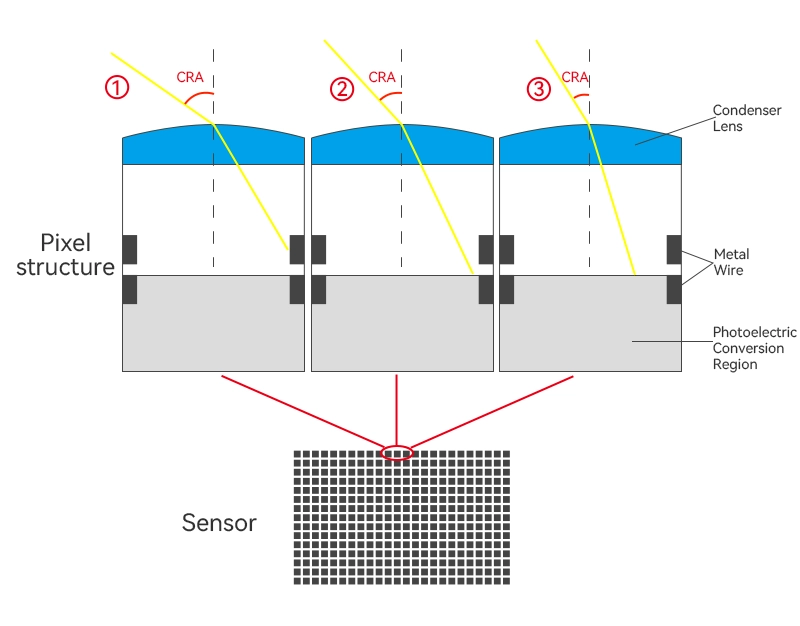
The Chief Ray Angle (CRA) of a lens refers to the angle between the principal ray of the lens and its optical axis. The CRA of a camera sensor indicates the maximum incident angle at which the sensor’s pixels can effectively receive light. If the incident angle of light exceeds the sensor’s designed CRA limit, the light will not be properly captured by the sensor
To ensure optimal imaging performance, it is generally required that the lens CRA should match the sensor CRA, with the lens CRA not exceeding that of the sensor.
Depth of Field
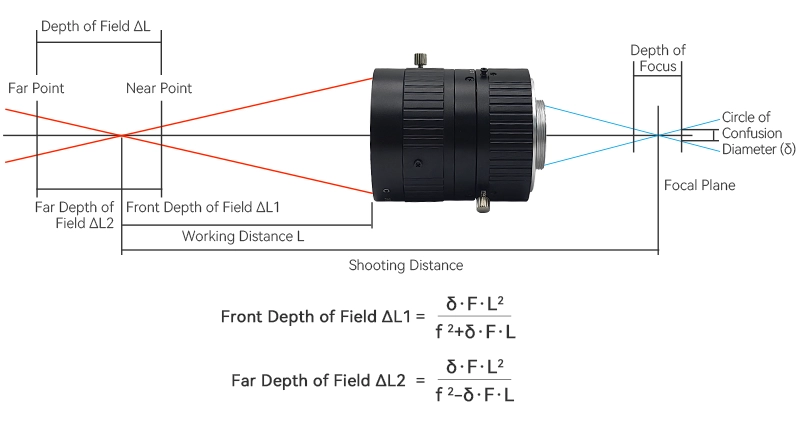
Depth of field refers to the axial range in front of and behind the focused plane within which objects can still appear acceptably sharp in an image. This range includes the front depth of field (the clear zone in front of the focal plane) and the rear depth of field (the clear zone behind the focal plane). The sum of these two zones constitutes the total depth of field
Three primary factors influence depth of field: aperture size, working distance, and lens focal length. Increasing the depth of field can be achieved by:
- Reducing the aperture size (i.e., using a larger f-number)
- Increasing the working distance
- Using a lens with a shorter focal length
Q1:How to choose between VIS2528C‑45MP, VIS3520C‑IR, and VIS5020C?
The VIS2528C‑45MP lens is good for large-area, high-resolution scenes; it has a short focal length, wide field of view, and a 400‑700nm visible light spectrum. It’s used for large-field inspections like lithium battery appearance checks and printing defect detection over big areas.
The VIS3520C‑IR has a large F2.0 aperture and a 400‑1200nm spectrum, extending into near-infrared. It handles both visible and near-infrared imaging and is suitable for panel defect inspections and industrial checks that need near-IR lighting.
The VIS5020C has a long focal length, narrow field of view, and magnifies details. Its minimum working distance is 0.4m, making it ideal for small-area, high-precision detail inspections.Q2:What are the minimum working distances, and is it possible to shoot closer than those distances?
The VIS2528C‑45MP lens has a minimum working distance of 0.15m; it cannot be used closer than 0.15m.
The VIS3520C‑IR lens has a minimum working distance of 0.15m; it cannot be used closer than 0.15m.
The VIS5020C lens has a minimum working distance of 0.4m; it cannot be used closer than 0.4m. Using an object closer than the specified working distance will result in the lens being unable to focus, and the image will remain blurry.Q3:What are the typical applications for this series of lenses?
This series of lenses has different minimum working distances and resolutions, and can be used for inspecting the appearance of lithium batteries, checking for printing defects, detecting panel flaws, and various visible-light industrial machine vision inspection scenarios. The whole unit has undergone high and low temperature, humidity, vibration, and drop reliability tests, making it highly stable in industrial environments.
Fixed focal length lenses for C‑mount visible‑light cameras
Item
Docs
Available
Price
Qty
VIS2528C-45MP
25mm Fixed Focal Length, F2.8 Aperture, C-Mount Visible Lens
VIS3520C-IR
35mm Fixed Focal Length, F2.5 Aperture, C-Mount Visible Lens
VIS5020C
50mm Fixed Focal Length, F2.0 Aperture, C-Mount Visible Lens