SMS Series SWIR Modular Microscopic System
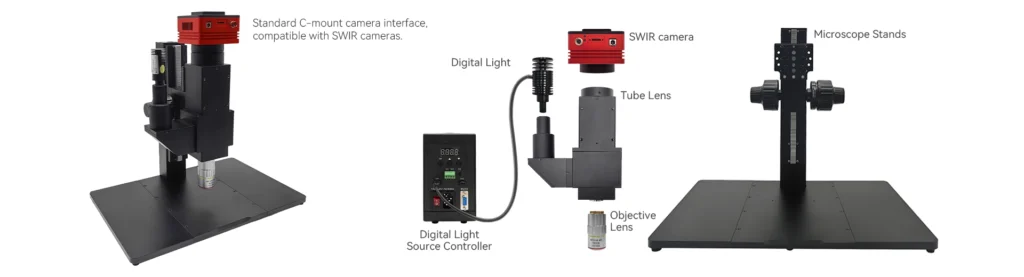
| Features |
| SWIR imaging range from 900-1700 nm |
| Dedicated M Plan Apo NIR series objectives (5X to 20X HR) |
| SWIR camera options (0.33M to 5.0M) with built-in TEC cooling |
| Standard C‑mount interface for easy SWIR camera integration |
| Coaxial Kohler illumination with 1200/1300/1400/1550 nm LEDs |
| Precision CNC structure with anti‑vibration design |
| Modular illumination, imaging, and mechanical architecture |
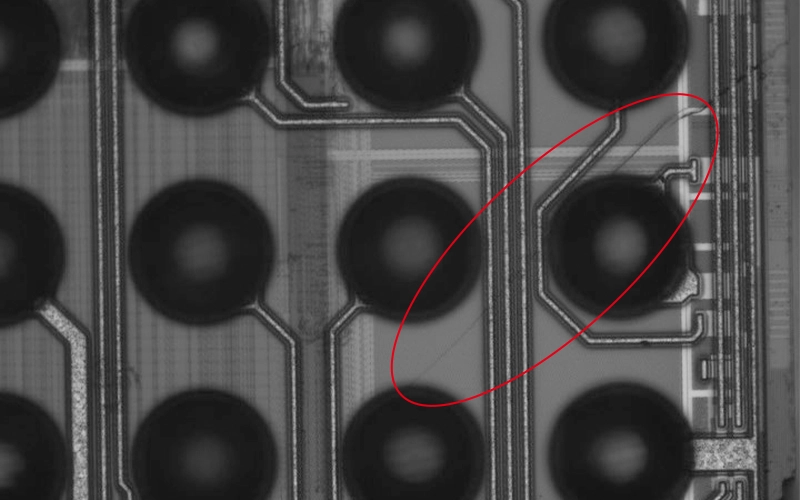
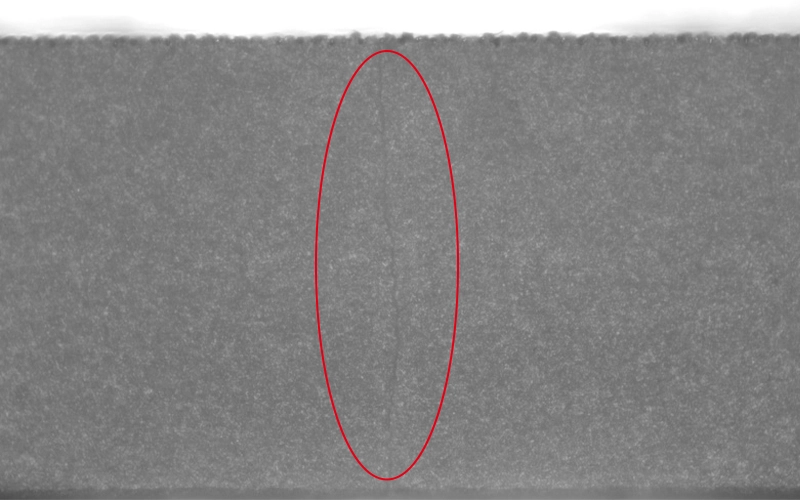
| Model | SWIR051AU | SWIR0503AU | SWIR035AU | SWIR033AU |
| Sensor Model | Sony IMX990 | Sony IMX991 | Sony IMX992 | Sony IMX993 |
| Sensor Size | 1/2″ | 1/1.4″ | 1/1.8″ | |
| Pixel Size | 5μm×5μm | 3.45μm×3.45μm | ||
| resolution | 1.3MP | 0.33MP | 5.0MP | 3.0MP |
| FPS | 392fps | 753fps | 135.7fps | 176fps |
| Data Interface | USB3.0 | |||
| Exposure Time | 15us-60s | |||
| Dimension | 80mm×80mm×45.5mm | |||
| TEC | Built-in TEC | |||
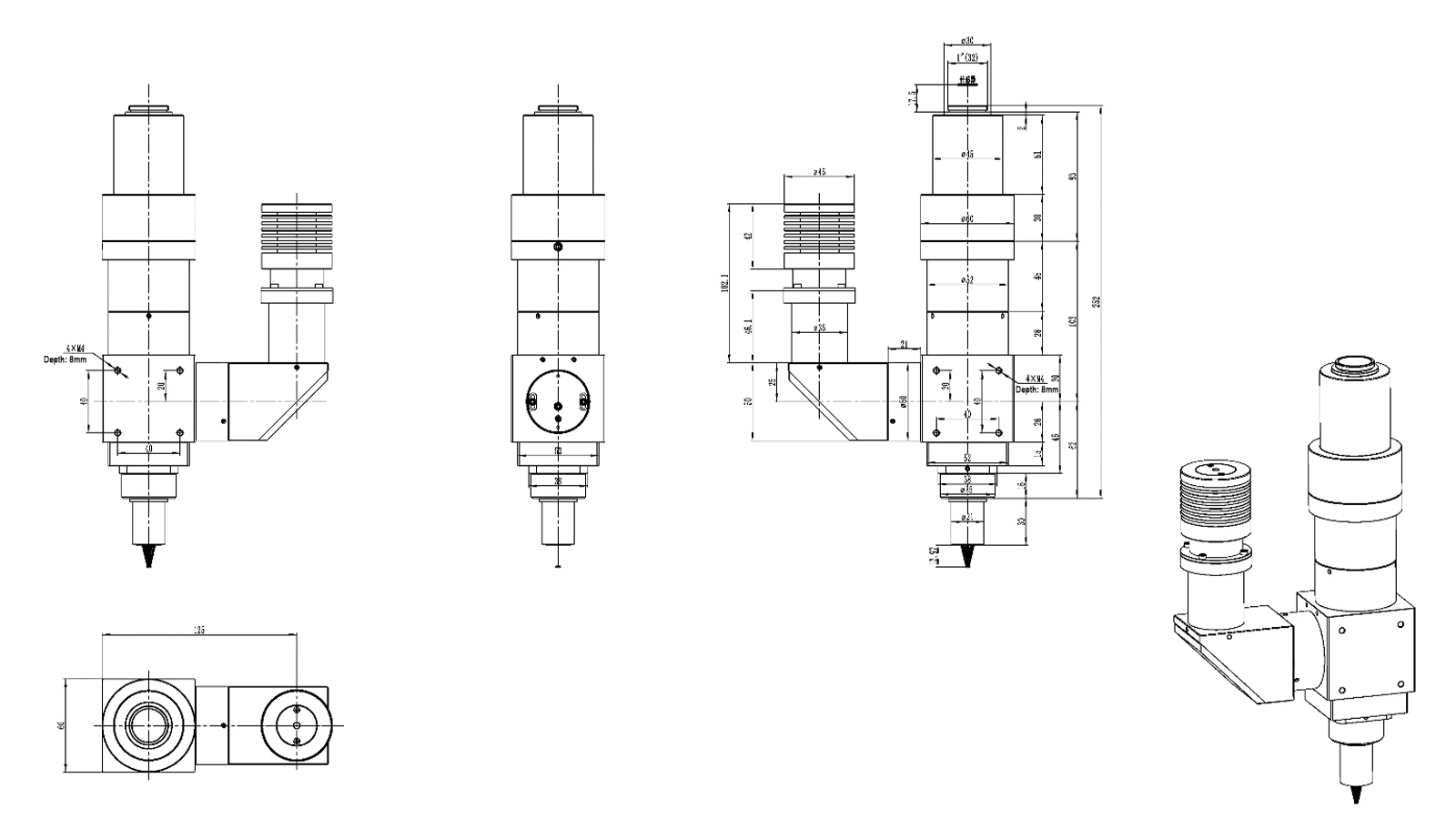
| Model | SMS-T090VA | SMS-T100VA | SMS-T180VA |
| Objective Support | Support infinity SWIR microscope objectives | Support high NA infinity SWIR microscope objectives | Support infinity SWIR microscope objectives |
| Tube Lens Focal Length | 90mm | 100mm | 180mm |
| Imaging Path Image Plane Size | 24mm (using 180mm focal length tube lens) |
33mm (using 200mm focal length tube lens) |
24mm (using 180mm focal length tube lens) |
| Imaging Path Spectral Range | 900-1700nm | ||
| Camera Mount | C-Mount | ||
| Illumination Method | Coaxial Kohler Lighting | ||
| Illumination Source | 1550/1400/1300/1200nm LED light source | ||
| Item Name | Magnification | Numerical Aperture | Working Distance | Focal Length | Resolution | Depth of Field | FN | Weight |
| M Plan Apo NIR 5X | 5X | 0.14 | 37.5 mm | 40 mm | 2.0 μm | 14 μm | 24 mm | 220 g |
| M Plan Apo NIR 10X | 10X | 0.26 | 30.5 mm | 20 mm | 1.1 μm | 4.1 μm | 24 mm | 250 g |
| M Plan Apo NIR 20X | 20X | 0.4 | 20 mm | 10 mm | 0.7 μm | 1.7 μm | 24 mm | 300 g |
| M Plan Apo NIR 50X | 50X | 0.42 | 17 mm | 4 mm | 0.7 μm | 1.6 μm | 24 mm | 315 g |
| M Plan Apo NIR 50X HR (High Resolution) |
50X | 0.65 | 10 mm | 4 mm | 0.4 μm | 0.7 μm | 24 mm | 450 g |
| Model | LED1200 | LED1310 | LED1450 | LED1550 |
| Peak Wavelength | 1200(±10) nm | 1310(±15) nm | 1450(±20) nm | 1550(±20) nm |
| Diameter | 6 mm | |||
| Forward Voltage | 1.35 V / 1 A | 1.3 V / 1 A | 1.25 V / 1 A | 1.2 V / 1 A |
| Irradiance | 45 mW/cm² | 110 mW/cm² | 50 mW/cm² | 60 mW/cm² |
| Total Power Consumption | 1.35 W | 1.3 W | 1.25 W | 1.2 W |
| Working Distance | 5–60 mm | |||
| Full Width at Half Maximum | 30 nm | |||
| Service Lifetime | 30,000 hours, luminous attenuation < 30% | |||
| Housing Material | Aluminum Alloy (Black Anodized Surface) | |||
| Heat Dissipation Mode | Passive Heat DissipationWarning: Forced cooling or derated operation required if ambient temperature exceeds 30°C | |||
| Standard Cable Length | 500 (±20) mm | |||
| Extension Cable | 2m / 3m / 5m, custom lengths available | |||
| Connector | SM3P, customizable on request | |||
| Net Weight | 50 g | |||
| Recommended Controller | HS-DCACCC-5-1A-2DF | |||
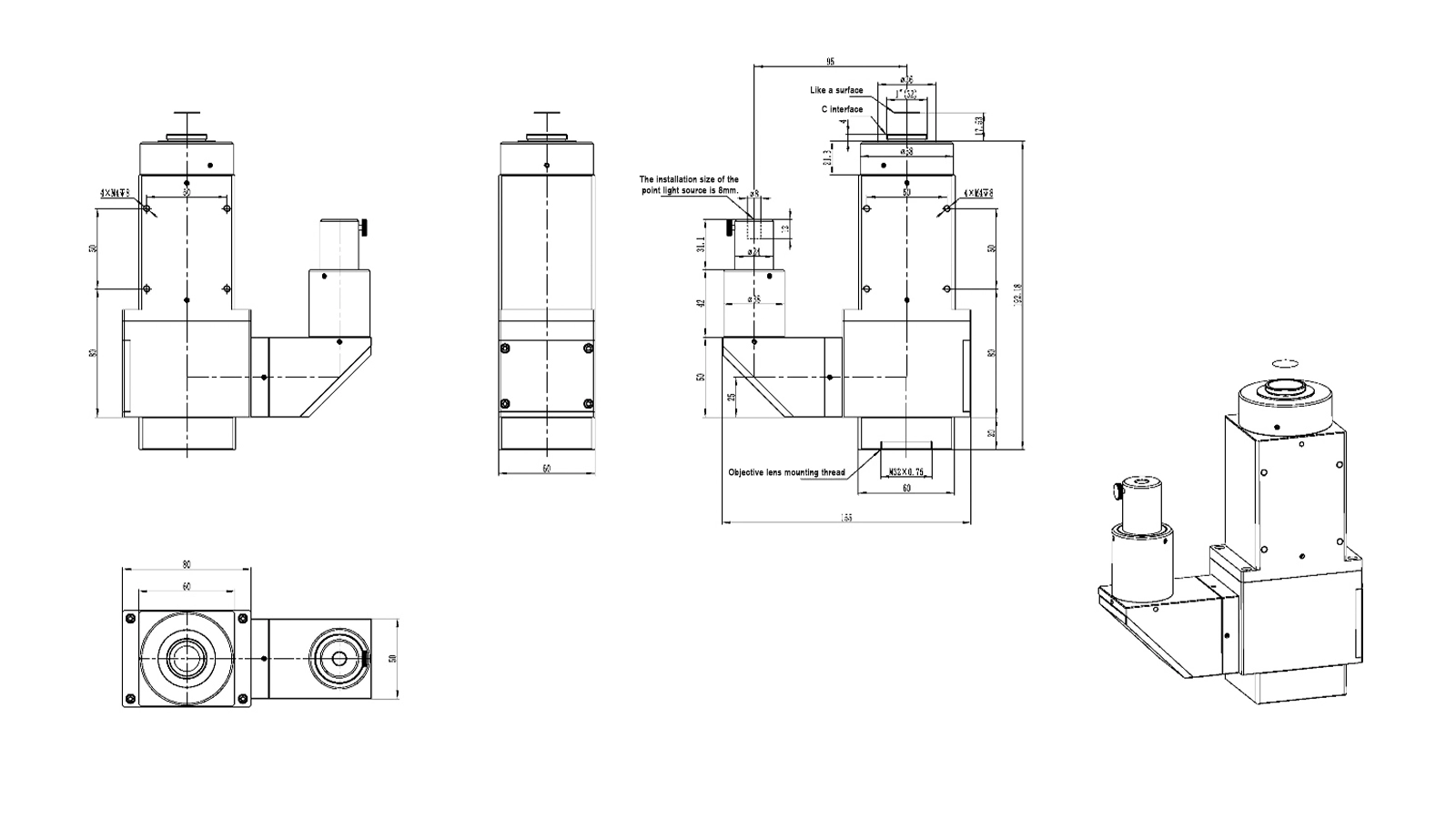
Q1:What are the main advantages of the SWIR modular microscopy system over a conventional visible-light microscopy system?
The main advantages include three key aspects:
- Enhanced material contrast – SWIR wavelengths can penetrate or distinguish features that are obscured under visible light, revealing more details inside materials or just below the surface.
- Cost efficiency – It allows direct use of existing microscope optics and works with affordable tungsten-halogen or LED illumination, eliminating the need for expensive dedicated SWIR objectives.
- Scalability – The modular design enables flexible customization for specific wavelengths, sensor types, or automation requirements, adapting to different application scenarios.
Q2:How to troubleshoot the image without any image and show everything black?
Check whether the camera is not functioning properly when not under the microscope system.
If a point light source is needed for illumination, check whether the point light source is turned on.
Check whether the objective lens has fine focusing, and whether the distance between the lens and the sample is close to the working distance of the lens objective. If it is, you can use fine-tuning to find the focal length for imaging purposes.Q3:What are the core components of the SMS series shortwave infrared modular microscopy system?
The system mainly includes: a infinity-corrected tube lens (SMS‑T090VA / SMS‑T100VA / SMS‑T180VA), an M Plan Apo NIR shortwave infrared objective lens, a SWIR cooled InGaAs camera, a coaxial Köhler LED point light source, and a microscope stand; the entire optical spectrum working range is 900–1700 nm, with a standard C-mount interface.
Compatible InGaAs SWIR Cameras
The SMS series SWIR modular microscopic system is compatible with multiple SWIR cameras integrated with built-in TEC, covering resolutions from 0.33M to 5.0MP. Equipped with Sony IMX990/991/992/993 sensors respectively, these cameras feature a uniform USB3.0 data interface, exposure time of 15us-60s, meeting diverse requirements for field of view, speed and detection sensitivity.
SWIR0503AU
0.33 MP InGaAs SWIR Camera, 5 µm Pixels, USB 3.0 Interface
SWIR051AU
1.3 MP InGaAs SWIR Camera, 5 µm Pixels, USB 3.0 Interface
SWIR033AU
3 MP InGaAs SWIR Camera, 3.45 µm Pixels, USB 3.0 Interface
SWIR035AU
5 MP InGaAs SWIR Camera, 3.45 µm Pixels, USB 3.0 Interface
SMS Series Tube Lens
The SMS series provides multiple tube lens configurations to match different SWIR microscope objectives and image plane requirements. All solutions share Coaxial Kohler illumination and a standard C‑mount camera interface, supporting 900–1700nm spectral range with optional LED sources (1550/1400/1300/1200nm).
SMS-T090VA
SWIR Microscopy Tube Lens, 90mm Focal Length, C-Mount
SMS-T100VA
SWIR Microscopy Tube Lens, 100mm Focal Length, C-Mount
SMS-T180VA
SWIR Microscopy Tube Lens, 180mm Focal Length, C-Mount
Objective Lens
Microscope objectives are critical components of a microscope’s optical system. Positioned near the sample, specimen, or object under inspection, they enable the formation of a magnified real image. Attostek offers the M Plan Apo NIR series of objectives with magnification from 5X to 20X. Optimized for the SWIR band, these objectives provide a balanced trade-off between working distance, resolution, and depth of focus, making them ideal for semiconductor, materials, and industrial inspection applications.
M Plan Apo NIR 5X
5X Microscope Objective, 0.14 NA, 37.5 mm WD
M Plan Apo NIR 10X
10X Microscope Objective, 0.26 NA, 30.5 mm WD
M Plan Apo NIR 20X
20X Microscope Objective, 0.4 NA, 20 mm WD
M Plan Apo NIR 50X
50X Microscope Objective, 0.42 NA, 17 mm WD
M Plan Apo NIR 50X HR
50X High Resolution Microscope Objective, 0.65 NA, 10 mm WD
Digital Light
LED1550
1550(±20)nm Wavelength, 6mm Diameter, 60mW/cm² Optical Power LED
LED1450
1450(±20)nm Wavelength, 6mm Diameter, 50mW/cm² Optical Power LED
LED1310
1310(±15)nm Wavelength, 6mm Diameter, 110mW/cm² Optical Power LED
LED1200
1200(±10)nm Wavelength, 6mm Diameter, 45mW/cm² Optical Power LED
Microscope Stands
Microscope Stands
SMS Series SWIR Modular Microscope Stands