400-1700nm C-Mount SWIR Fixed Focus Lens

This series of SWIR fixed focal length lenses covers the broad spectral range of 400–1700 nm. It is available in 6MP and 4K resolutions with focal lengths of 35 mm and 50 mm. Featuring a large F1.4 aperture, the lenses support C-mount and M42 threaded mount options.
The C-mount version achieves a minimum working distance down to 0.2 m, suitable for standard vision systems and close-range inspection. The M42-mount version has a working distance from 0.8 m to infinity, ideal for high-precision industrial inspection with a wide field of view.
- Available Focal Lengths: 35 mm, 50 mm
- Spectral Range: Optimized for the 400–1700 nm SWIR band
- Aperture: F1.4
- Compatible Sensor Format: 1/1.4″, 1.85”
- Aperture Control: Manual adjustable iris
- Optical Mount: C-mount or M42 mount optional
| Item | SWR3514CW | SWR5014LW |
| Spectral Range | 400~1700nm | |
| Aperture | F1.4 | |
| Focal Length | 35mm | 50mm |
| Image Format | 1/1.4″ | 1.85” |
| Resolution | 6MP | 4K |
| Optical Distortion | ≤0.6% | ≤0.8% |
| Interface | C | M42 |
| Flange Focus Length | 17.526mm | 46.5mm |
| Back Focus Length | 13.42mm | 17.56mm |
| Working Distance | 0.2–∞ | 0.8–∞ |
| Dimension | Φ50.5 × 88mm | Φ75 × 103.5mm |
| FilterThread | M46×0.75mm | M72×0.75mm |
| Operating method | Manual aperture/manual focusing | |
| Infrared function | NO | |
| Item | Image Format | Field of View | ||
| D | H | V | ||
| SWR3514CW | 1/1.4″ | 37.4° | 30° | 22.6° |
| 1/2″ | 12.4° | 9.8° | 7.2° | |
| 1/3″ | 9.2° | 7.2° | 5.5° | |
| SWR5014LW | 1/1.4″ | 34° | 27.4° | 20.7° |
| 1/2″ | 9° | 7.2° | 5.4° | |
| 1/3″ | 6.9° | 5.4° | 4.1° | |
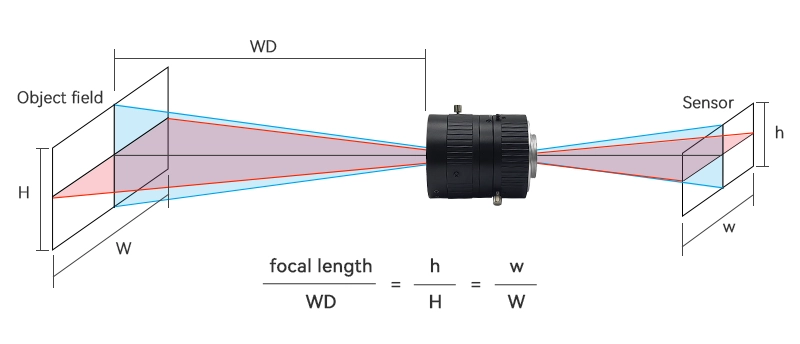
Focal length refers to the distance between the optical center (rear principal point) of a lens and its imaging focal point, serving as a key performance parameter of the lens. It determines the angle of view: the shorter the focal length, the wider the field of view and the broader the observable range; the longer the focal length, the narrower the field of view and the more concentrated the observation area.
The aperture controls the amount of light entering the lens—a larger aperture results in a brighter image. This parameter directly affects exposure time and, consequently, the camera’s response speed. In daytime shooting, if the light is too strong, the aperture can be narrowed to prevent overexposure; at night or in low‑light conditions, the aperture can be widened to increase light intake, ensuring optimal imaging performance under varying lighting conditions.
The optical lens interface refers to the standardized mechanical mount connecting a lens to a camera body, determining compatibility and ensuring precise alignment for correct optical focus onto the image sensor. In industrial applications, C-mount and CS-mount are generally employed with cameras featuring smaller sensor sizes, while F-mount is typically used for larger sensors. Additional interfaces commonly found in line-scan cameras include M42, M58, and M72 mounts—essentially threaded connections of specified diameters.
C-mount lenses represent the established standard in machine vision, compatible with cameras housing image sensors up to approximately 20 mm (1.5 inches) in diagonal dimension. This interface supports a wide array of specifications across focal lengths, resolutions, and working distances.
When used with a larger sensor, the edges of the sensor extend beyond the lens’s image circle, resulting in dark corners or black borders around the photo.
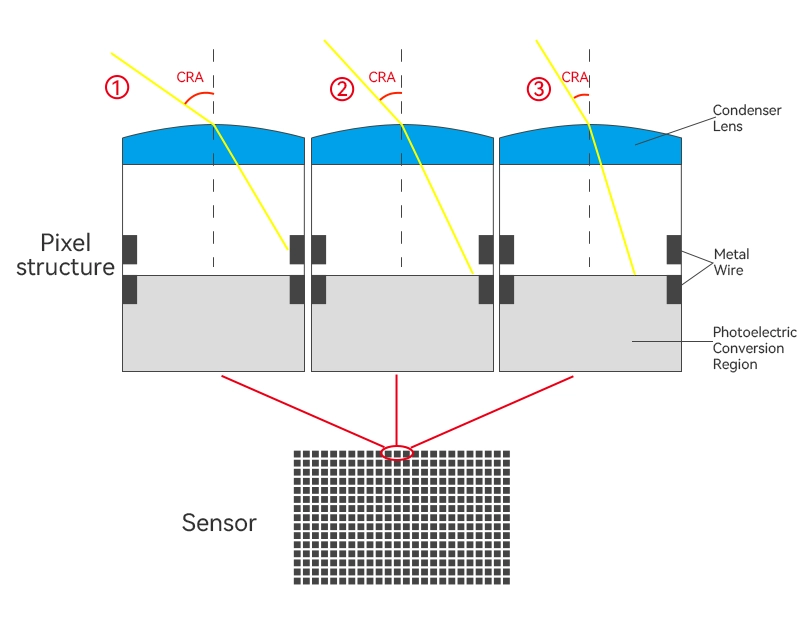
To ensure optimal imaging performance, it is generally required that the lens CRA should match the sensor CRA, with the lens CRA not exceeding that of the sensor.
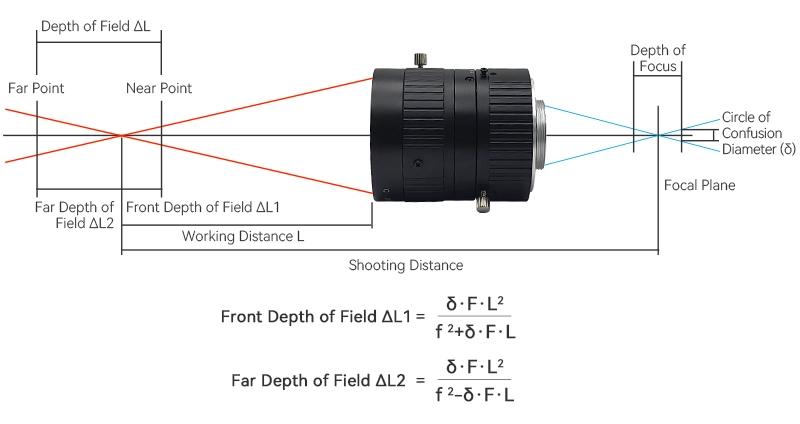
Three primary factors influence depth of field: aperture size, working distance, and lens focal length. Increasing the depth of field can be achieved by:
- Reducing the aperture size (i.e., using a larger f-number)
- Increasing the working distance
- Using a lens with a shorter focal length
Q1: Can the 400–1700 nm SWIR lens work with an ordinary visible-light camera?
Compatibility depends on the camera’s spectral response, the lens’ spectral transmission performance and mount matching. This 400–1700 nm SWIR lens is designed for broad-spectrum imaging covering both visible and SWIR bands. It can be used normally with a visible-light camera if the camera’s spectral response spans 400–1700 nm and the mount fits, and the lens will form valid images in the visible spectrum.
Q2: Is the SWIR3514CW lens suitable for wafer inspection?
Yes. SWIR features longer wavelengths and is less affected by Rayleigh scattering caused by fine particles, giving it better penetration through smoke and haze compared with visible light. Moreover, silicon is transparent to SWIR light around 1100 nm. Paired with our 400–1700 nm SWIR camera, this lens supports internal defect inspection for semiconductor silicon wafers.
Q3: Can I clean a dirty lens directly with regular lens tissue or alcohol? What precautions should be taken for daily use and storage?
Follow standard optical cleaning procedures. First blow loose dust off the surface with an air blower. For stubborn stains, dampen lens tissue or cotton swabs with anhydrous ethanol or dedicated optical cleaner, then wipe gently in one direction from the center outwards. Do not dry-wipe or rub back and forth.
Keep the front and rear caps on during storage and place the lens in a dry, dust-free area. For long-term storage, a dry cabinet is recommended to prevent moisture damage and mold growth on optical coatings. Keep the mount threads clean. Do not over-tighten during installation, as this may damage the flange surface and impair back focal length accuracy.
SWIR Fixed Lens for 400–1700 nm Band
AttosTek offers fixed SWIR lenses optimized for imaging in the 400–1700 nm band, available in C-mount and M42 mount versions with 35 mm and 50 mm focal lengths and a large F1.4 aperture.
These lenses have passed a full suite of stringent reliability tests including temperature cycling, humidity, vibration and drop tests, delivering outstanding optical performance and robust mechanical stability. They are ideal for applications such as industrial material sorting, machine vision and scientific research.
SWIR3514CW
400-1700nm spectral range, 35mm fixed focus, F1.4 aperture, C-interface SWIR lens
SWIR5014LW
400-1700nm spectral range, 50mm fixed focus, F1.4 aperture, M42 interface SWIR lens