Resolution 2048×264, 200nm-1050nm Spectroscopy CCD Camera
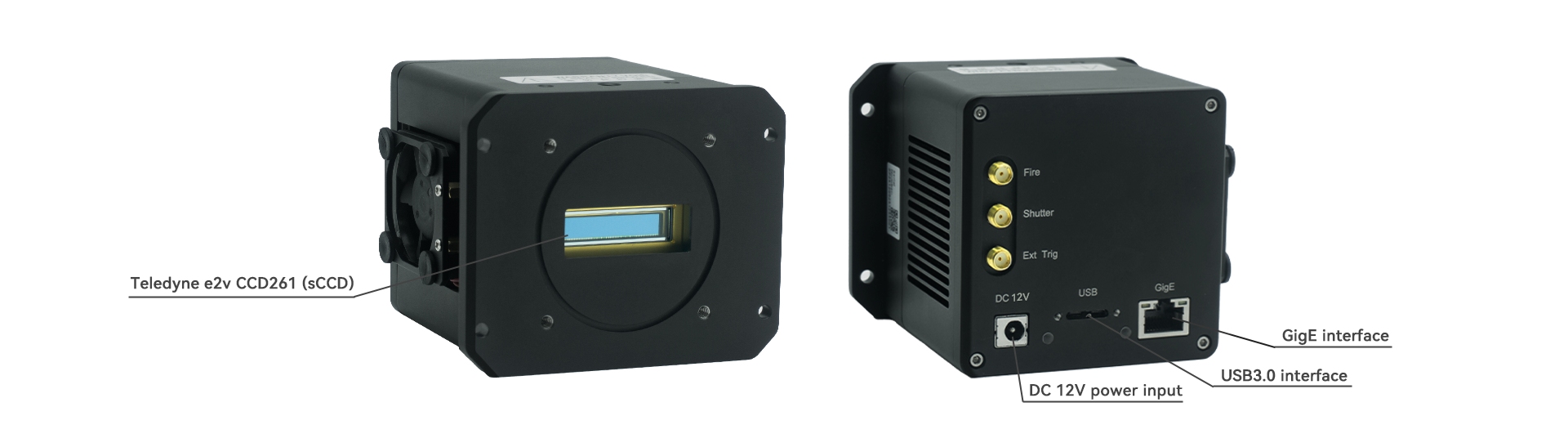
| Features |
| 200nm-1000nm spectral response,15 µm Pixel size |
| Compatible with USB 3.0 / GigE data interface |
| TEC high-efficiency cooling structure |
| Global Shutter |
| Data bit depth 8-bit / 16-bit |
| Supports external I/O trigger control |
| Built-in 512 MB buffer (4 Gb DDR3) |
| CE/FCC Cerifcation,Multi-platform SDK |
The SDK supports development languages such as C/C++, C #/VB.net, Python, Java, etc,
Third-party support including LabVIEW, MATLAB, Micro-Manager, DirectShow, and TWAIN.
| Model | UVISI261BUG |
| Sensor model | E2V CCD261 |
| Spectral Range | 200nm – 1050nm |
| Pixel Size | 15 μm × 15 μm |
| Sensor Size | 30.7mm × 4.0mm |
| Frame rate & Resolution | 12 fps@2048×264 |
| Memory | 512MB (4Gb) |
| Conversion Gain | 7.0 e⁻/ADU |
| Dynamic Range | 86.5dB |
| Readout Noise | 22e⁻ rms |
| Full Well | 459ke⁻ |
| SNRmax | 56.6dB |
| Sensitivity | TBD |
| Dark current | 184e⁻/s/pixel@-35℃ |
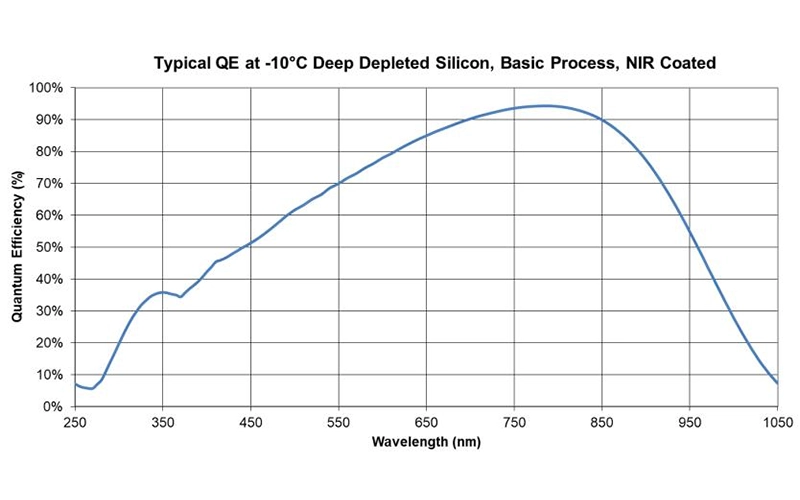
| Peak QE | 95% @ 800nm |
| Dark signal inhomogeneity | 0.50% |
| Optical signal inhomogeneity | 1.50% |
| Exposure Time Range | ≤60mins |
| Conversion Range | 1X |
| Shutter Mode | Global shutter |
| Binning Mode | 2×2,4×4,8×8,16×16,32×32,64×64 |
| Date interface | USB3.0/GigE |
| Digital IO | SHUTTER,TRIG |
| Digital Format | 8bit / 16bit |
| Cooling Temperature | -35°C TEC cooling (ambient temperature 20°C) |
| Lens Mount | M42 x 1mm |
| Power Supply | 12V 5A power supply |
| Power Consumption | TBD |
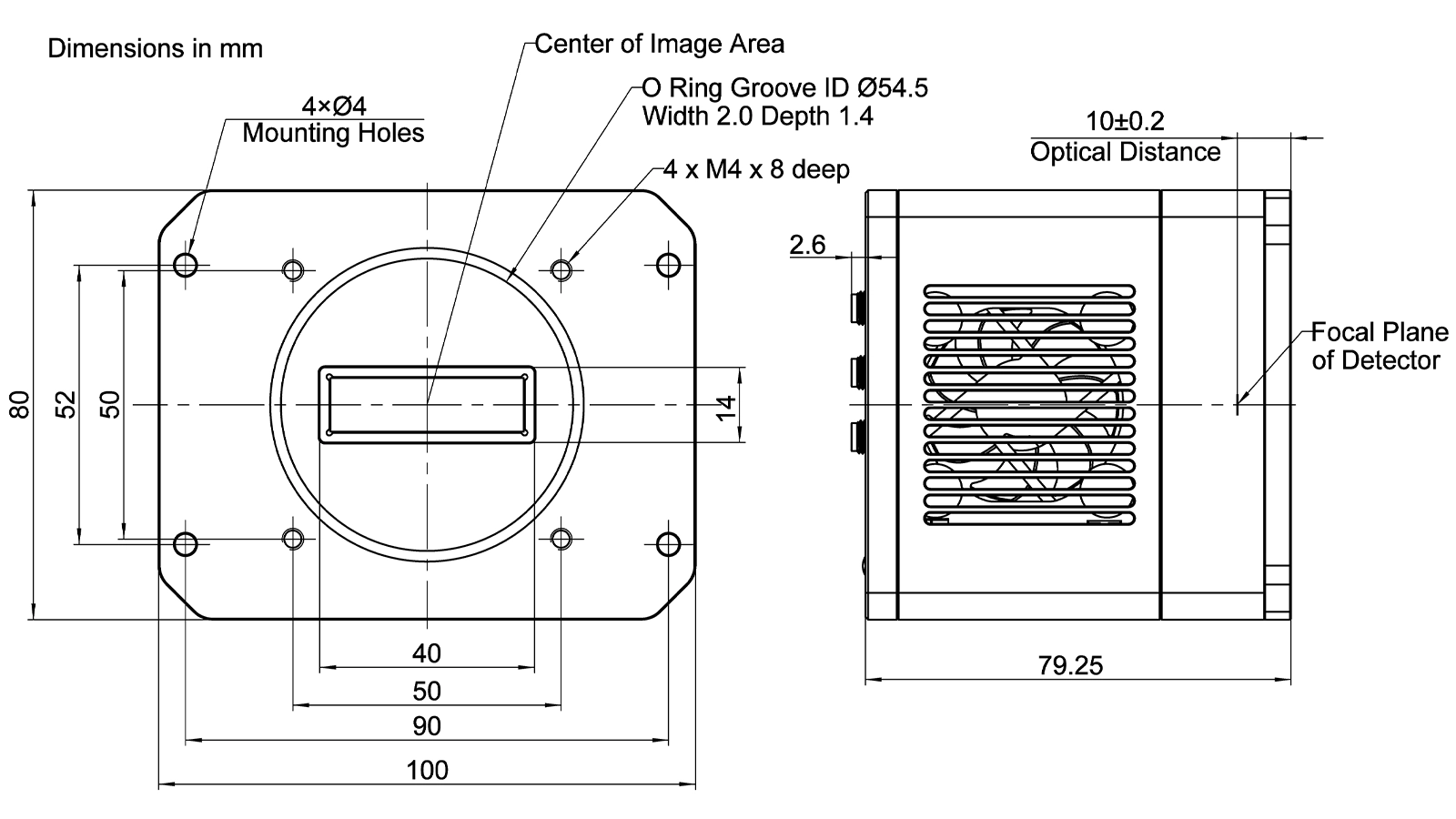
| Size | 100mm×80mm×79.25mm |
| Weight | 800g |
| Software | AttosView,LabView,MATLAB third-party software |
| SDK | C, C++, C#, Python |
| Operating system | Windows, Linux |
| Temperature | Operating Temperature – 30~45℃,Storage Temperature – 40~60℃ |
| Humidity | Operating Temperature 0–95%,Storage Temperature 0–95% |
| Cerifcation | CE/FCC |
| Parameter | Specification |
| Dimension | 100mm × 80mm × 79.25mm |
| Item | Specification |
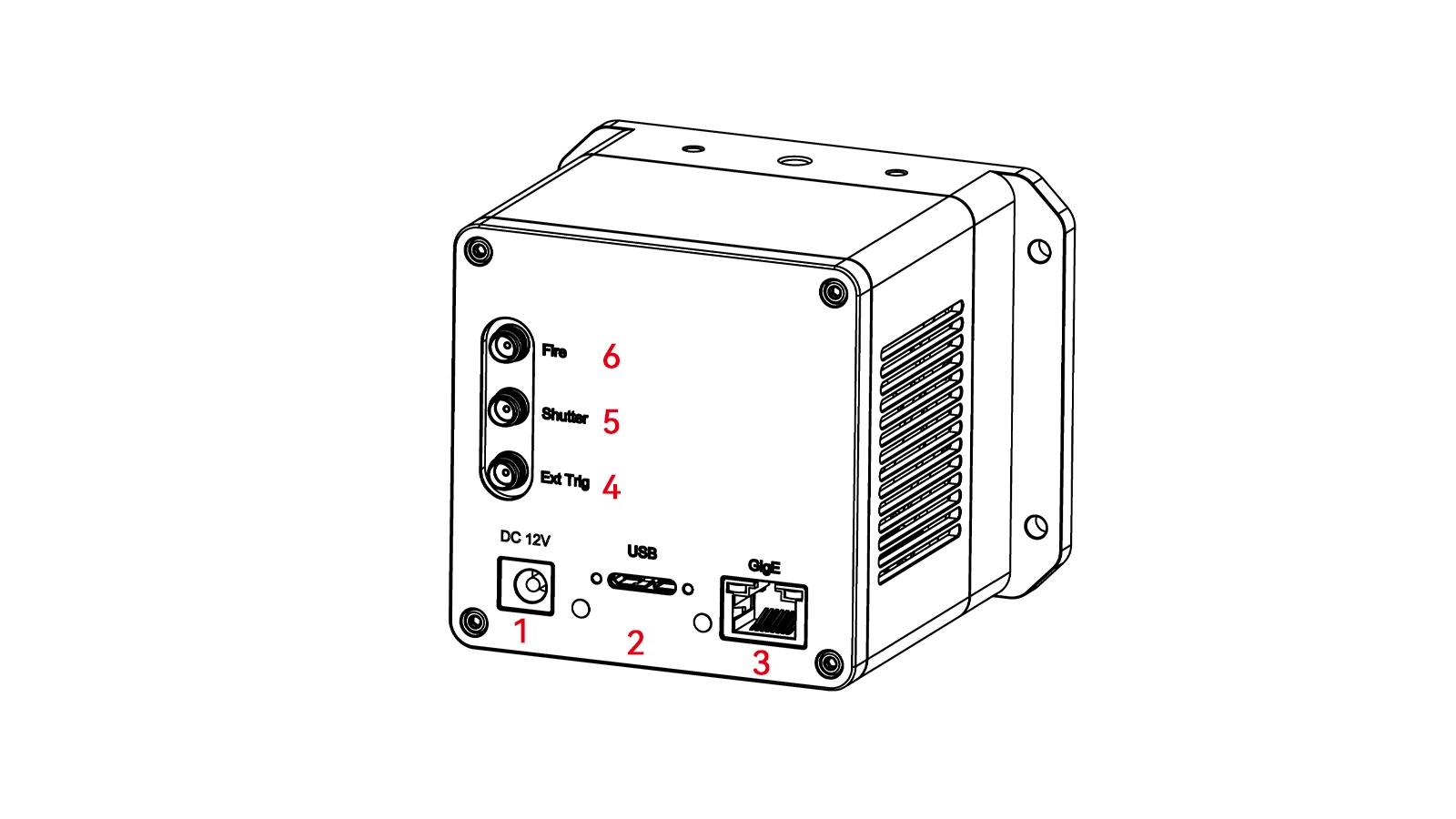
| 1 | DC 19V power port |
| 2 | USB 3.0 port |
| 3 | GigE port |
ascamsdk support a variety of APIs, including: Native C/C++,.NET/C#/VB.NET, Python, Java, DirectShow, Twain, LabView, Matlab, etc. Compared with other APIs, Native C/C++ API as a low-level API is characterized by using pure C/C++ development without relying on other runtime libraries. The interface is simple and the control is flexible.
AttosTek provides extensive third-party software support for its UV-Vis cameras and SWIR cameras, facilitating rapid integration and use in various development environments. This includes SDK and demo programs for LabVIEW and MATLAB, as well as DirectShow drivers, Micromanager, and TWAIN SDK drivers. These features enable seamless compatibility with mainstream development environments and third-party software, greatly simplifying the workflow for system integration and secondary development.
|
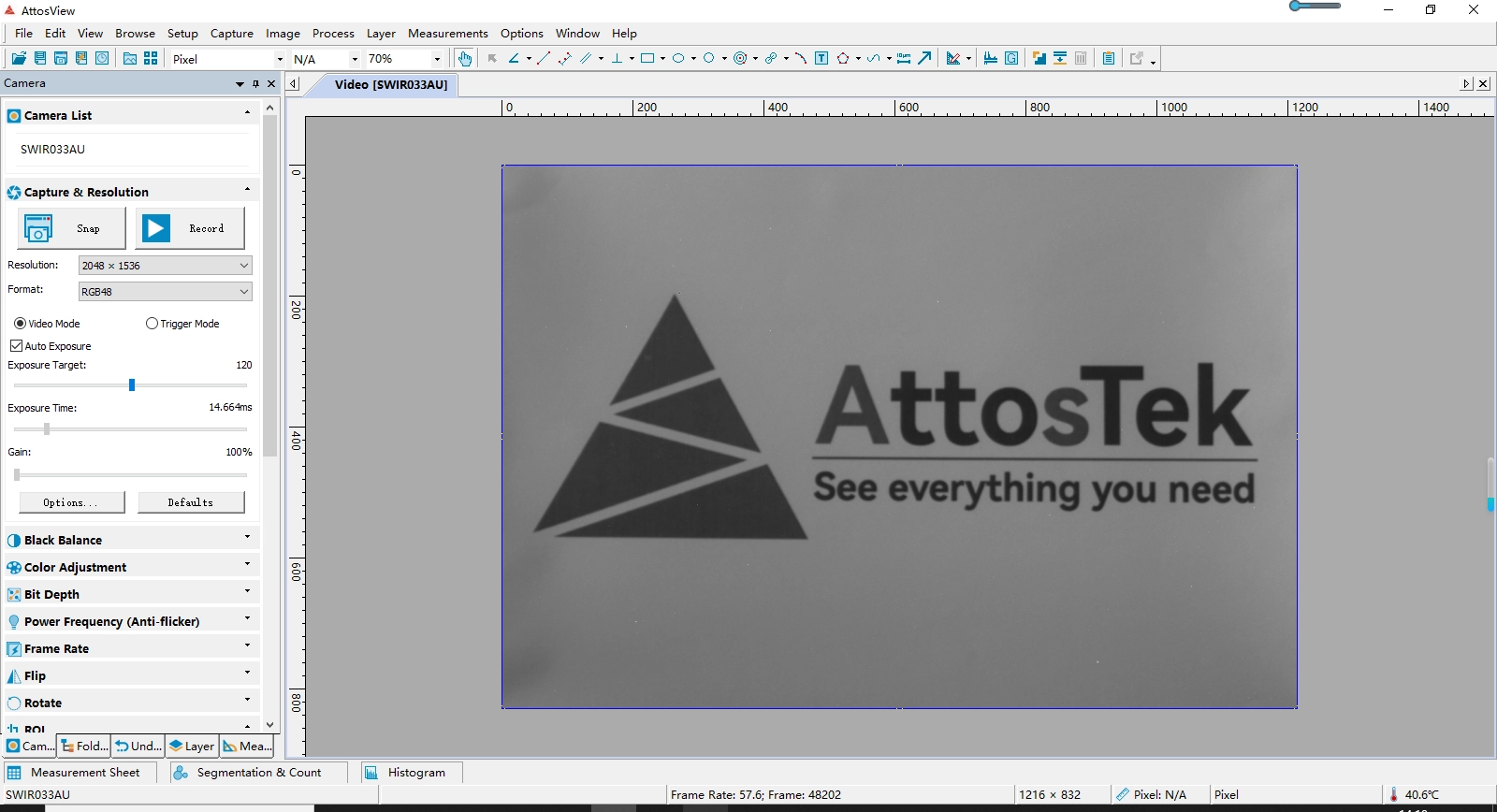
AttosView Recommended System Requirements |
|
|
Operating System |
Microsoft® Windows® XP / Vista / 7 / 8 /10 /11(32 & 64 bit), Mac OSX, Linux |
|
Processor (CPU) |
≥3.0 GHz Intel Core i5 or Higher |
|
Memory (RAM) |
≥8 GB |
|
Hard Drive |
NVMe Solid State Drive (SSD) |
|
Graphics Card |
Dedicated Adapter with ≥256 MB RAM |
|
Motherboard |
USB 3.0 (-USB) Cameras: Integrated Intel USB 3.0 Controller or One Unused One Unused PCle3.0*16 Slot |
|
Connectivity |
Internet Connectivity for Driver Installation |
Q1 : What specific advantages does this camera have in Raman spectroscopy detection?
The UVISI261BUG camera has several key advantages for Raman spectroscopy detection. It offers a quantum efficiency of about 95% at 800 nm, making it great at catching Raman scattering signals in the near-infrared range. With an ultra-low readout noise of 22 e⁻ rms and a high dynamic range of 86.5 dB, you can get high signal-to-noise ratio spectral data even in low light. Its TEC cooling can reach -35°C, and the dark current is as low as 184 e⁻/s/pixel, which effectively reduces thermal noise—perfect for Raman spectroscopy that needs long exposure times to accumulate signals. The maximum exposure time can go up to 60 minutes, giving plenty of time to gather photons for detecting weak signals.
Q2 : CCD detector vs CMOS, how to choose for spectral applications?
CCD advantages: Excellent image/spectral uniformity, ultra-high dynamic range of 86.5dB, low readout noise of 22e⁻, clean long integration baseline, and better quantification for very weak Raman/PL signals; downsides are slower readout speed and higher overall power consumption.
CMOS advantages: High frame rate, low power consumption, and low cost, but higher dark current and serious baseline drift for long integrations, making it unsuitable for tiny weak-light spectra.
Selection advice: For Raman, photoluminescence, and high-spectral-precision research, prioritize this e2v linear CCD; for high-speed dynamic appearance inspection, go with a CMOS camera.
Q3 :Key points for protecting long-term spectroscopy equipment in high/low temperature and humid labs?
Key points for protecting long-term spectroscopy equipment in high/low temperature and humid labs?
Answer 3: The camera’s temperature and humidity specs are: Operating – 30~45°C, Storage – 40~60°C, Humidity 0–95% non-condensing.
For labs with long-term temperatures above 40°C, add a small air-cooled auxiliary cooling system to reduce TEC load and suppress dark current rise with temperature.
In labs with large temperature differences and high humidity, use a moisture-proof lens cover along with the camera’s anti-condensation design to prevent fogging on optical windows and moisture damage to internal circuits, ensuring long-term spectral stability. …
2048×264 Resolution,15 µmBig Pixel Size,CCD Scientific Camera for Spectroscopy
UVISI261BUG
0.54MP Monochrome CCD Camera, 15µm Pixel, Global Shutter, USB 3.0 & GigE Interface
Optional accessories – lenses
AttosView offers an optional YLGD series continuous zoom optical system for visible light cameras, designed specifically for high-precision imaging scenarios. The YLGD series continuous zoom optical system series provides multiple focal length options and is suitable for various professional applications such as security surveillance, industrial vision inspection, and scientific observation, ensuring excellent image clarity, operational flexibility, and environmental adaptability. For inquiries, please contact sales@attostek.com