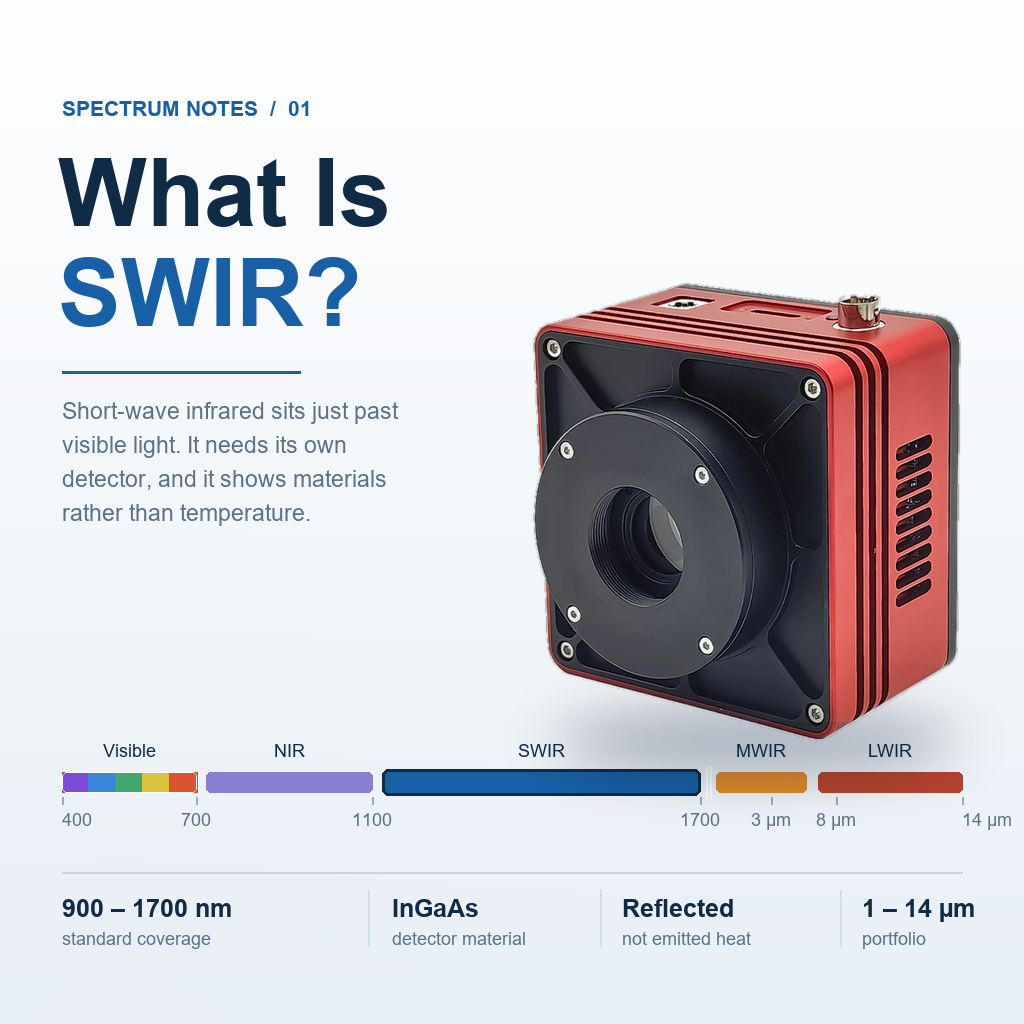
Choosing a short-wave infrared (SWIR) camera for industrial inspection or machine vision requires more than comparing resolution alone. Frame rate, spectral response, sensor noise, data interface, and system integration all influence the final imaging performance.
For applications that require a balance between spatial resolution, acquisition speed, and system complexity, 1.3-megapixel SWIR cameras with 5 µm pixels are a practical option to consider.
This guide compares four SWIR cameras with a resolution of 1280 × 1024 pixels and a 5 µm pixel size: the AttosTek SWIR051AU, Allied Vision Goldeye G-130 VSWIR TEC1, Xenics Wildcat+ 1280 U3V, and JAI WAA-1300-GE-TEC. It summarizes their key specifications, highlights their distinguishing features, and explains which application requirements each configuration may suit.
Quick Comparison: 4 SWIR Cameras with 5 µm Pixels
The four cameras compared in this article share the same resolution, pixel size, and wide spectral coverage — 1.3 MP, 5 µm pixels, and a 400–1700 nm range — but differ in frame rate, interface, power consumption, and published sensor noise specifications.
| Specification |
AttosTek
SWIR051AU
|
Allied Vision
Goldeye G-130 VSWIR TEC1
|
Xenics
Wildcat+ 1280 U3V
|
JAI
WAA-1300-GE-TEC
|
|---|---|---|---|---|
| Resolution | 1280 × 1024 | 1280 × 1024 | 1280 × 1024 | 1280 × 1024 |
| Pixel size | 5µm × 5µm | 5µm × 5µm | 5µm × 5µm | 5µm × 5µm |
| Spectral range | 400–1700 nm | 400–1700 nm | 400–1700 nm | 400–1700 nm |
| Frame rate | 200 fps | 94 fps | 120 Hz | 90 fps |
| Peak QE | 75% at 1200 nm | 75% at 1200 nm | 75% at 1200 nm | 77% @1200nm |
| Readout noise | 211 e⁻ | 250 e⁻ | 200 e⁻ | Not listed |
| Dark current | 383 e⁻/s/pixel | 4800 e⁻/s/pixel | 3000 e⁻/s/pixel | Not listed |
| Data interface | USB 3.0 | GigE Vision | USB 3.0 / Camera Link | GigE Vision |
| Shutter | Global shutter | Global shutter | Global shutter | Global shutter |
| Lens mount | C-mount | C-mount | C-mount / M42 | C-mount |
| Power consumption | <25 W | <12.95 W | <7 W | <6.5 W |
Note: Camera specifications in the table above are sourced from the respective manufacturers’ official websites, collected in October 2026.
AttosTek SWIR051AU High-Speed Imaging for Industrial Inspection
The AttosTek SWIR051AU has a maximum frame rate of 200 fps at full resolution, making it well suited for machine vision systems that capture moving targets or rapidly evolving optical signals.
The SWIR051AU achieves a maximum imaging SNR of 52.6 dB, thanks to its low dark current and low readout noise.Featuring a USB 3.0 high-speed interface with plug-and-play operation, it provides a simple connection path for compatible industrial PCs and laboratory systems. Its global shutter eliminates the rolling-shutter distortion typical of sequential row exposure when imaging moving objects.
Applications
This camera is ideal for use cases where acquisition speed is a key selection requirement. For laser beam analysis and optical experiments, its high frame rate enables capture of dynamic beam profiles and time-varying optical patterns. In industrial sorting, high-speed acquisition supports inspection of products in motion, subject to system exposure timing and processing limits.
Explore the product: AttosTek SWIR051A Series SWIR Cameras
Allied Vision Goldeye G-130 VSWIR TEC1 GigE Vision and PoE Integration
The Allied Vision Goldeye G-130 VSWIR TEC1 provides a GigE Vision interface and supports Power over Ethernet (PoE). PoE can reduce cabling requirements where the host equipment and power budget support it.
Its listed maximum frame rate is 94 fps at full resolution. Compared with cameras optimized for higher acquisition rates, this may be sufficient for inspection tasks where reliable integration and a moderate imaging speed take priority.
Applications
The Goldeye G-130 VSWIR TEC1 may suit semiconductor and solar-cell inspection, industrial material analysis, and selected scientific imaging applications. For projects involving distributed camera installations, Ethernet connectivity and PoE support may be useful considerations during system design.
Xenics Wildcat+ 1280 U3V Interface Flexibility and Low Readout Noise
The Xenics Wildcat+ 1280 U3V has a maximum frame rate 120 Hz and its readout noise is 200 electrons. The combination of a 5 µm pixel size, global shutter, and USB 3.0 and Camera Link interface options provides flexibility for different imaging-system configurations. Its power consumption of less than 7 W may also be attractive in applications where the available power budget is limited.
Applications
The camera may be considered for high-speed material sorting, agricultural inspection, and automated inspection systems where the selected interface and acquisition rate match the production-line requirements.
JAI WAA-1300-GE-TEC Wide Spectral Coverage and Low Power Consumption
The JAI WAA-1300-GE-TEC features a GigE Vision interface and a maximum frame rate of 90 fps. Among the four cameras selected in this article, it has the highest peak quantum efficiency, reaching up to 77% at 1200 nm, while the other three are all 75% at 1200 nm. Its power consumption is below 6.5 W, making it suitable for deployment in power-constrained scenarios while balancing performance and stability.
Applications
Include fruit and vegetable sorting, material classification, plastic inspection, and semiconductor alignment tasks. For example, SWIR imaging can reveal differences associated with moisture or material composition that are not obvious in visible-light images.
Frequently Asked Questions
1. What are the advantages of 5 µm pixels in a SWIR camera?
Pixel size affects spatial sampling and the amount of light collected by each pixel under comparable optical and sensor conditions. A 5 µm pixel pitch is one option for balancing resolution, sensitivity, and sensor format. It does not independently determine image quality, which also depends on quantum efficiency, noise, optics, illumination, and exposure settings.
2. Is a higher frame rate always better?
No. A higher frame rate is valuable when the target moves quickly or the signal changes rapidly. It may also increase data throughput and system-processing requirements. The best choice is the camera that meets the required acquisition rate and image quality without adding unnecessary system complexity.
For more information about SWIR imaging solutions, explore the AttosTek SWIR051A Series , or contact AttosTek to discuss your imaging requirements.