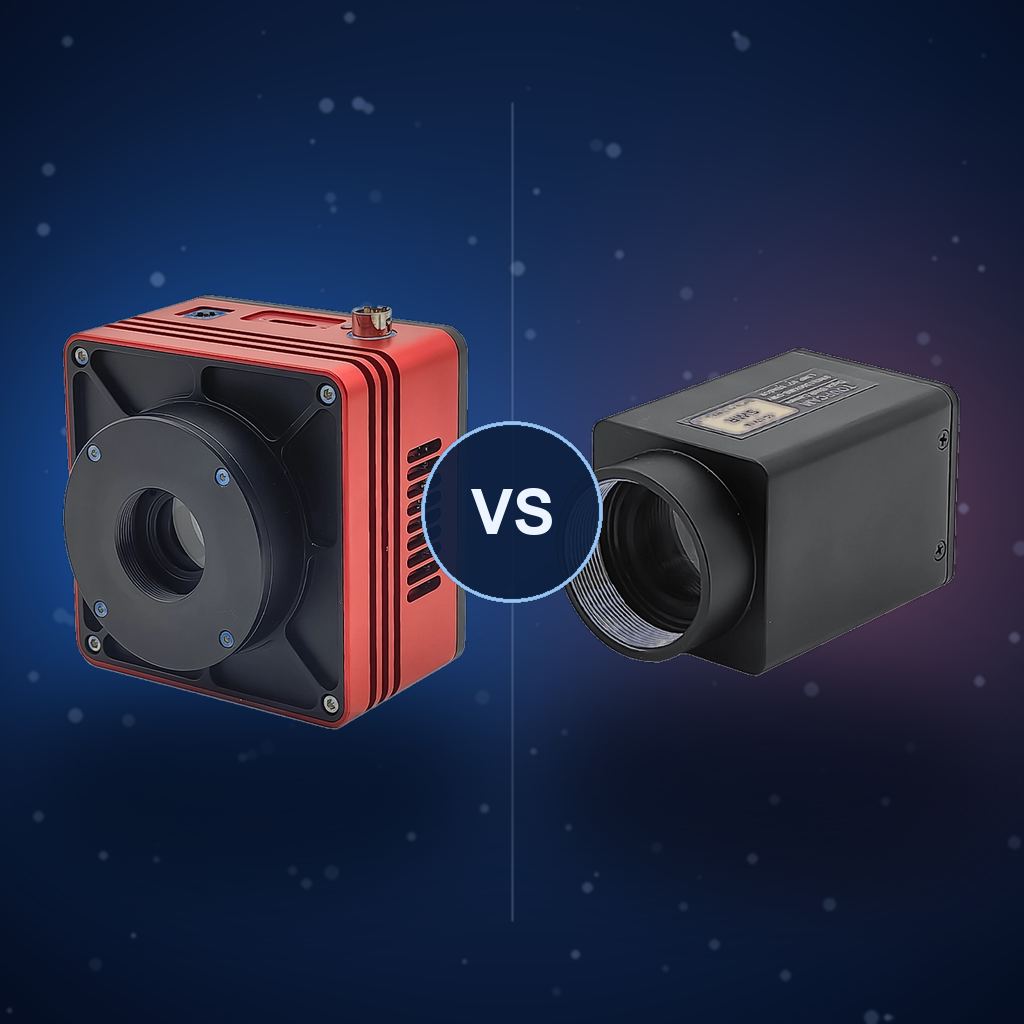
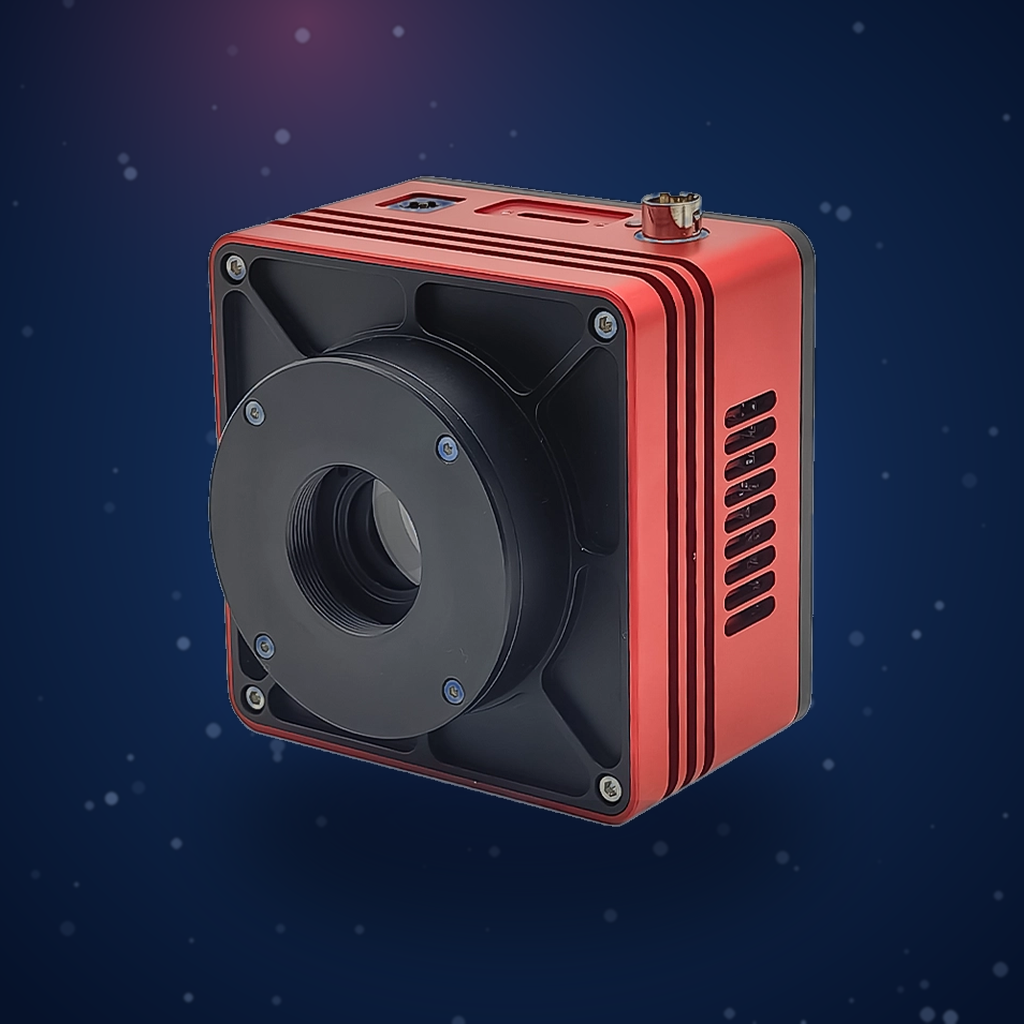
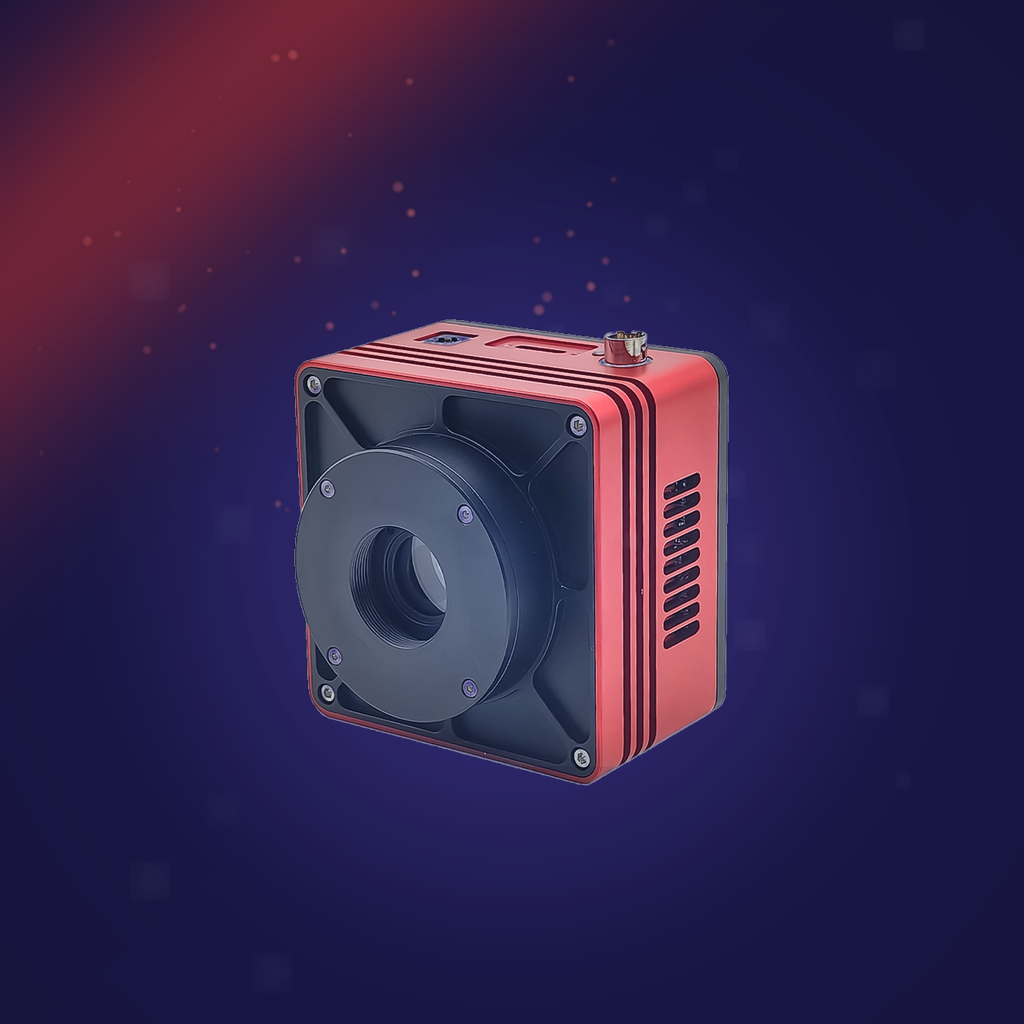
I. Experimental Objective
This experiment uses the AttosTek SWIR1503BU-DC deep-cooled SWIR camera to acquire dark-field images under unified test conditions. By comparing the imaging quality at different cooling temperatures, the suppression effect of cooling temperature on the camera’s dark noise level is systematically evaluated, providing experimental evidence for the selection of SWIR imaging systems in low-light, high-sensitivity applications.
II. Application Background and Experimental Principle
Most mainstream SWIR cameras employ InGaAs sensors, which have a narrow bandgap. At room temperature, the thermal excitation carrier effect is significant, and the dark current is much higher than that of visible-light sensors, affecting the signal-to-noise ratio. Cooling technology can fundamentally suppress dark current and improve the signal-to-noise ratio. To visually observe the suppression effect of deep cooling on dark current, we selected a completely dark, no-light dark-field environment, kept the exposure time and other parameters constant, and captured dark-frame images of the camera under uncooled, –10°C cooling, –20°C cooling, and –50°C cooling conditions, directly presenting the noise differences at different cooling temperatures.
III. Test Conditions and Test Results
3.1 Test Conditions
| Parameter | Specification |
|---|---|
| Deep-Cooled Camera | SWIR1503BU-DC |
| Exposure Time | 1 s |
| Ambient Temperature | Room temperature 20°C |
| Camera Temperature Settings | 20°C, –10°C, –20°C, –50°C |
3.2 Test Results
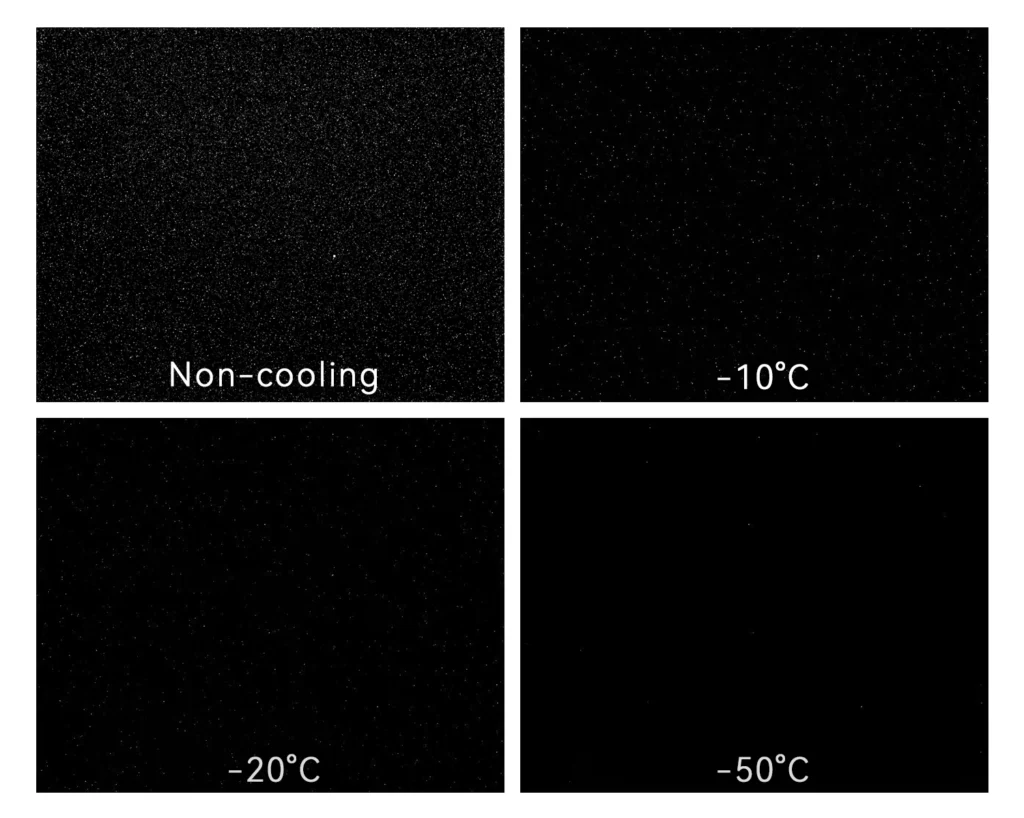
From the images, it can be observed that in the uncooled state, the dark-field image is filled with dense bright noise spots and the background is rough. As the temperature drops to –10°C, the noise spots are significantly reduced. At –20°C, the image uniformity improves markedly. Under deep cooling at –50°C, the image presents an extremely clean and uniform dark field, with only a very few isolated weak noise spots remaining.
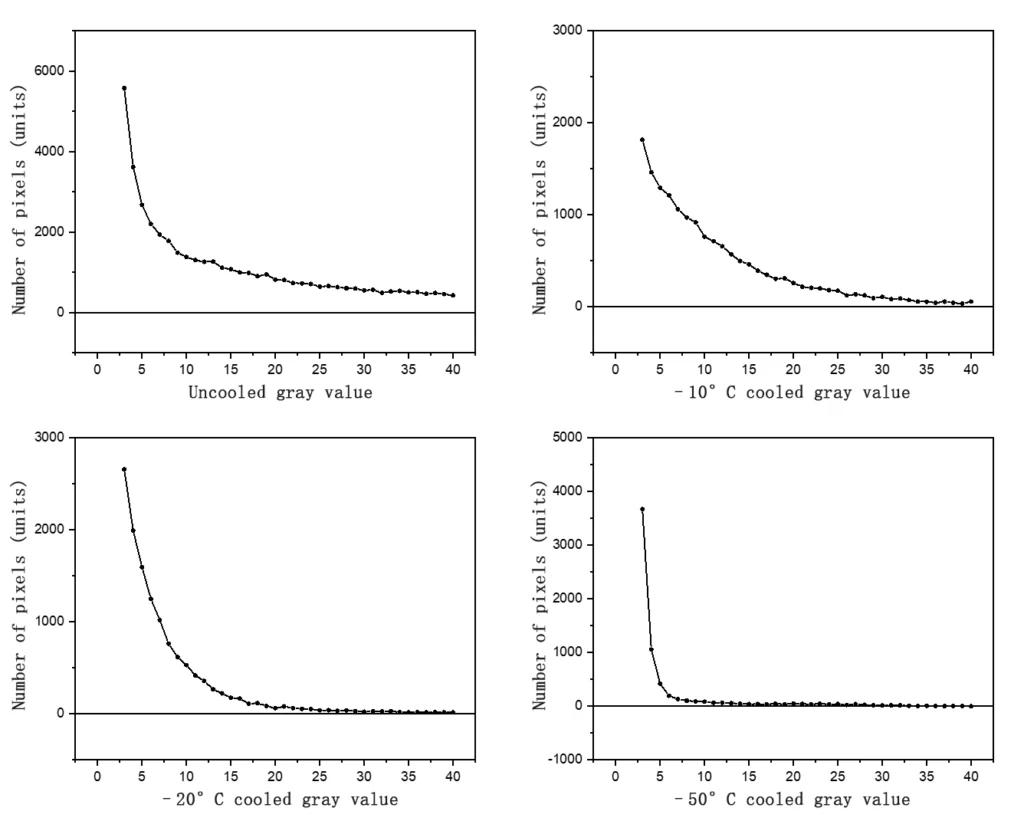
| Cooling Temperature | Pixel Count at Grayscale 10 | Pixel Count at Grayscale 20 | Pixel Count at Grayscale 30 | Pixel Count at Grayscale 40 |
|---|---|---|---|---|
| 20°C | 1382 | 817 | 550 | 428 |
| –10°C | 1295 | 260 | 108 | 57 |
| –20°C | 531 | 62 | 23 | 17 |
| –50°C | 83 | 50 | 14 | 0 |
To clearly demonstrate the suppression effect of cooling temperature on dark current, we calculated the dark current at different cooling temperatures as shown in the table below.
| Cooling Temperature | Dark Current(e-/s/pixel) | Dark Current Reduction Ratio (Relative to Uncooled) |
|---|---|---|
| 20℃ | 3242.8 | – |
| -10℃ | 659.3 | 4.91 |
| -20℃ | 573.5 | 5.62 |
| -50℃ | 218.9 | 14.81 |
IV. Summary
This experiment visually demonstrates the suppression effect of deep cooling technology on dark current. At a cooling temperature of –50°C, the dark current is only 218.9 e⁻/s/pixel. Compared with uncooled SWIR cameras of the same specifications, deep-cooled cameras offer irreplaceable performance advantages in weak signal detection and long-exposure imaging scenarios, making them particularly suitable for scientific research and industrial applications that are extremely sensitive to noise, such as astronomical observation, fluorescence imaging, and near-infrared spectroscopy analysis.
👉 For more technical details, application cases, and specifications of the SWIR1503BU-DC camera used in this experiment, please visit:
0.33 MP 15 μm Pixels -50°C Cooled 900-1700nm SWIR Camera