I. Product Introduction
The SWIR1503BU-DC is a deep‑cooled SWIR camera equipped with an InGaAs CMOS sensor, capable of achieving –50°C cooling (at 20°C ambient temperature). With a resolution of 0.33 MP, a pixel size of 15 µm, a USB3.0 interface, and a global shutter, the SWIR1503BU-DC is an ideal choice for research institutes, medical institutions, and high‑end industrial applications, thanks to its stable cooling system and exceptional scientific imaging performance.
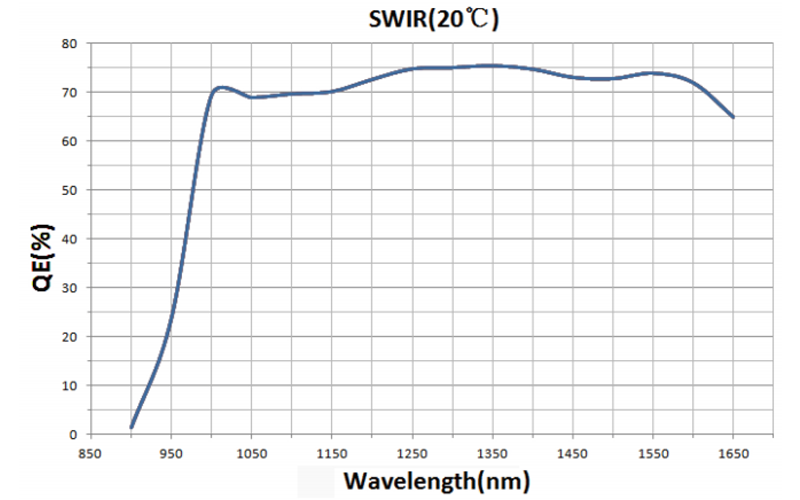
II. QE Curve
III. Camera Specifications
| Parameter | Specification |
|---|---|
| Model | SWIR1503BU-DC |
| Sensor Type | InGaAs CMOS |
| Spectral Range | 900 nm – 1700 nm |
| Pixel Size | 15 µm × 15 µm |
| Sensor Format | 3/4″ |
| Frame Rate & Resolution | 300 fps @ 640 × 512 |
| Hardware Image Buffer | 512 MB |
| Conversion Gain | 0.96 e⁻/DN (HCG), 5.36 e⁻/DN (MCG), 145 e⁻/DN (LCG) |
| Dynamic Range | 55.8 dB (HCG), 58.1 dB (MCG), 58.3 dB (LCG) |
| Readout Noise | 22.8 e⁻ (HCG), 106 e⁻ (MCG), 2708 e⁻ (LCG) |
| Full Well Capacity | 14 ke⁻ (HCG), 85 ke⁻ (MCG), 2216 ke⁻ (LCG) |
| Maximum SNR | 41.5 dB (HCG), 49.3 dB (MCG), 63.4 dB (LCG) |
| Dark Current | MCG 193.909 e⁻/s/pixel, HCG 630.516 e⁻/s/pixel, LCG 131.561 e⁻/s/pixel |
| Exposure Time Range | 16 µs – 5 s |
| Shutter Mode | Global shutter |
| Data Interface | USB3.0 |
| Digital I/O | 1 opto‑isolated input, 1 opto‑isolated output, 2 non‑isolated I/O ports |
| Data Format | 8‑bit / 16‑bit |
| Cooling Temperature | –50°C (at 20°C ambient temperature) |
| Optical Interface | C‑mount |
| Power Supply | 19 V 4.74 A DC |
| Power Consumption | 8.4 W (TEC OFF) / <16 W (TEC ON) |
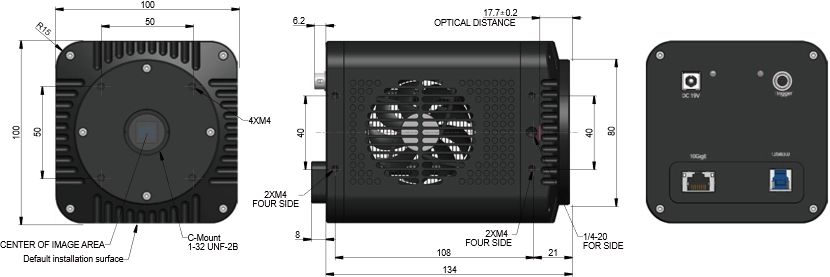
| Dimensions | 137.8 mm × 100 mm × 100 mm |
| Weight | 1.31 kg |
| Software | AttosView / SDK |
| Operating System | Windows, Linux |
| Temperature | Operating: –30°C to 45°C; Storage: –40°C to 60°C |
| Humidity | Operating: 0–95%; Storage: 0–95% |
| Certifications | CE, FCC |
IV. Dimensions
V. Package Contents
| Item Name | Specification | Quantity |
|---|---|---|
| SWIR Camera | SWIR1503BU-DC | 1 |
| USB3.0 Data Cable | A Male to B Male Cable, 1.5m, GoldPlated | 1 |
| External trigger control line | 7-Core Female Trigger Cable, 2m | 1 |
| Power Cord | Power Cord(Default: EU standard; Optional: US/UK standard) | 1 |
| Power Adapter | Input AC 100–240V 50/60Hz, output DC 12V 3A | 1 |
| USB Flash Drive | USB Drive with Software, Drivers, and Manual | 1 |
VI. Application Cases
The SWIR1503BU-DC SWIR camera is widely used in the life sciences and materials science fields. In life sciences, the camera enables small‑animal near‑infrared fluorescence imaging, deep‑tissue structural observation, and NIR‑II probe detection, supporting deep‑brain tissue imaging, neural activity monitoring, and vascular imaging and hemodynamic analysis in brain research. In materials characterization, it is suitable for semiconductor defect inspection and optoelectronic device performance evaluation.
👉 For more technical details, application cases, and specifications, please visit: 0.33 MP 15 μm Pixels -50°C Cooled 900-1700nm SWIR Camera