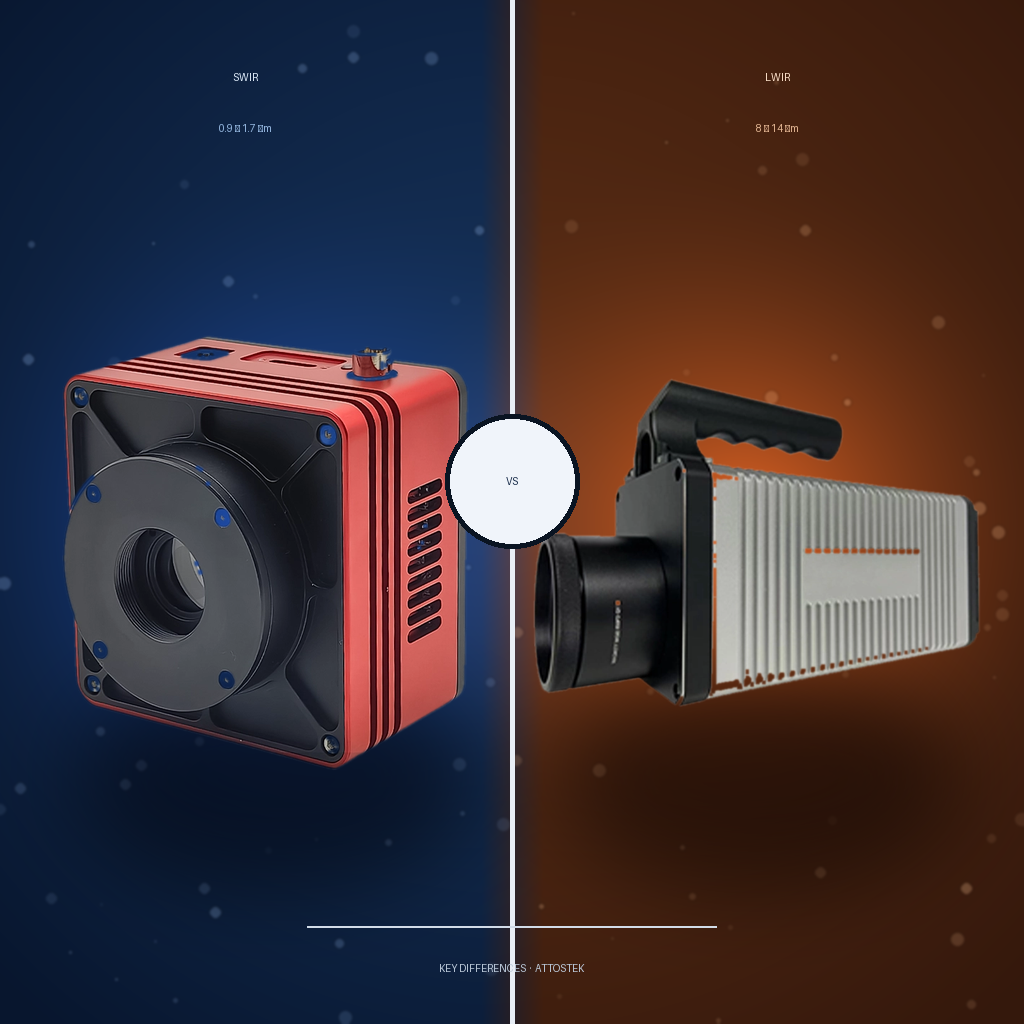
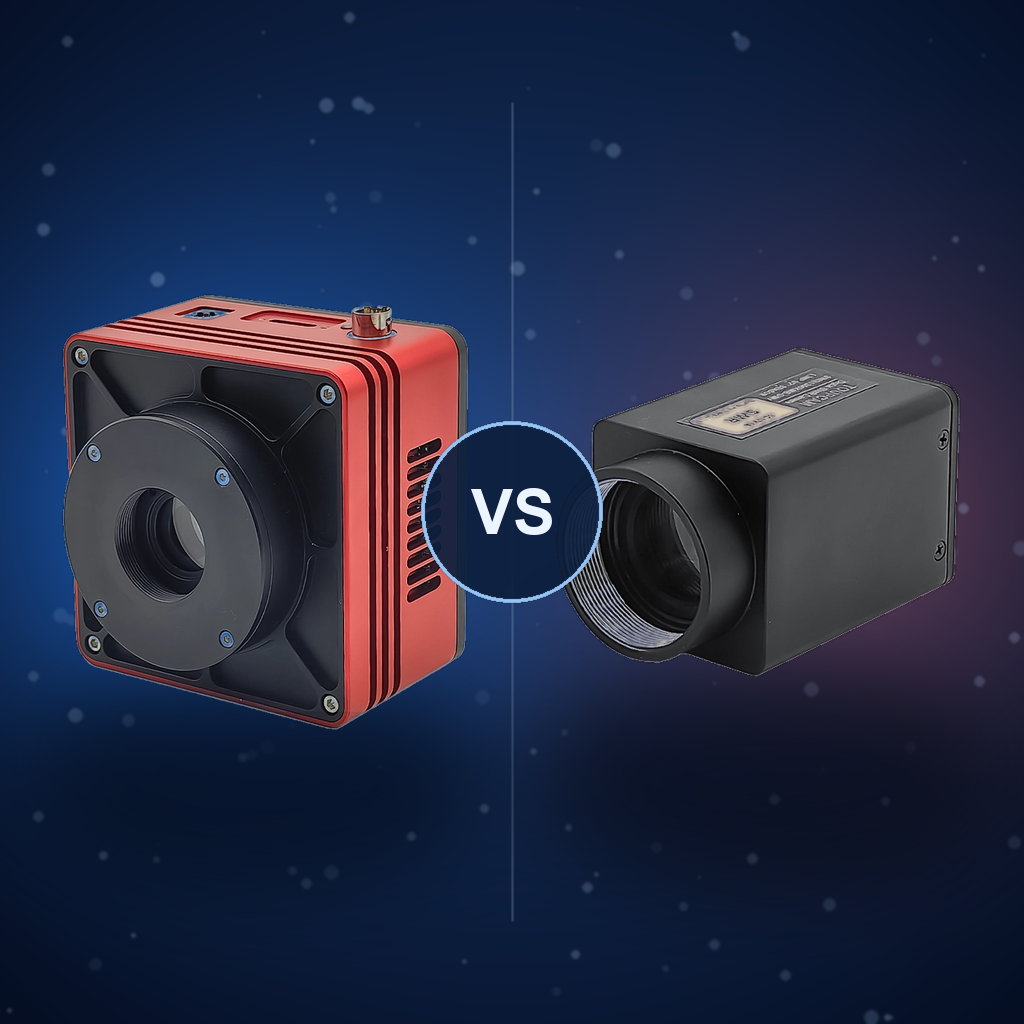
A SWIR camera detects reflected short-wave infrared photons between roughly 0.9 and 1.7 μm and produces sharp, high-resolution images of material contrast; an LWIR camera detects thermal radiation that the object itself emits in the 8–14 μm band and produces a heat map. The difference is not one of quality but of physics: wavelength range, imaging mechanism, lens materials, cost and applications all follow from those two facts.
Key Takeaways
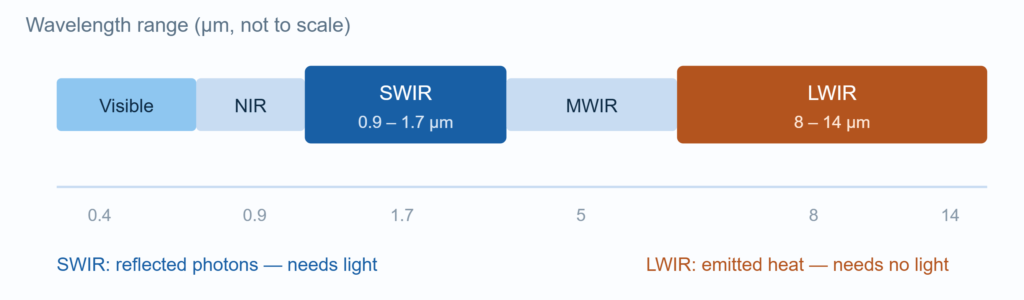
- The wavelength gap is roughly a factor of ten. SWIR cameras work from about 0.9 to 1.7 μm, while LWIR cameras cover 8–14 μm — two ends of the infrared spectrum with different physics, optics and price tags.
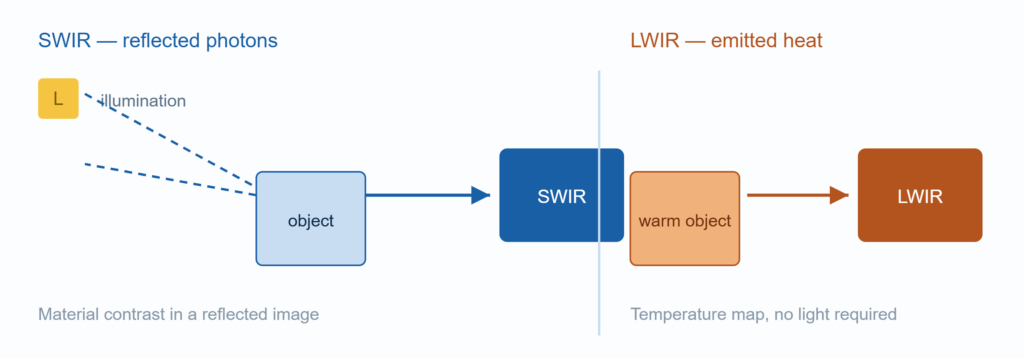
- The imaging mechanisms are opposite. A SWIR sensor reads photons reflected off the scene, so it needs light much like a visible camera; an LWIR sensor reads radiation the object emits, so it needs no illumination at all.
- Materials decide the optics. Silicon is transparent to SWIR and ordinary glass passes it, while glass blocks LWIR completely — long-wave infrared demands germanium or chalcogenide lenses.
- Cost runs in opposite directions. Mass-produced VOx microbolometers have pushed LWIR pricing down toward consumer levels, while InGaAs focal plane arrays keep SWIR cameras several times more expensive.
- Choose by question, not by band. Material identification, silicon inspection and moisture detection point to SWIR; temperature mapping, night surveillance and search-and-rescue point to long-wave infrared thermal cameras.
What is an LWIR Camera Module?
An LWIR camera module is a complete imaging engine built around a long-wave infrared detector: the sensor, the lens interface, the drive electronics and the data interface, packaged so an OEM can drop it into a larger instrument. The band is 8–14 μm, where objects near room temperature radiate most of their energy. AttosTek’s LWIR line covers the three detector families on the market — uncooled cameras based on vanadium oxide (VOx) microbolometers, cooled cameras built on mercury cadmium telluride (MCT) or type-II superlattice (T2SL), and high-operating-temperature (HOT) cooled designs — with resolutions from 640 × 512 through 1024 × 768 to 1280 × 1024 and industrial interfaces including GigE, USB 3.0, CameraLink and MIPI.
The module format matters commercially. A handheld thermal imager and a fixed surveillance camera may share the same LWIR camera module, and an integrator building inspection equipment usually buys the module rather than the finished camera, adding their own optics housing and user interface around it. That is also why long-wave infrared thermal cameras are so widely available: once the module is standardized, the same engine serves security, thermography and automotive night-vision products without redesign.
How LWIR Sensors Work
An uncooled LWIR sensor is a microbolometer. Each pixel is a tiny membrane that absorbs incoming 8–14 μm radiation and warms by a fraction of a degree; the warming changes the electrical resistance of the VOx layer, and the readout circuit converts that change into a pixel value. The image is therefore a map of radiated heat. No cooler is required — a thermoelectric stabilizer holds the array at a fixed temperature — which is why uncooled models start instantly, run for hours and cost relatively little.
Cooled LWIR sensors work on a different principle. MCT and T2SL are photon detectors: incoming infrared excites charge carriers in the semiconductor, much as in a camera for visible light, but the bandgap is so narrow that thermal noise would swamp the signal at room temperature. A cryocooler holds the detector near cryogenic temperature, which buys far better sensitivity — a cooled LWIR camera resolves smaller temperature differences and detects targets at longer range than an uncooled one — at the price of higher cost, standby power and a cool-down wait. HOT designs narrow that gap by operating the photon detector at a warmer setpoint. The sensitivity metric to compare on datasheets is NETD, the noise-equivalent temperature difference.
What is a SWIR Sensor?
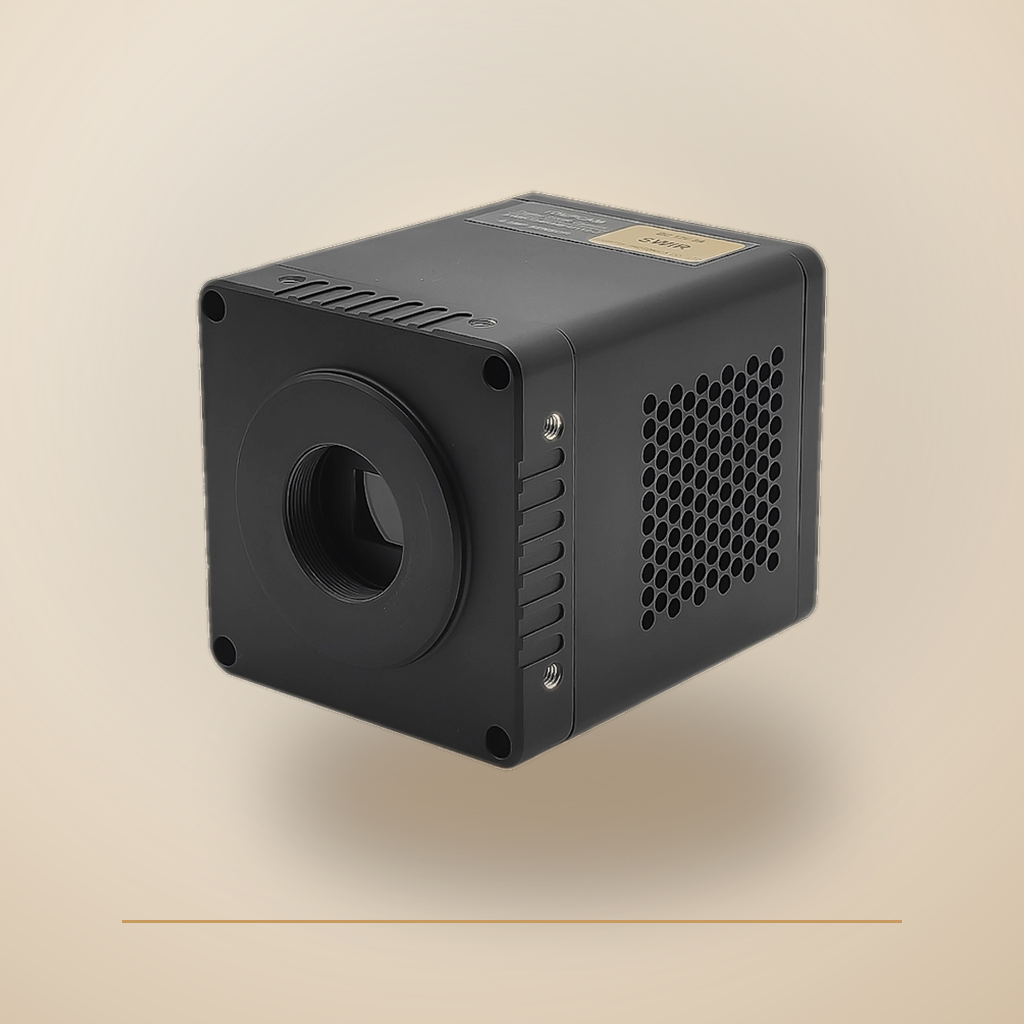
A SWIR sensor images the 0.9–1.7 μm band, just beyond where silicon stops responding. The dominant detector material is indium gallium arsenide (InGaAs), a III-V compound whose bandgap matches the short-wave infrared; colloidal quantum dot (CQD) sensors extend coverage down toward 300 nm, and extended-wavelength InGaAs reaches 1.9, 2.2 or 2.7 μm for material identification further into the infrared. A representative AttosTek model, the 1.3 MP 5 μm TEC-cooled InGaAs SWIR camera, pairs a Sony IMX990 array of 1280 × 1024 pixels with a 400–1700 nm response and a thermoelectric cooler for dark-current control.
Because the wavelengths are short, SWIR sensors behave like silicon image sensors that simply see further into the infrared: small pixels, high resolution, fast readout and the same lens-mount conventions as machine-vision cameras. That is a direct consequence of the wavelength range, and it shapes everything in the comparison below.
How SWIR Sensors Work
The imaging mechanism is reflected light. A SWIR camera photographs the scene in short-wave infrared exactly as a visible camera photographs it in color — ambient light, or an active LED or laser illuminant, bounces off the object and the sensor records the returning photons. Three material behaviors create the contrast that makes SWIR useful. Silicon becomes transparent beyond 1.1 μm, so these sensors can inspect wafers, solar cells and IC packages for internal defects. Water absorbs strongly near 1.45 μm, which turns moisture content into visible contrast for food and pharmaceutical inspection. And the band penetrates haze and smoke better than visible light, which is why it is used for perimeter surveillance and fogged road imaging.
The photon-counting nature of the sensor also explains SWIR speed. A 1.3 MP InGaAs array reads the full frame at 200 fps and reaches 8000 fps once the region of interest is cropped, so frozen motion, droplet analysis and laser monitoring are natural applications. Cooling — from light TEC stages down to deep-cooled designs at −50 °C — keeps dark current low when exposures stretch out, but for short exposures an uncooled design is often enough.
Key Differences Between LWIR and SWIR Sensors
The two sensor families answer different questions, and the datasheet lines below show where they diverge. The comparison uses representative figures from AttosTek’s product families.
| Aspect | SWIR camera | LWIR camera |
|---|---|---|
| Wavelength range | 0.9–1.7 μm (InGaAs standard); 400–1700 nm filtered models; extended 1.9 / 2.2 / 2.7 μm | 8–14 μm |
| Imaging mechanism | Reflected short-wave photons; needs ambient or active illumination | Self-emitted thermal radiation; needs no illumination |
| Typical detector | InGaAs, CQD, extended-response MCT | VOx microbolometer (uncooled); MCT / T2SL / HOT (cooled) |
| Typical resolution | 0.33–5 MP arrays, e.g. 1280 × 1024 at 5 μm pitch | 640 × 512 to 1280 × 1024 |
| Lens material | Ordinary glass optics, standard C-mount | Germanium or chalcogenide optics; glass is opaque in this band |
| Speed | Up to 200 fps full frame, ROI readout to 8000 fps | Video-rate thermal imaging for monitoring and thermography |
| Cost and availability | Higher cost; InGaAs supply concentrated among few vendors | Lower cost; VOx microbolometers produced at very large scale |
| Characteristic applications | Silicon and solar-cell inspection, material sorting, moisture detection, haze penetration | Non-contact temperature measurement, building diagnostics, surveillance, fire search-and-rescue |
Wavelength range drives the first practical consequence: penetration through materials. Short-wave infrared passes through ordinary glass, so SWIR cameras use standard C-mount machine-vision lenses and can even image through a window; the same transparency of silicon beyond 1.1 μm is what enables wafer inspection. LWIR behaves the other way — glass, water and most visible plastics are opaque in the 8–14 μm band, which is why thermal lenses are ground from germanium or chalcogenide and why a long-wave infrared thermal camera measures surface temperature only, never through a pane.
The imaging mechanism decides where each camera is usable. Because an LWIR sensor needs no light at all, it works in complete darkness and through smoke — the reason fire crews and security systems rely on it. Because a SWIR sensor needs photons to reflect, it behaves like a high-resolution visible camera that is blind to color but sensitive to material composition; give it a 1550 nm LED line and it will sort plastics, detect bruises under fruit skin or see laser spots the eye cannot. Cost and availability follow the same logic in reverse: VOx microbolometer arrays ship in volumes that span consumer thermography and automotive night vision, while InGaAs focal plane arrays remain a lower-volume, higher-cost component — a gap that quantum dot sensors and improved InGaAs manufacturing are slowly narrowing.
SWIR or LWIR: Which One Fits Your Application?
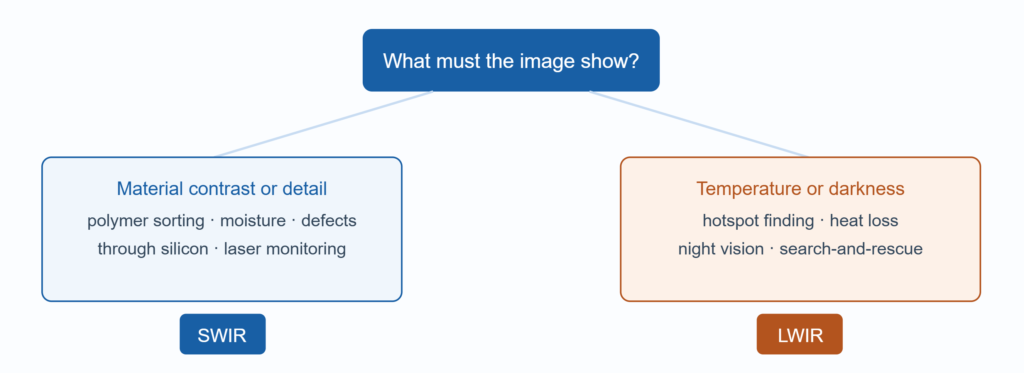
Start from the question the measurement must answer. If the value lives in material composition — identifying polymers, detecting moisture, seeing inside silicon, sorting food — SWIR is the tool, and its high resolution and frame rate come along effectively for free. If the value lives in temperature — finding a failing component on a PCB, locating heat loss in a building envelope, seeing a person in total darkness — LWIR is the tool, and no amount of SWIR resolution will substitute for a calibrated heat map.
Budget and integration follow. An uncooled LWIR camera module is the least expensive route to an infrared image and the simplest to integrate into a larger instrument; a SWIR system costs more but delivers contrast and detail that thermal imaging cannot. Many programs end up needing both — thermal localization plus material identification — and AttosTek supplies cooled and uncooled SWIR cameras and uncooled and cooled LWIR cameras under one roof, so a two-band system can be specified as one program. If the requirement sits between catalogue models, the AttosTek customization team will configure sensor, interface, cooling and housing for small batches and return a CIF quotation.
SWIR and LWIR Cameras from AttosTek
The models below span both bands discussed in this article — high-resolution InGaAs SWIR cameras for material contrast, and long-wave infrared modules for thermal imaging. Every camera ships with AttosView control software, a full SDK and CE/FCC certification.

400–1700 nm · 1280 × 1024 @ 200 fps, ROI to 8000 fps · TEC cooling · USB3.0 / GigE / CoaXPress / CameraLink

High-resolution A-Series for inspections that need fine sampling at production speed · TEC-cooled · global shutter · 12-bit ADC
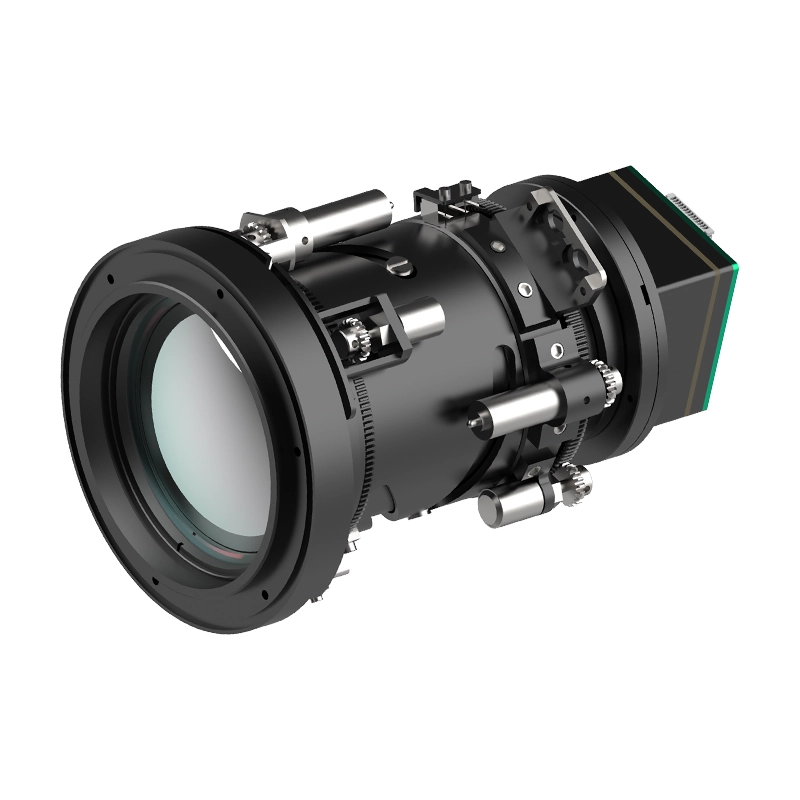
VOx microbolometer module for OEM integration · instant start, no cryocooler · GigE / USB3.0 / CameraLink / MIPI interfaces

Handheld-format thermal imaging engine · temperature measurement, surveillance and search-and-rescue applications
Why Teams Buy Infrared Cameras from AttosTek
| Complete Product RangeSWIR, MWIR and LWIR cameras and modules plus UV-VIS lines — multiple bands from a single supplier. | Quality Excellence100% factory testing before shipment, with CE and FCC certification on every camera. | Flexible CustomizationDetector, interface, cooling and housing options, accepted even for small-batch orders. | Timely Service7 × 24 support across the full lifecycle, from band selection through integration. |
Frequently Asked Questions
Is a SWIR camera a thermal camera?
No. A SWIR camera images reflected short-wave infrared photons, much as a visible camera images reflected light, so it shows material contrast rather than temperature. Only LWIR cameras — and MWIR cameras — measure radiated heat and produce a calibrated thermal image.
Why do LWIR cameras need germanium lenses while SWIR cameras use ordinary glass?
Wavelength range decides it. The 8–14 μm radiation an LWIR camera detects is blocked by glass, so its optics must be germanium or chalcogenide. SWIR photons between 0.9 and 1.7 μm pass through ordinary glass, which keeps SWIR lensing compatible with standard C-mount machine-vision optics and lowers system cost.
Which costs more, a SWIR camera or an LWIR camera?
For comparable imaging tasks, SWIR costs more. InGaAs focal plane arrays are produced in far lower volumes than the microbolometers inside long-wave infrared thermal cameras, which ship at consumer scale. The gap narrows for deep-cooled LWIR models, which add a cryocooler and move back up in price and sensitivity.
Can one camera cover both SWIR and LWIR bands?
Not in a single detector — the physics and optics differ too much, from bandgap to lens material. The practical answer is a two-camera system sharing one software platform. AttosTek supplies SWIR, MWIR and LWIR cameras with the same AttosView interface and SDK, so a combined program stays manageable.
What should I send AttosTek to get a SWIR or LWIR quotation?
Describe the target material or temperature, the scene size and working distance, and the resolution and interface you need. The team returns a configuration with a CIF quotation that includes freight and insurance but excludes destination duty, import tax and VAT; logistics is a flat 50 USD within Asia and 100 USD elsewhere.
Not Sure Whether You Need SWIR or LWIR? Ask Us.
Send the target material or temperature, working distance and interface requirements to the AttosTek customization team and receive a band recommendation with a CIF quotation — freight and insurance included, destination duty, import tax and VAT excluded. Small-batch customization is welcome, and DHL or FedEx shipping applies a flat logistics fee of 50 USD within Asia and 100 USD elsewhere.
Sales: sales@attostek.com · (+86) 130 4111 6989
Support: support@attostek.com · (+86) 156 5912 7889