Cooling changes three things in an InGaAs camera: dark current, usable exposure time and the faintest signal you can recover. An uncooled InGaAs camera draws about 2 W, weighs tens of grams and starts instantly, which suits bright, short-exposure industrial work. A cooled InGaAs camera holds the image sensor below ambient with a thermoelectric cooler or a deep-cooled stage, cutting dark current by an order of magnitude so exposures can stretch from milliseconds to seconds. Neither design is better in the abstract — the application decides, and the numbers make the choice obvious.
Key Takeaways
- Cooling buys exposure time, not resolution. In a cooled InGaAs camera dark current falls as the image sensor chills; one 1.3 MP model drops from 638 e/s at 20°C to 383 e/s at 0°C, which is what makes multi-second exposures usable.
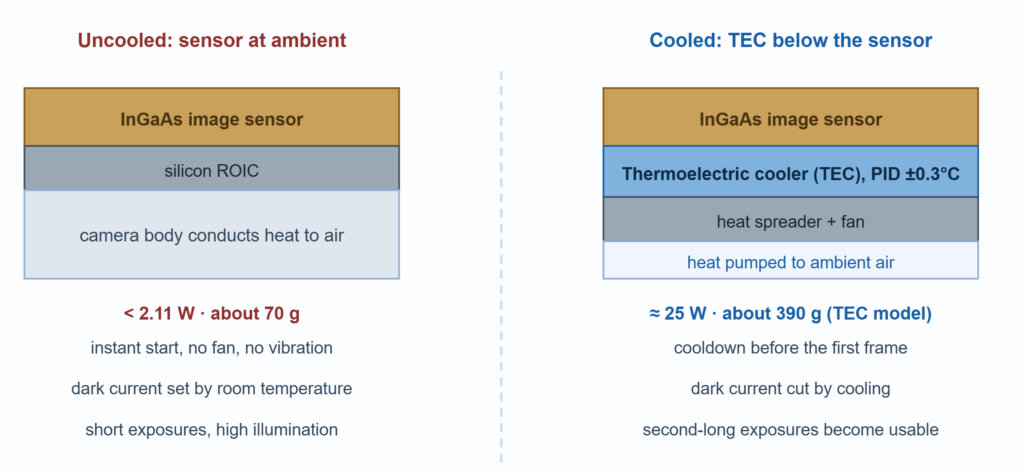
- Uncooled wins on size, power and startup. An uncooled USB3.0 model draws under 2.11 W and weighs about 70 g, against roughly 25 W and 390 g for a TEC-cooled camera in the same family.
- Deep cooling is a different class. A camera holding the sensor at -50°C reaches 22.8 e- readout noise at high gain, a noise floor no uncooled design approaches on a long exposure.
- Match cooling to illumination. Bright, millisecond-scale inspection on a moving line rarely needs a cooler, while photon-starved work with second-long exposures almost always does.
- Do not let cooling pick your interface. Cooled and uncooled models both ship USB3.0, GigE, CoaXPress and CameraLink options, so choose the cooling first and the interface second.
1. Understanding Cooled and Uncooled InGaAs Camera Technologies
An InGaAs camera is built around a short-wave infrared image sensor: a two-dimensional array of indium gallium arsenide photodiodes, bonded pixel by pixel to a silicon readout integrated circuit. The photodiodes convert 900–1700 nm photons into charge, and the ROIC integrates, amplifies and digitises it. That same structure serves both designs — what separates them is how the sensor is held thermally.
In an uncooled InGaAs camera the sensor sits at ambient temperature and heat leaves through the body. There is no cooler, no fan and no wait, so the camera produces an image immediately. In a cooled InGaAs camera, a Peltier thermoelectric cooler sits under the sensor, driven by a PID loop that holds the setpoint to within about 0.3°C, with a heat spreader and fan dumping the pumped heat into the air. The sensor can therefore be held roughly 40°C below ambient, or at a fixed point such as -10°C or -20°C. Deep-cooled cameras go further, holding the sensor at -50°C and, in the deep-cooled family, -80°C; those bodies are larger and use a dedicated supply because the cooling load dominates power draw.
2. Core Technical Differences Between Cooled and Uncooled InGaAs Camera
The differences that matter in a specification are dark current, exposure headroom, power, mass and startup. Spectral range is not one of them: cooled and uncooled models built on the same InGaAs process both cover 900–1700 nm, and the wideband variants reach 400–1700 nm. What cooling changes is the noise floor at long exposure, and the price is a cooler, a fan, a larger body and a longer wait before the first frame.
The uncooled side of AttosTek’s line shows how small the trade can be made: the uncooled USB3.0 models from 0.33 to 5 MP measure 33 mm × 33 mm × 38 mm, weigh 70 g and run on less than 2.11 W, which makes them the natural choice for handheld instruments and portable inspection. The cooled equivalents in the same family accept a higher power budget in exchange for a much lower dark current, and the deep-cooled versions accept more still.
| Attribute | Uncooled (USB3.0) | TEC-cooled | Deep-cooled |
|---|---|---|---|
| Sensor | Sony IMX990/991/992/993 InGaAs | Sony IMX990 InGaAs | InGaAs CMOS |
| Typical format | 0.33–5 MP, 5 μm / 3.45 μm pixels | 1.3 MP, 1280 × 1024, 5 μm pixels | 0.33 MP, 640 × 512, 15 μm pixels |
| Spectral range | 400–1700 nm | 400–1700 nm | 900–1700 nm |
| Cooling | None — sensor at ambient | TEC, setpoint near -10°C at a 20°C ambient | -50°C guaranteed at a 20°C ambient (down to -80°C in the deep-cooled family) |
| Exposure range | 15 µs – 60 s | 15 µs – 60 s | 16 µs – 5 s |
| Power | < 2.11 W, USB bus powered | < 25 W including cooling | 8.4 W TEC off / < 16 W TEC on |
| Mass and size | 70 g, 33 × 33 × 38 mm | < 390 g | 1.31 kg, 137.8 × 100 × 100 mm |
| Interface | USB3.0 | USB3.0 / GigE / CoaXPress / CameraLink | USB3.0 |
| Best fit | Handheld, portable and high-speed lines | Industrial inspection and spectroscopy | Fluorescence, NIR-II and ultra-low-light research |
3. Noise Performance: How Cooling Technology Reduces Image Noise
Total noise in an InGaAs image sensor has three parts: shot noise from the signal itself, read noise from the ROIC, and dark current generated thermally inside the photodiodes. Cooling touches only the third, but that is the term that grows with exposure time and eventually overwhelms everything else. Read noise stays where the ROIC puts it — 211 e on a cooled InGaAs camera in this class, and 22.8 e- at high gain on a deep-cooled design.
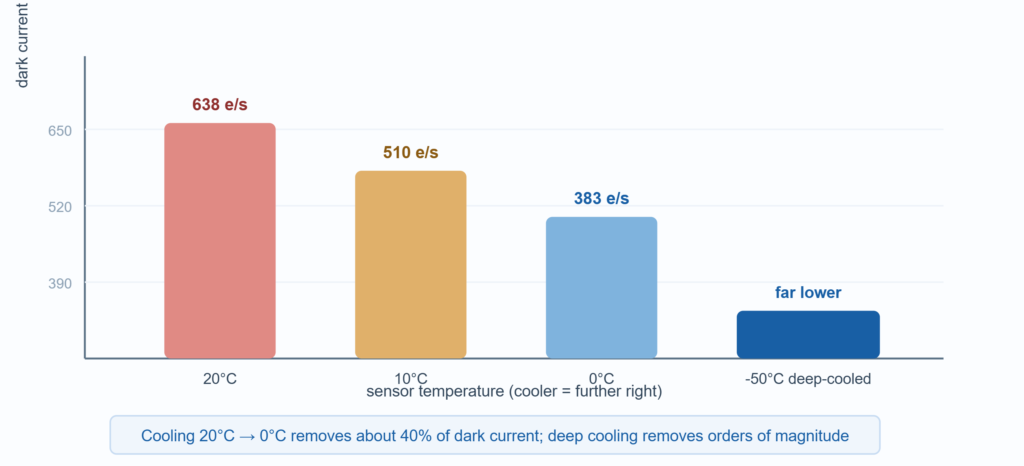
Dark current roughly doubles for every 7–8°C of warming, so a modest temperature change produces a large noise change. The measured behaviour is clear: the same 1.3 MP InGaAs camera generates 638 e/s of dark current at 20°C, 510 e/s at 10°C and 383 e/s at 0°C. Cooling the sensor by 20°C removes about 40% of the dark current, and because dark-current shot noise scales with the square root of the accumulated charge, the benefit compounds over a long exposure. Hold the sensor at -50°C instead and the reduction is measured in orders of magnitude rather than percent, which is why a deep-cooled 900–1700 nm SWIR camera can integrate for seconds without the frame filling with thermal noise.
| Sensor temperature | Dark current | What it means in practice |
|---|---|---|
| 20°C (uncooled, room temperature) | 638 e/s | Fine for short exposures; long integrations fill with thermal noise |
| 10°C | 510 e/s | Light cooling already trims the noise floor |
| 0°C | 383 e/s | About 40% less dark current than at 20°C; multi-second exposures become practical |
| -50°C and below (deep-cooled stage) | Orders of magnitude lower | Second-long fluorescence and NIR-II integration without a thermal-noise floor |
4. How Cooling Affects Exposure Time and Imaging Quality
Exposure range on paper can mislead, because a range is not the same as a usable range. An uncooled InGaAs camera and a cooled InGaAs camera can both quote 15 µs to 60 s, yet the longest frames are only useful when dark current stays small relative to the signal. Dark current accumulates in proportion to exposure time, so at 60 s an uncooled sensor may collect more thermal electrons than photoelectrons. Cooling is what converts a 60 s setting from a specification into a measurement.
Imaging quality follows the noise floor. Lower dark current means better contrast in dim scenes, fewer hot pixels that drift with temperature, more stable grey levels between frames and a dynamic range that holds up as integration lengthens. The deep-cooled case shows the effect clearly: a 640 × 512 sensor at -50°C combines 22.8 e- readout noise with a 55.8 dB dynamic range at high gain and stores up to 12 groups of dark-field correction in hardware, which is what makes weak NIR-II fluorescence visible against tissue autofluorescence.
What cooling does not do is freeze motion. A long exposure blurs a moving part no matter how cold the sensor runs. Where speed is the requirement, a TEC-cooled 1.3 MP 400–1700 nm InGaAs camera with a short exposure and a global shutter, or an uncooled high speed InGaAs camera with region-of-interest readout up to 8000 fps, is the right tool. Cooling and speed solve different problems. Handheld thermal monoculars make the same trade in a different band: they are uncooled LWIR instruments that give up sensitivity for a body you can carry and power from a battery.
5. Cooled or Uncooled InGaAs Camera: Which Is Best for Your Industrial Application?
Choose cooling from the signal, not from the price list. If the scene is brightly lit, the exposure is measured in microseconds to a few milliseconds and the part is moving, an uncooled InGaAs camera is almost always the correct answer: it starts instantly, mounts anywhere and does not add a fan to a clean production environment. On a sorting line that same short exposure is what lets a high speed InGaAs camera run at full frame rate with no cooler at all. If the exposure needs to reach hundreds of milliseconds or seconds, if the illumination is weak, or if the measurement depends on a repeatable noise floor, cooling pays for itself.
The middle ground is worth stating plainly. A TEC-cooled camera at a -10°C or -20°C setpoint covers the large majority of industrial inspection and spectroscopy work, because it removes most of the dark current without the mass, cost and cooldown time of a deep-cooled system. Reserve the -50°C and -80°C class for photon-starved applications — fluorescence imaging, NIR-II probes, deep-tissue work — where the signal sits at the edge of detection. The same reasoning explains why thermal monoculars are built uncooled: once an instrument leaves the bench, readiness and battery life matter more than the last decibel of sensitivity.
| Application | Typical exposure | Recommended cooling | Why |
|---|---|---|---|
| High-speed sorting and inline inspection | microseconds to milliseconds | Uncooled | Short integration keeps dark current negligible; low power and no fan matter more |
| Handheld and portable instruments | milliseconds | Uncooled | 70 g, USB powered and instant start make battery operation practical |
| Silicon and semiconductor inspection | milliseconds to hundreds of ms | Uncooled or TEC-cooled | Decide on contrast requirements rather than on cooling alone |
| Offline spectroscopy and moisture mapping | hundreds of ms to seconds | TEC-cooled | Dark current would otherwise compete with the absorption signal |
| Fluorescence, NIR-II and deep-tissue imaging | seconds | Deep-cooled (-50°C to -80°C) | Only deep cooling makes weak emission visible over thermal noise |
6. Conclusion
The cooled versus uncooled question has a measurable answer. Cooling reduces dark current — from 638 e/s at 20°C to 383 e/s at 0°C on a 1.3 MP sensor, and by orders of magnitude at -50°C — and that reduction is what extends usable exposure from microseconds to seconds. Uncooled designs win on power, mass and instant startup, which is why they dominate handheld instruments, inline sorting and any application where the exposure stays short. Cooled designs win whenever the signal is faint, and deep cooling is the only option when the exposure runs into seconds. Where the requirement is throughput rather than faintness, a high speed InGaAs camera reaches its full frame rate with no cooler at all.
AttosTek builds both ends of that range and everything between: the full range of cooled and uncooled SWIR cameras spans 300–2700 nm, with formats from 0.33 to 5 MP, cooling from none to -80°C, and USB3.0, GigE, CoaXPress or CameraLink interfaces. Every unit is 100% factory tested and CE/FCC certified, and every camera ships with AttosView software plus an SDK for C/C++, C#/VB.NET, Python and Java. Describe your target, wavelength, expected exposure and line speed to the AttosTek customization team for a configuration and a CIF quotation, including small-batch builds.
7. FAQ
Does cooling always improve InGaAs camera image quality?
No. Cooling reduces dark current, so it helps when exposures are long or the signal is faint. For bright, microsecond-scale inspection on a moving line, dark current is already negligible and an uncooled camera delivers the same image with less power, less mass and no cooldown delay. Cooling is a tool for the noise floor, not a general upgrade.
How much longer can a cooled InGaAs camera expose?
Both cooled and uncooled models can be set to 60 s, but the usable limit differs. Dark current accumulates with exposure time, so an uncooled sensor fills with thermal electrons long before a cooled one. TEC cooling makes hundreds of milliseconds to seconds practical, while deep cooling to -50°C or -80°C makes second-long fluorescence integration routine.
Is a cooled InGaAs camera worth the extra power and weight?
It depends on the measurement, not the budget alone. A TEC-cooled camera draws under 25 W and weighs under 390 g, against 2.11 W and 70 g for an uncooled USB3.0 model, and a deep-cooled unit reaches 1.31 kg with a dedicated supply. If your exposure stays in the milliseconds, the uncooled camera is the better engineering choice.
Can an uncooled InGaAs camera be used in a handheld device?
Yes. An uncooled USB3.0 model runs from the bus at under 2.11 W, measures 33 mm × 33 mm × 38 mm and weighs 70 g, so it suits portable instruments and battery-powered units. Handheld thermal monoculars are a different class of device: they use uncooled LWIR detectors rather than an InGaAs image sensor.
How do I choose between cooled and uncooled, and get a quotation?
Start from the exposure time your signal needs. Send AttosTek the target wavelength, expected exposure, resolution and frame rate, and the team returns a configuration with a CIF quotation covering freight and insurance but excluding destination duty, import tax and VAT. Logistics is a flat 50 USD within Asia and 100 USD elsewhere.