Industrial Inspection
描述
聚焦公司最新动态,追踪光电行业前沿资讯。

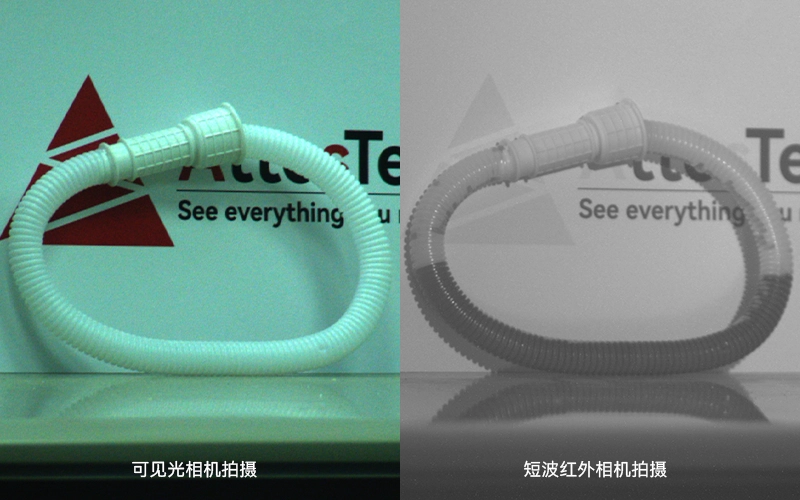
SWIR051AU SWIR Camera Imaging of Liquid Position in Opaque Plastic Tube
Project Name: Liquid Position Imaging in Opaque Container Using SWIR051AU CameraTest Date: May 2026 I. Test Objective To verify the capability of the Attostek SWIR051AU SWIR camera to perform non-contact imaging detection of internal liquid level height through the wall of an opaque plastic tube, and to compare the results with visible-light camera imaging, while evaluating the effectiveness of supplementary light sources and optical filters in improving imaging contrast. II. Application Background and Principle 2.1 Application Background In the production processes of chemical, pharmaceutical, food and beverage, and daily chemical industries, liquid level detection is a critical step in quality control. However, many industrial pipelines and containers are made of opaque plastic materials to protect the contents from light exposure or to meet structural strength requirements. Conventional visible-light cameras cannot penetrate such opaque tube walls, and the human eye cannot directly observe the internal liquid level. 2.2 Detection Principle Most plastics that are opaque in visible light have good transmittance in the short-wave infrared band. Water accounts for the majority of the liquid inside industrial pipelines. In this experiment, water was selected as the internal liquid. Water can absorb infrared light at wavelengths around 1450 nm. When captured by a…
06/21/2026

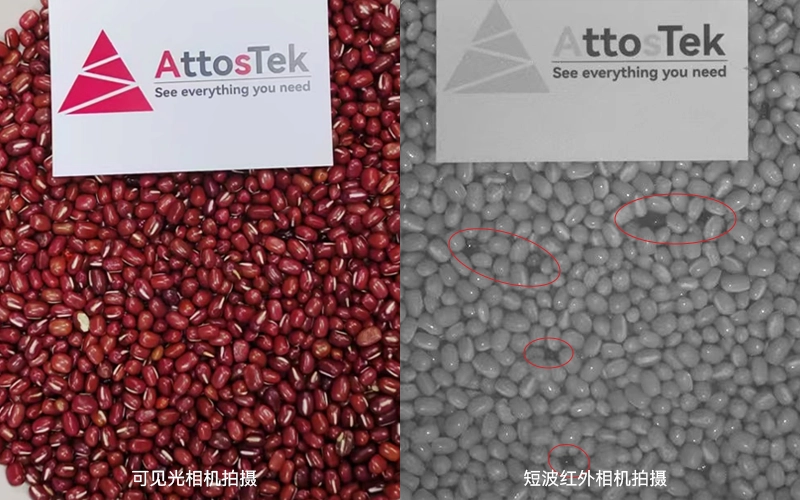
Imaging Experiment Report on Same-Color Red Beans and Pebbles Using a SWIR033AU SWIR Camera
Project Name: Imaging Experiment Report on Same-Color Red Beans and Pebbles Using a SWIR033AU SWIR CameraTest Date: May 2026 I. Test Objective To verify the imaging capability of the Attostek SWIR033AU SWIR camera in distinguishing organic material (red beans) from inorganic material (stones), and to compare the results with those of a visible-light camera. II. Application Background and Principle 2.1 Application Background In industries such as food processing, agricultural product sorting, and mineral detection, there is often a need to quickly and non-contact distinguish materials that are similar in appearance but different in nature. For example, during grain processing, inorganic impurities such as small stones may become mixed into the grain. Traditional visible-light imaging struggles to effectively distinguish them, posing a food safety risk. SWIR imaging technology offers an effective solution to this problem. 2.2 Detection Principle The imaging range of SWIR cameras is mostly 400 nm–1700 nm, capturing images through infrared light. Organic red beans and inorganic stones have different absorption levels in the SWIR band. Stones have a higher absorption rate in the SWIR band and appear dark in the image, while red beans absorb less and appear bright, thus allowing the two to be distinguished. An external…
06/13/2026

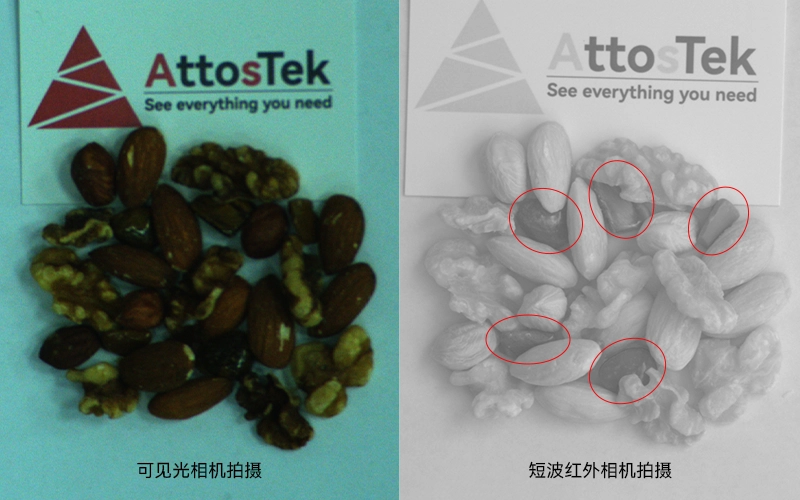
SWIR033AU SWIR Camera Imaging Experiment Report on Same-Color Nuts and Stones
Project Name: Imaging Experiment Report on Same-Color Nuts and Stones Using SWIR033AU SWIR CameraTest Date: May 2026 I. Test Objective To verify the imaging capability of the Attostek SWIR033AU SWIR camera in distinguishing organic materials (nuts) from inorganic materials (stones) of similar color, and to compare the results with those of a visible-light camera. II. Application Background and Principle 2.1 Application Background In food industries such as nut processing and grain sorting, inorganic impurities like stones are often mixed in during harvesting, drying, or transportation. Traditional manual or visible-light vision sorting systems mainly rely on color and brightness differences for identification. However, when the stones themselves are dark in color or even similar to the outer shell color of nuts (e.g., dark-colored nuts and dark-colored stones), effective distinction under visible light becomes difficult, leading to missed detections of impurities and posing food safety risks. Short-wave infrared (SWIR) imaging technology, based on the chemical composition characteristics of materials, offers a solution to this challenge. 2.2 Detection Principle The imaging range of SWIR cameras is mostly 400 nm–1700 nm, capturing images through infrared light. Organic nuts and inorganic stones have different absorption levels in the SWIR band. Stones have a higher absorption…
06/13/2026

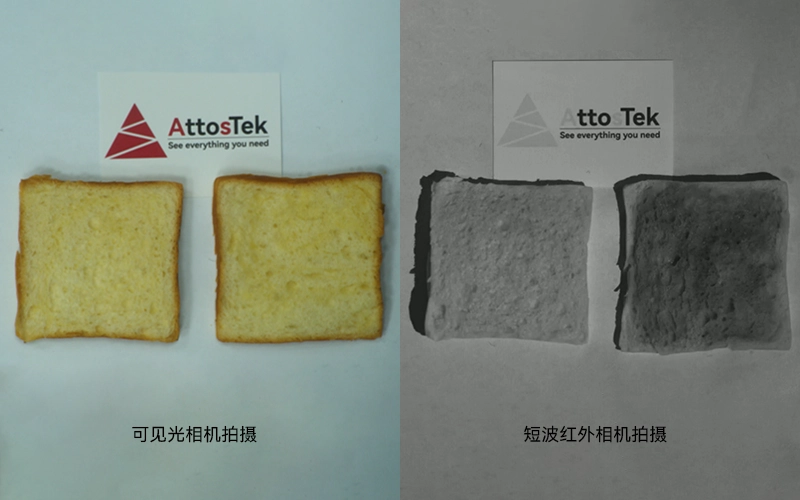
Imaging Experiment Report on Bread Freshness Inspection Using SWIR1503B10G SWIR Camera
Imaging Experiment Report on Bread Freshness Inspection Using SWIR1503B10G Short-Wave Infrared CameraTesting Period: May 2026 1. Test Purpose To verify the capability of Attostek’s SWIR1503B10G short-wave infrared (SWIR) camera to judge bread freshness by measuring bread moisture content, and compare its imaging performance with a visible-light camera. 2. Application Background & Detection Principles 2.1 Application Background Bread is a convenient and staple food for breakfast and afternoon tea, mainly made from water, wheat flour, sugar, eggs, yeast, with cream, chocolate, dairy and other additives commonly included in most varieties. Bread is prone to dehydration, and its freshness directly determines mouthfeel. As consumers pursue higher quality of life and food safety standards, there is growing demand for fresher, healthier bread products. 2.2 Detection Principle Traditional freshness assessment relies on production date labels or manual tactile pressing, which cannot deliver objective quantitative results. Bread staleness is primarily caused by moisture loss: fresh bread retains high moisture content, while prolonged storage leads to gradual water evaporation and a dry, hard texture. Water molecules strongly absorb infrared light near the 1450 nm wavelength. Leveraging this characteristic, SWIR imaging enables non-contact mapping of moisture distribution inside bread: Differences in grayscale values allow fast, intuitive evaluation…
06/13/2026

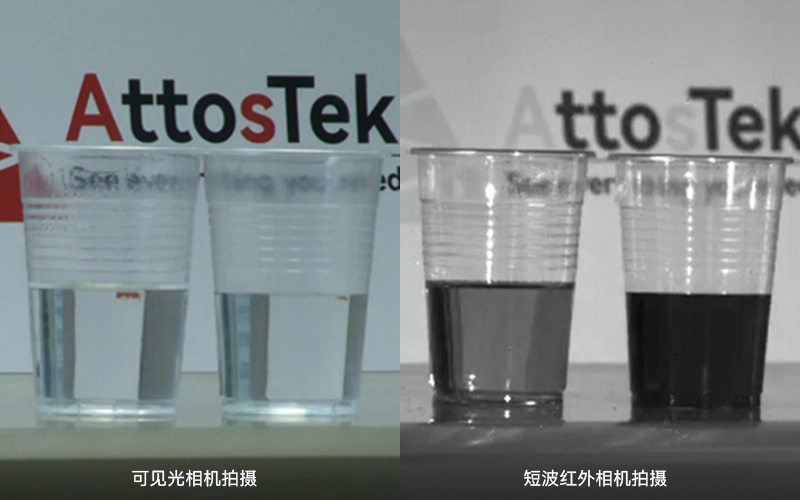
SWIR1503B10G SWIR Camera Imaging Experiment Report on Distinguishing Same-Color Oil and Water
Project Name: Imaging Experiment on Same-Color Oil and Water Using SWIR1503B10G SWIR CameraTest Date: May 2026 I. Test Objective To verify the imaging capability of the Attostek SWIR1503B10G SWIR camera in distinguishing same-color oil and water, to evaluate the feasibility of SWIR technology for liquid identification and oil-water separation detection, and to compare the results with those of a visible-light camera. II. Application Background and Principle 2.1 Application Background In industrial production, food processing, chemical storage, and environmental monitoring, there is often a need to distinguish between oil and water. For example, detecting whether moisture has mixed into pipelines, monitoring water accumulation layers in oil tanks, and assessing the effectiveness of oil-water separation in wastewater treatment. When oil and water are the same color, the naked eye and visible-light cameras cannot directly distinguish them. Short-wave infrared imaging technology, based on the different absorption characteristics of liquid molecules to infrared light, can effectively solve this problem. 2.2 Detection Principle Water exhibits strong absorption of infrared light, particularly at the 1450 nm wavelength, resulting in weak reflected signals and appearing as dark areas in the image. Oil, on the other hand, has no strong absorption characteristics in this band, and its reflected…
06/13/2026

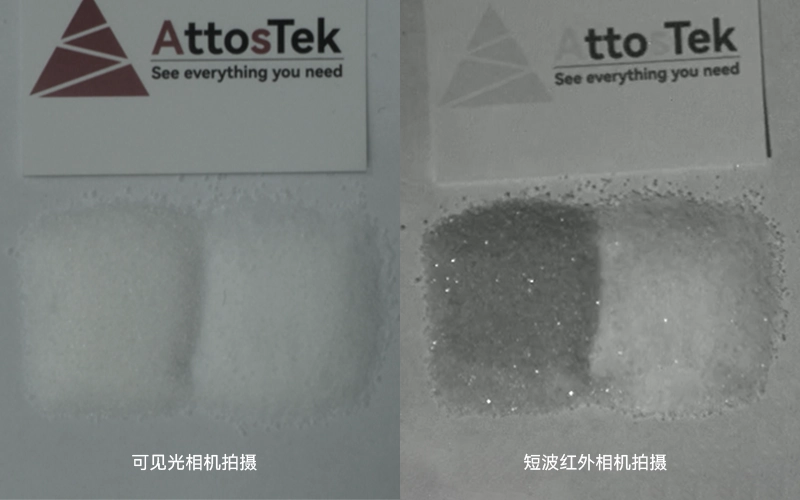
SWIR1503B10G SWIR Camera Imaging Experiment Report on Distinguishing Same-Color White Sugar and Salt
Project Name: Imaging Experiment on Distinguishing Same-Color White Sugar and Salt Using SWIR1503B10G SWIR CameraTest Date: May 2026 I. Test Objective To verify the imaging capability of the Attostek SWIR1503B10G SWIR camera in distinguishing white granular materials with highly similar appearance—sugar and salt—to evaluate the feasibility of material identification based on short-wave infrared spectral characteristics, and to compare the results with those of a visible-light camera. II. Application Background and Principle 2.1 Application Background Sugar and salt are essential daily necessities, providing taste and energy and serving as indispensable elements. However, under visible light conditions, both appear as white or colorless transparent crystals, making it difficult for the naked eye to distinguish between them. This can easily lead to production mixing, packaging errors, and other issues. Short-wave infrared cameras operate in different spectral bands and can effectively differentiate materials with different chemical compositions. 2.2 Detection Principle At the microscopic level, sugar and salt have different crystal structures, making them easy to distinguish. Due to these structural differences, they exhibit different absorption spectra in the infrared band: sugar absorbs infrared light, while salt absorbs almost none. Based on this phenomenon, an infrared camera can capture reflected light of different intensities, producing…
06/13/2026

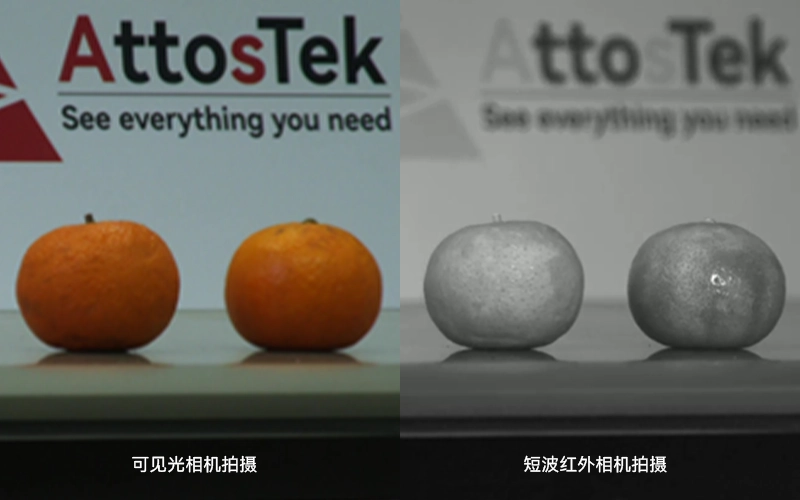
SWIR051AU SWIR Camera Orange Quality Inspection Experiment Report
Project Name: Orange Damage Imaging Using SWIR051AU CameraTest Date: May 2026 I. Test Objective To verify the capability of the Attostek SWIR051AU camera in detecting fruit (orange) damage. Based on the distinguishing ability of short-wave infrared imaging, water absorbs SWIR light, and the damaged area of an orange has a higher water content. The SWIR camera was used to photograph healthy and damaged oranges, and the results were compared with those of a visible-light camera. II. Application Background and Principle 2.1 Application Background Oranges are a very common fruit in our daily lives, rich in various vitamins and beneficial to human health. However, during transportation and storage, subcutaneous bruises caused by squeezing, bumping, and other impacts are often hidden beneath the bright peel and are difficult to detect with the naked eye. If these early-stage damages are not screened out in time, they not only affect eating quality but may also lead to mold growth, causing batch losses. 2.2 Detection Principle The local tissue cells at the bruised area of an orange rupture, and juice penetrates into the peel, resulting in a higher water content in the damaged area. Water can absorb infrared light near the 1450 nm wavelength. Therefore,…
06/13/2026

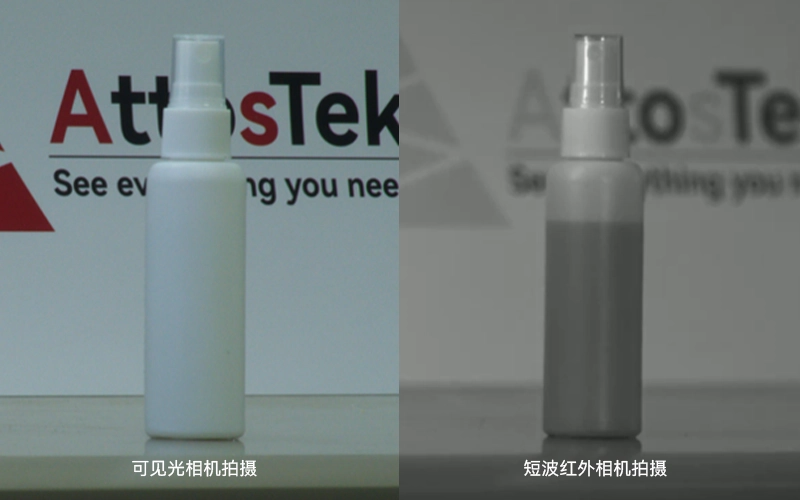
SWIR051AU SWIR Camera Imaging Experiment on Liquid Level in Opaque Containers
Project Name: Liquid Level Imaging in Opaque Containers Using SWIR051AU CameraTest Date: May 2026 I. Test Objective To verify the capability of the Attostek SWIR051AU SWIR camera to detect liquid level inside opaque plastic bottles using SWIR imaging technology, and to compare the results with those of a visible-light camera, while evaluating the effectiveness of supplementary light sources and optical filters in improving imaging contrast. II. Application Background and Principle 2.1 Application Background Plastic spray bottles and cleaning agent containers are common items in daily life. Such packaging often uses light-blocking or opaque designs to protect the stability of the contents. However, this also prevents consumers and production line quality inspectors from determining the remaining liquid volume or whether filling is qualified through the naked eye or ordinary cameras. 2.2 Detection Principle Most plastics that are opaque in visible light (such as HDPE and PP) have good transmittance in the short-wave infrared band (SWIR, 900–1700 nm). Water can absorb infrared light at wavelengths around 1450 nm. A SWIR camera can image the liquid inside the bottle to determine the liquid content. Areas with liquid appear as dark regions due to strong absorption of light by water molecules and weak reflected…
06/13/2026

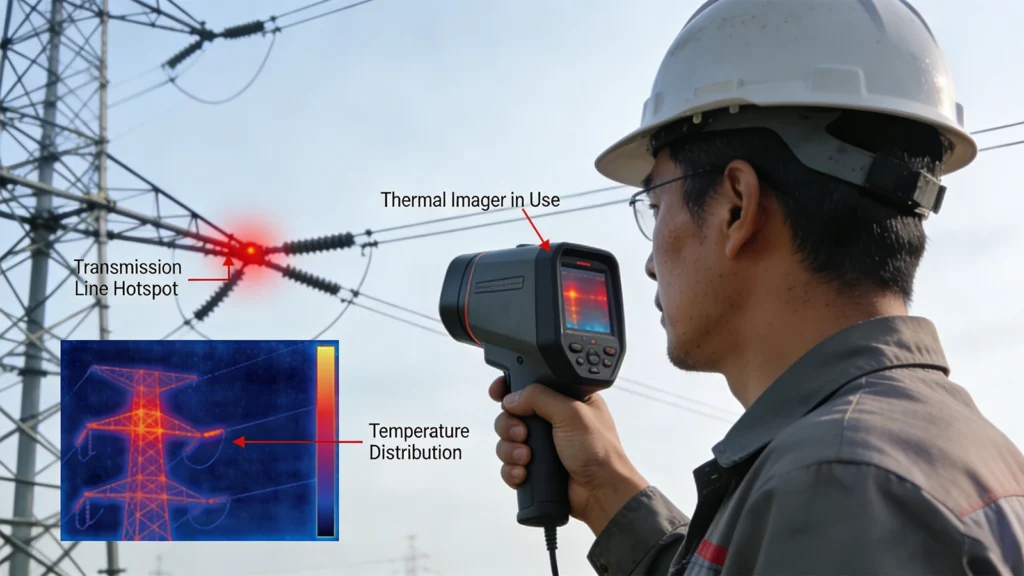
LWIR Solutions for Substation, Distribution, and Transmission Status Monitoring
Long-wave infrared technology is widely applied in the power industry. Attostek's LWIR camera products offer accurate temperature measurement and high reliability, providing mature solutions for substation, distribution, and transmission systems.
04/27/2026
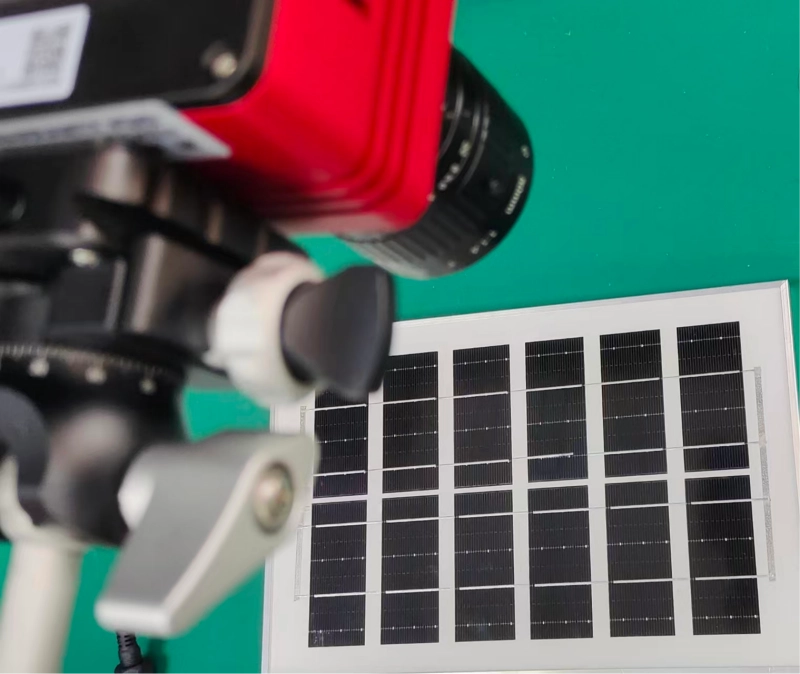
SWIR Camera Applications in Solar Panel Production Lines
Attostek SWIR cameras provide high-precision defect detection solutions for solar panel production lines, capable of detecting minute physical defects, solder joint issues, and internal structural anomalies while ensuring product quality through non-destructive testing methods.
03/27/2026