0.33 MP 15 μm Pixels 900-1700nm SWIR Camera
| Features |
| The spectral response range covers 900–1700 nm. |
| 640×512resolution,15 μm pixel size |
| Global shutter, high-speed acquisition |
| Hardware ROI & external triggering |
| 512MB cache Model-Dependent |
| CE/FCC Cerifcation,Multi-platform SDK |
| Common Specifications | |
| Sensor type | InGaAs CMOS |
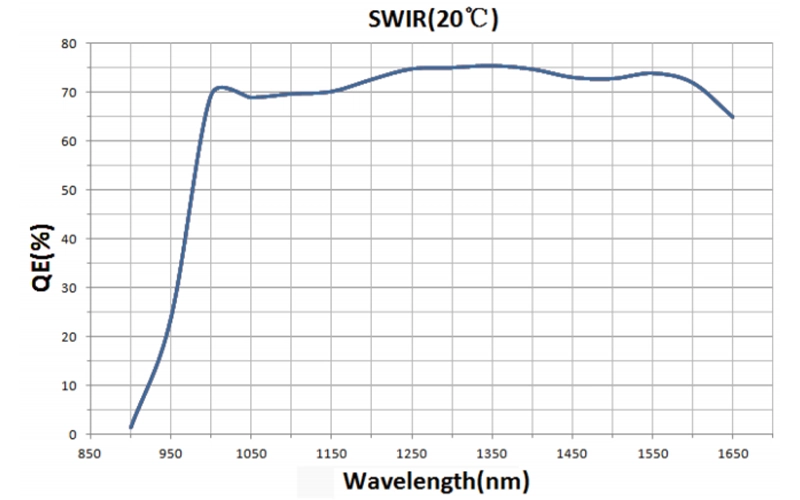
| Spectral Range | 900nm – 1700nm |
| Resolution | 0.33MP (640×512) |
| Pixel Size | 15 µm x 15 µm |
| Sensor Size | 3/4″ |
| Image Buffer | 512MByte |
| QE | 75%@ 1350nm |
| Dark current | 30fA@0.1V&18℃ |
| Shutter Mode | Global shutter |
| Cooling emperature | -20°C TEC cooling (ambient temperature 20°C) |
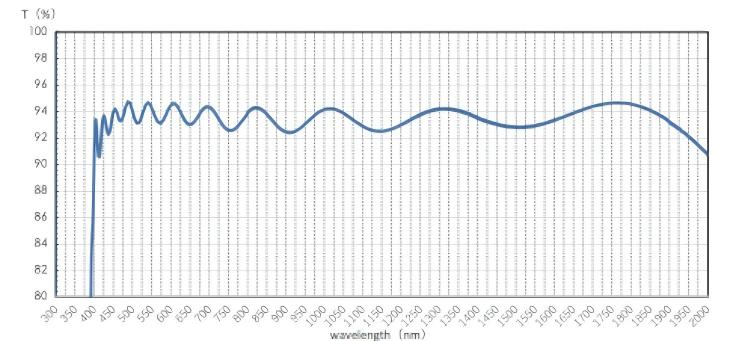
| Optical Filter | 400-1800nm (Standard) |
| Power consumption | 8.4W (TEC OFF ) / <16W (TEC ON ) |
| Operating Temperature | -30 °C to +60 °C |
| Storage Temperature | -40 °C to +85 °C |
| Humidity | 20%-80% , non-condensing |
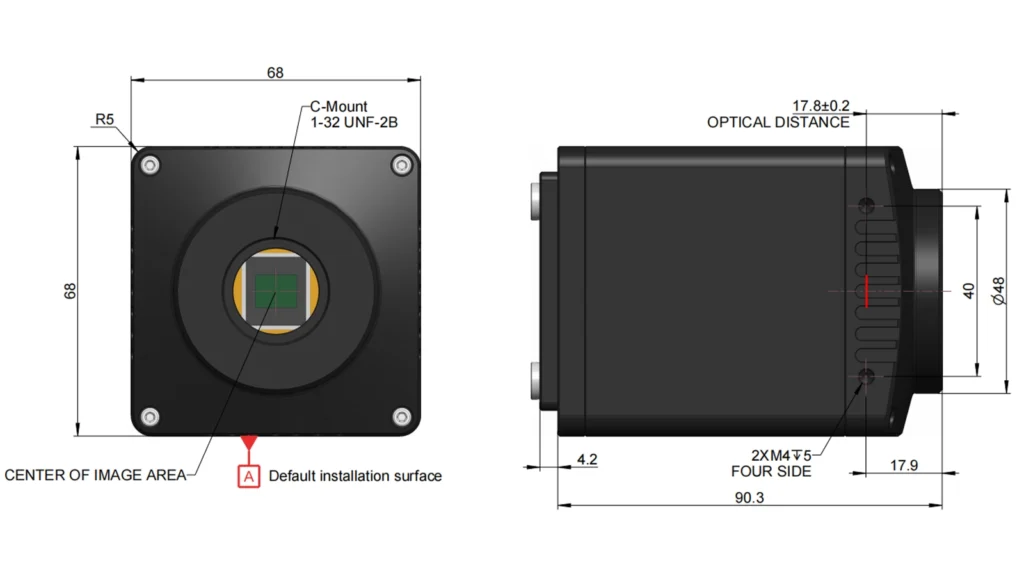
| Size | 68mm×68mm×90.3mm |
| Weight | 485g |
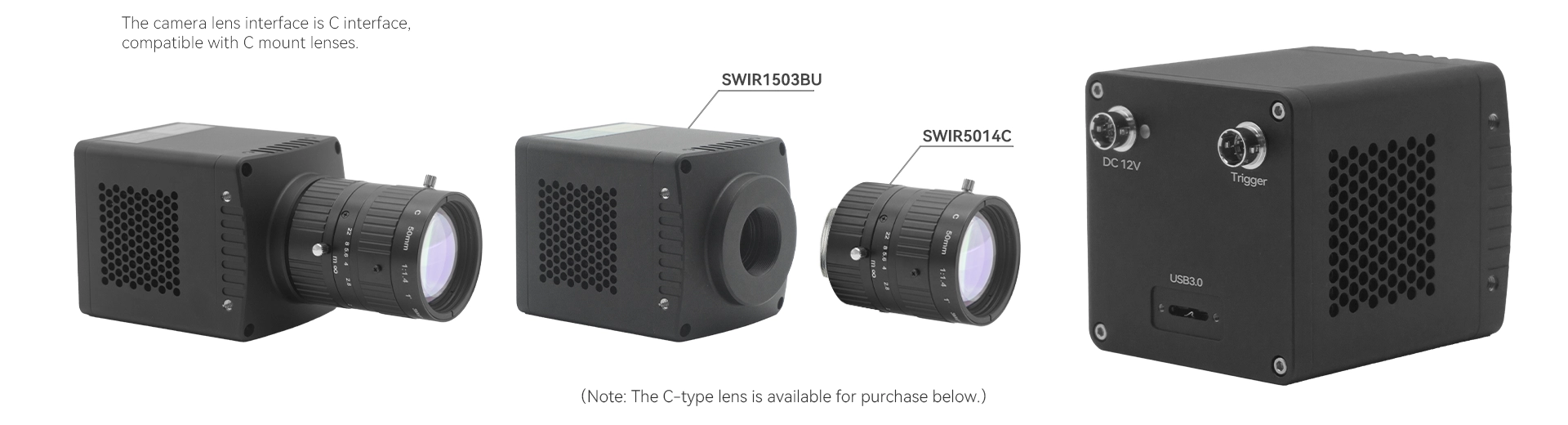
| Lens mount | C-mount |
| Software | AttosView / SDK |
| Certification | CE, FCC |
| Parameter | Specification |
| Size | 68*68*90.3mm |
| Mount | C mount |
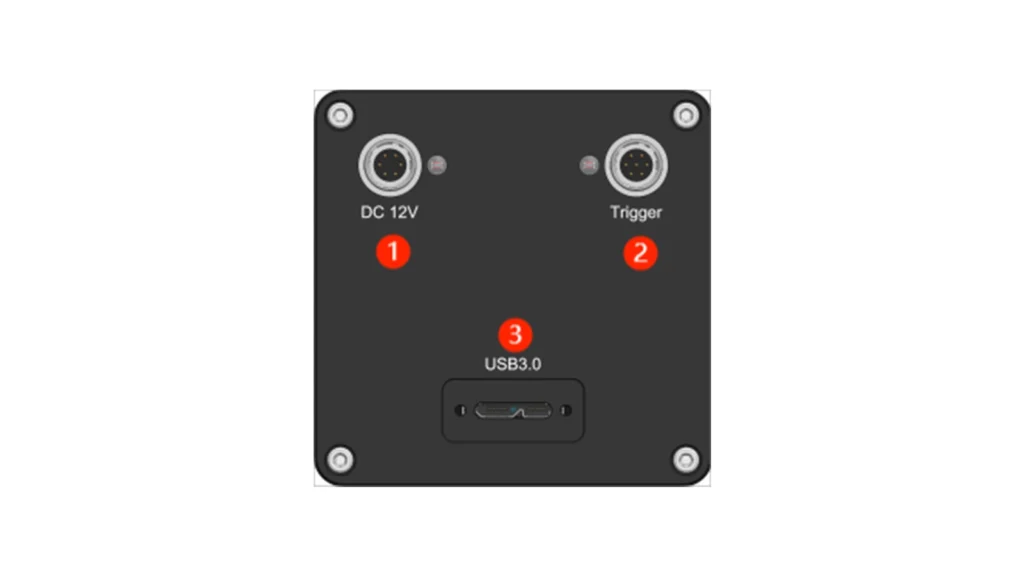
| Item | Specification |
| 1 | DC 12V power |
| 2 | External IO connection port |
| 3 | USB3.0 port |
| Parameter | Specification |
| Size | 68*68*90.3mm |
| Mount | C mount |
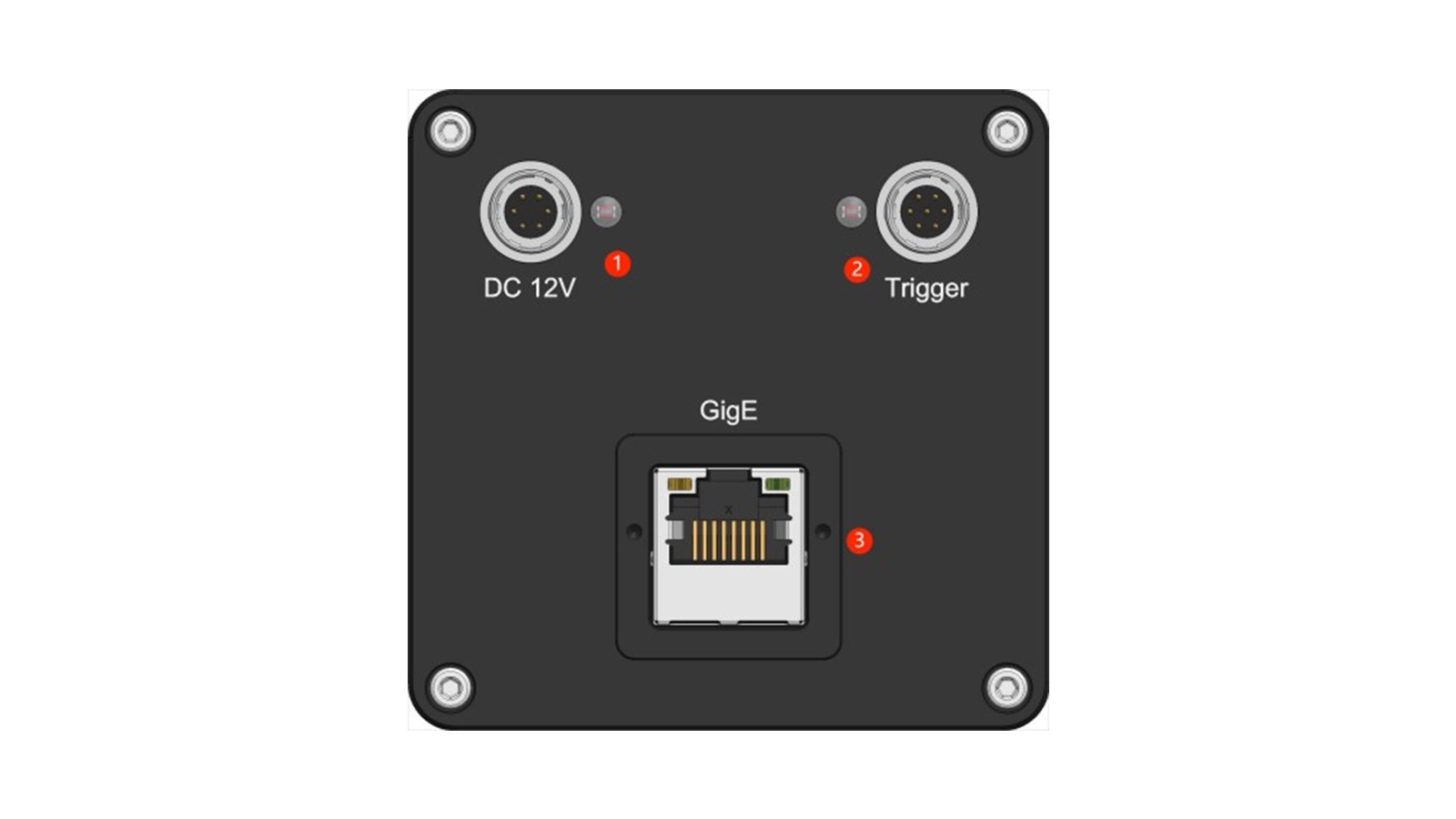
| Item | Specification |
| 1 | DC 12V power |
| 2 | External IO connection port |
| 3 | GigE port |
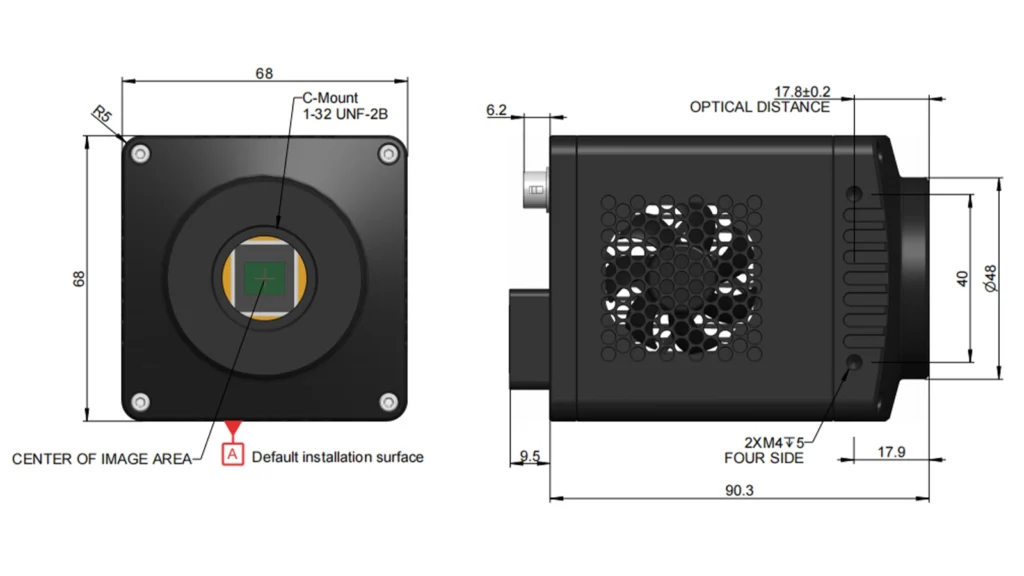
| Parameter | Specification |
| Size | 68*68*90.3mm |
| Mount | C mount |
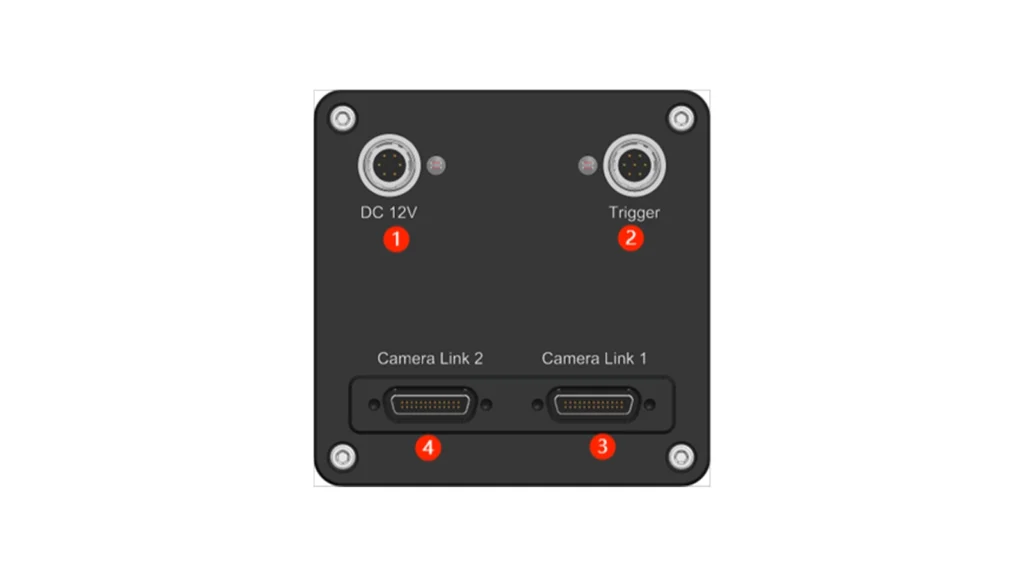
| Item | Specification |
| 1 | External IO connection port |
| 2 | DC 12V power |
| 3 | CameraLink1 |
| 3 | CameraLink2 |
| Table1: USB port, GigE port, CL port refrigerated camera pin signal definitions | |||||
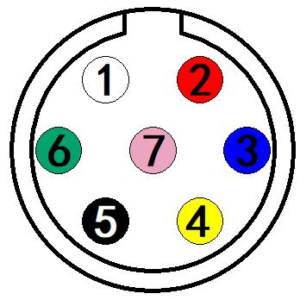 |
Color | Pin | Signal | Description of the signal | |
| White | 1 | GDN | Direct-coupled signal ground | ||
| Red | 2 | 12V | 12VDC power input | ||
| Blue | 3 | OPTO_GND | Opto-isolated signal ground | ||
| Yellow | 4 | DIR_GPIO0 | Direct-coupled General Purpose I/O (Software configurable input/output) (line2) | ||
| Black | 5 | DIR_GPIO1 | Direct-coupled General Purpose I/O (Software configurable input/output) (line3) | ||
| Green | 6 | OPTO_IN | Opto-isolated input signal (line0) | ||
| Pink | 7 | OPTO_OUT | Opto-isolated output signal (line1) | ||


The electrical characteristics of the opto-isolated output (external voltage 5V, external resistor 1K) are shown in Table 2.
| Table 2: Opto-isolated output signal’s electrical characteristics | ||
| Parameter name | Parameter notation | Parameter value |
| Output logic low | VL | 742mV |
| Output logic high | VH | 4.134V |
| Output rise time | TR | 4us |
| Output fall time | TF | 1.8us |
| Output rise delay | TDR | 12us |
| Output fall delay | TDF | 2us |
The output of the corresponding output current and VL when using different voltages and resistors in externalcircuit are shown in Table 3.
| Table 3:Opto-isolated output logic’s low levels parameters | |||
| External voltage | External resistor | VL | Output current |
| 3.3V | 1KΩ | 510mV | 2.82mA |
| 5V | 1KΩ | 742mV | 4.31mA |
| 12V | 2.4KΩ | 795mV | 4.68mA |
| 24V | 4.7KΩ | 850mV | 4.97mA |
1. Line2/line3 is set as input pin
Logic 0 input level: 0~0.6VDC (DIR_GPIO0/DIR_GPIO1 pins)
Logic 1 input level: 2.0~24VDC (DIR_GPIO0/DIR_GPIO1 pins)
Maximum input current: 25mA
When the input level is between 0.6V and 2.0V, the circuit action state is uncertain, please avoid the input voltage range working in this range.
To prevent damage to the GPIO pins, please connect the pin GND first, and then input voltage to the Line2 pin.
Input rise delay (TDR): 0.02us
Input fall delay (TDF): 0.02us
2. Line2/line3 are set as output pins
The maximum current allowed through this pin is 25mA.
The external pull-up voltage is 5V, the pull-up resistor is 1KΩ, and the GPIO is configured to output the logic level and electrical characteristics as shown in Figure 4.


When the ambient temperature is 25 degrees Celsius, the relationship between the external voltage, resistance and low-level voltage output is shown in Table 4.
| Table 4:Non-isolated output Logic’s low level parameters | ||
| External voltage | External resistor | VL(GPIO) |
| 3.3V | 1KΩ | 0.11V |
| 5V | 1KΩ | 0.167V |
| 12V | 2.4KΩ | 0.184V |
| 24V | 4.7KΩ | 0.385V |
| Table 5: Non-isolated output electrical characteristics | ||
| Parameter name | Parameter notation | Parameter value |
| Output rise time | TR | 0.08us |
| output fall time | TF | 0.02us |
| Output rise delay | TDR | 0.1us |
| Output fall delay | TDF | 0.04u |
ascamsdk support a variety of APIs, including: Native C/C++,.NET/C#/VB.NET, Python, Java, DirectShow, Twain, LabView, Matlab, etc. Compared with other APIs, Native C/C++ API as a low-level API is characterized by using pure C/C++ development without relying on other runtime libraries. The interface is simple and the control is flexible.
AttosTek provides extensive third-party software support for its UV-Vis cameras and SWIR cameras, facilitating rapid integration and use in various development environments. This includes SDK and demo programs for LabVIEW and MATLAB, as well as DirectShow drivers, Micromanager, and TWAIN SDK drivers. These features enable seamless compatibility with mainstream development environments and third-party software, greatly simplifying the workflow for system integration and secondary development.
|
AttosView Recommended System Requirements |
|
|
Operating System |
Microsoft® Windows® XP / Vista / 7 / 8 /10 /11(32 & 64 bit), Mac OSX, Linux |
|
Processor (CPU) |
≥3.0 GHz Intel Core i5 or Higher |
|
Memory (RAM) |
≥8 GB |
|
Hard Drive |
NVMe Solid State Drive (SSD) |
|
Graphics Card |
Dedicated Adapter with ≥256 MB RAM |
|
Motherboard |
USB 3.0 (-USB) Cameras: Integrated Intel USB 3.0 Controller or One Unused One Unused PCle3.0*16 Slot |
|
Connectivity |
Internet Connectivity for Driver Installation |
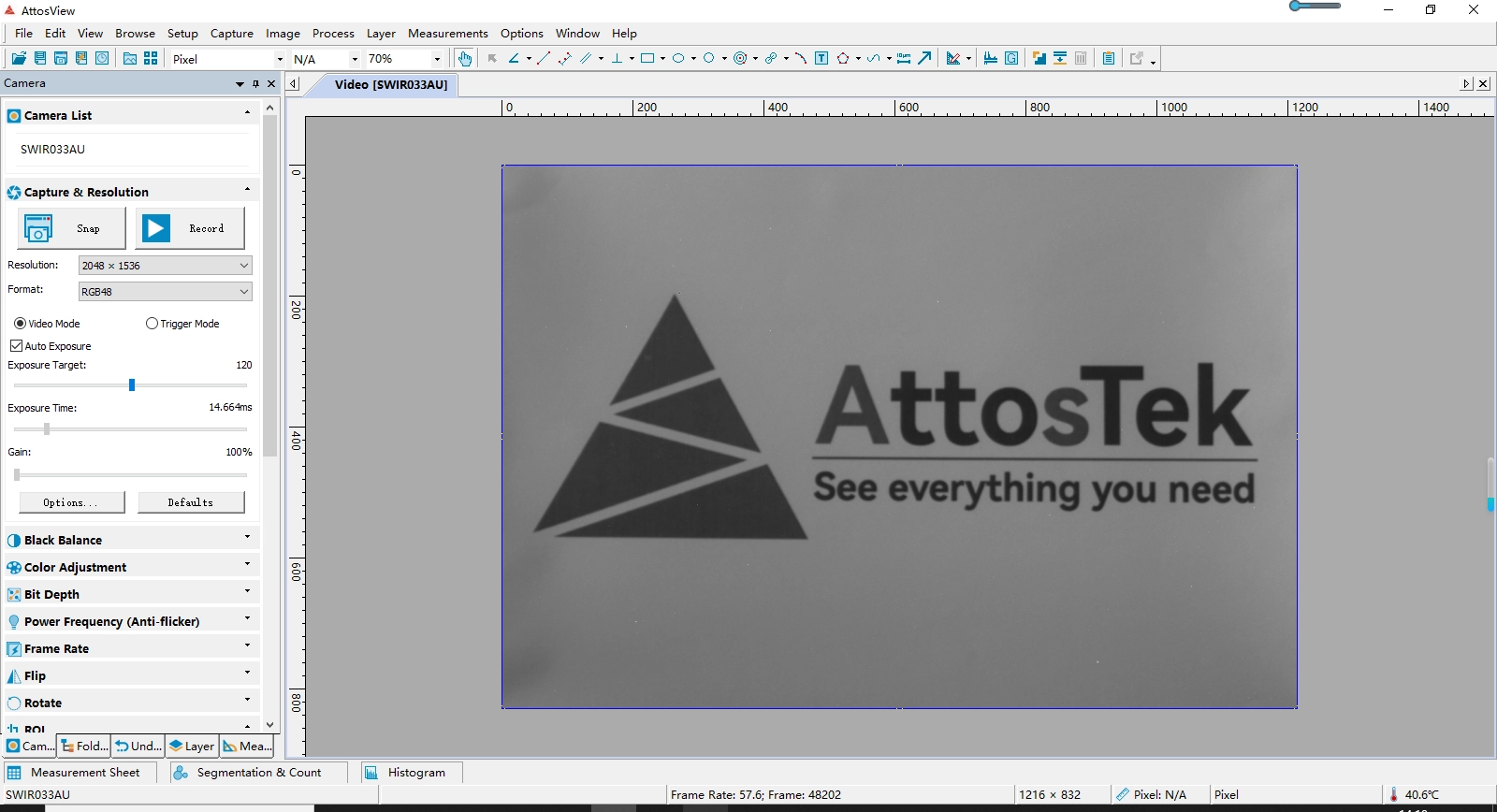
|
Function |
Function description |
|
Operating mode |
Operating mode: video mode or trigger mode |
|
Denoise |
The camera hardware incorporates denoise |
|
Automatic exposure |
Automatic exposure or manual exposure function |
| Gain |
HG, MG, LG 3 gain modes |
|
Frame rate |
Supports precise frame rate control |
|
ROI |
Supports single-zone ROI with a maximum frame rate of 8000fps after ROI |
| Flip |
Supports Vertical/horizontal flip |
| Custom dark field correction |
The hardware supports up to 12 groups of user-defined dark field correction image functions |
|
Timestamp function |
Timestamps can be turned on or off. After the timestamp function is enabled, the low 8bits of 1-8 pixels, 9-16 pixels, and 17-24 pixels will be modified to: 0-7: frame number; 8-15: Frame time; 16-23: trigger signal count |
|
Firmware update |
Supports firmware online update |
|
Pipette function |
Supports the display of the gray value of the mouse pixel position |
|
Histogram display |
Supports histogram display and statistics |
| Plane line function |
Supports the function of viewing surface data |
|
Regional gray statistics |
Support the average gray statistics function of user-defined areas |
|
Cooling system |
1) The cooling system of the camera uses a built-in TEC cooling chip for the sensor, with external heat dissipation structure and fan auxiliary heat dissipation, the working temperature can be adjusted to a specific value, the effective cooling temperature can be lower than the ambient temperature of 40℃, and the high-efficiency cooling system ensures extremely low dark current level; |
问1:为什么高灵敏度相机在数字显微镜中更受欢迎
高灵敏度相机之所以被青睐,是因为它们能够探测和捕捉极低光信号,提升数字显微镜中的图像质量和实验灵活性,克服传统显微镜的局限。
问2:什么是可见光相机?
可见光相机是一种成像设备,旨在仅利用电磁波谱中可见的部分(波长约400–700纳米)来捕捉图像或视频,这与人眼可探测的范围相同。
问3:相机USB3.2接口和10GigE接口有什么区别?
相机USB3.2和10GigE接口的核心区别在于设计目标:USB3.2追求在短距离内的高速、简单连接;而10GigE则旨在实现远距离、高带宽的稳定数据传输,并具备强大的组网能力,支持长距离工作。
问4:UVISI064系列相机适合哪些应用?
它们广泛应用于生物显微镜、荧光成像、快速天体检测、天文学、X射线成像、冷原子研究及其他精密科学场景。
问1:为什么高灵敏度相机在数字显微镜中更受欢迎
高灵敏度相机之所以被青睐,是因为它们能够探测和捕捉极低光信号,提升数字显微镜中的图像质量和实验灵活性,克服传统显微镜的局限。
问2:什么是可见光相机?
可见光相机是一种成像设备,旨在仅利用电磁波谱中可见的部分(波长约400–700纳米)来捕捉图像或视频,这与人眼可探测的范围相同。
问3:相机USB3.2接口和10GigE接口有什么区别?
相机USB3.2和10GigE接口的核心区别在于设计目标:USB3.2追求在短距离内的高速、简单连接;而10GigE则旨在实现远距离、高带宽的稳定数据传输,并具备强大的组网能力,支持长距离工作。
问4:UVISI064系列相机适合哪些应用?
它们广泛应用于生物显微镜、荧光成像、快速天体检测、天文学、X射线成像、冷原子研究及其他精密科学场景。
Q1 : What are the industrial sorting advantages of the SWIR1503B 900–1700nm narrow shortwave spectrum compared to the 400–1700nm models?
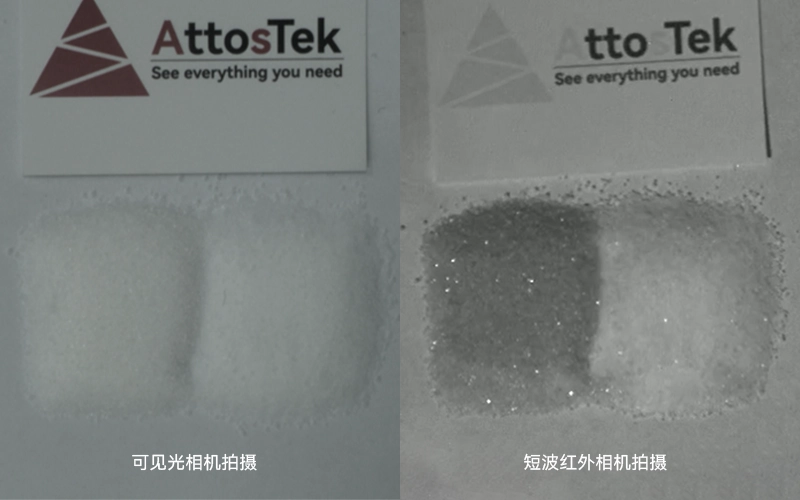
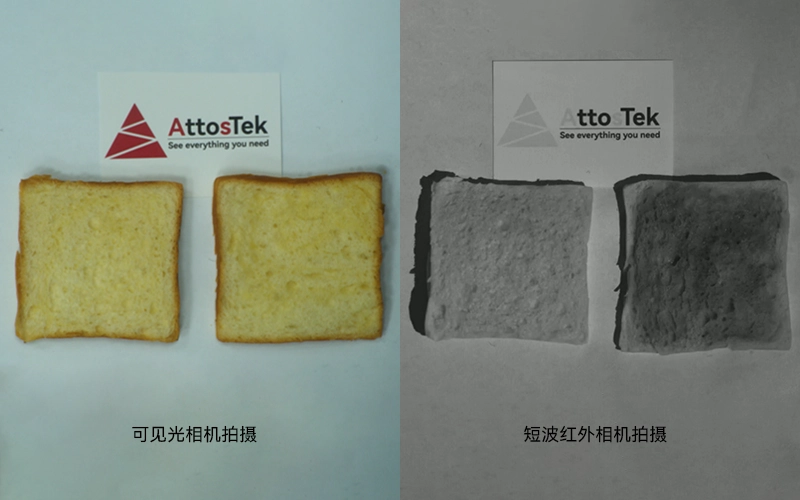
Underlying imaging principle: The 900–1700nm wavelength range avoids interference from visible light stray light. Various polymers, sugars, salts, and silicon materials have unique molecular absorption peaks in this range. Materials that look exactly the same under visible light show clear infrared reflection differences, making them easy to distinguish quickly.
Q2 :Can this series of cameras be prioritized for high-speed dynamic scenes?
They can be used in high-speed dynamic scenes. This series of cameras all feature 15-micron large pixel sizes and high frame rates. The SWIR1503BCL2 camera uses a CameraLink data interface with wide transmission bandwidth, and its full-frame frame rate can reach up to 1000fps, meeting the needs of ultra-high-speed applications.
Q3 : How to choose among the 5 models in the SWIR1503B series?
The SWIR1503B series comes with a unified configuration high-performance InGaAs sensor. Pixel size, resolution, and cooling are completely the same, with the only differences being in the transmission interface, frame rate, and exposure limits.
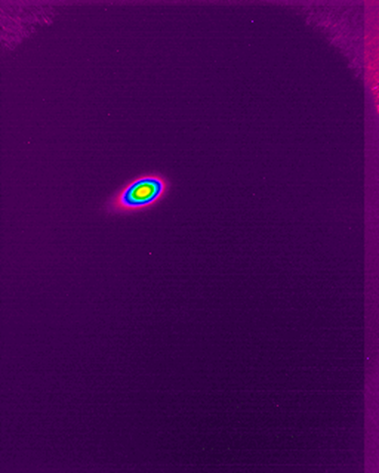
SWIR1503BU (USB3.0 interface): Frame rate: 724fps at 8/Packet 12bit, 579fps at 14bit; exposure 16μs~5s; no capture card needed. Ideal for desktop lab setups, small offline sample detection, and short-distance laser observation—great for plug-and-play, low-cost solutions.
SWIR1503BG (GigE interface): Frame rate: 360fps at 8bit, 180fps at 14bit; exposure 25μs~5s; ethernet cable can transmit up to 100m. Suitable for medium-to-low speed long production line material sorting, remote production line stations, and budget-conscious mass production projects.
SWIR1503B10G (10GigE interface): Full-frame 8/14bit both at 724fps; exposure 25μs~5s; supports long-distance high-bandwidth transmission and multi-camera networking. Great for high-speed plastic or powder sorting, and large-area online photovoltaic inspection.
SWIR1503BCL1 (CameraLink Full interface): Full-frame 724fps; exposure 16μs~1s; works with CLView capture software. Perfect for traditional research equipment upgrades and standard high-frame-rate spectral experiments.
SWIR1503BCL2 (CameraLink Full interface): Maximum full-frame across the series 1000fps; exposure 16μs~1s. Ideal for scenarios needing high frame rates, like pulse laser transient capture and ultra-high-speed material sorting.
Q4 : What application pain points do the three main hardware features—global shutter, hardware ROI, and 512MB cache—solve?
Global Shutter: Eliminates motion blur from high-speed conveyor materials and pulsed laser movements, with an ultra-short 16μs exposure to capture fast-moving objects without any ghosting; exposure ranges from 16μs to 5s to suit both short and long sequence captures.
Hardware ROI: Crops out useless background areas in the frame, greatly reducing single capture time and boosting production line speed and efficiency in laser experiments.
512MB Large Buffer: Temporarily stores high-speed image data streams so you won’t miss frames even if your computer isn’t super powerful, ensuring complete continuous sorting and long-timed spectral data.
0.33MP SWIRB Series InGaAs CMOS Cameras with Large Pixels Size
| Model | SWIR1503BU | SWIR1503BG | SWIR1503B10G | SWIR1503BCL1 | SWIR1503BCL2 |
| Data Interface | USB3.0 | GigE | 10GigE | CameraLink Full | |
| Frame Rate | 8bit: 724@640×512, Packet12:724@640×512, 14bit:579@640×512 |
8bit: 360@640×512, 700@320×256, 14bit: 180@640×512 |
8bit: 724@640×512, 14bit: 724@640×512 |
724fps@640 x 512 | 1000fps@640 x 512 |
| Exposure Time Range | 16µs~5s | 25µs~5s | 16µs~1s | ||
| Conversion Gain | 138.6e-/ADU(LG),5.54e-/ADU(MG),1.2e-/ADU (HG) | 970.01e-/DN(LG), 18.02e-/DN(MG), 3.31e-/DN (HG) | |||
| Dynamic Range | 70.59dB(LG),67.96dB(MG),47.98dB(HG) *1 | 69.2dB(LG), 63.2dB(MG), 57.4dB(HG) *1 | |||
| Readout Noise | 586.82e(LG),35.05e(MG),68.44e(HG) | 1.3DN(LG), 2.7DN(MG), 5.0DN(HG) | |||
| Full Well Charge | 1986426.78e(LG),87649.83Ke(MG),17147.351e(HG) *1 | 3.5Me(LG), 70Ke(MG), 12Ke(HG) *1 | |||
| Maximum SNR | 62.98dB(LG),49.43dB(MG),42.34dB(HG) | 65.4dB(LG), 48.5dB(MG), 40.7dB(HG) | |||
| Digital I/O | 1 channel of optically isolated input, 1 channel of optically isolated output, 2 channels of non-isolated input/output port |
1 channel of optically isolated input, 1 channel of optically isolated output, |
|||
| Data Format | Mono 8 / Mono 14 / Packet12 | Mono 8 / Mono 14 | Mono 12 / Mono 14 | ||
*1: LG: CDS-OFF, DeNoise-ON; MG: CDS-ON, DeNoise-OFF; HG: CDS-ON, DeNoise-OFF.
SWIR1503BU
0.33 MP InGaAs CMOS SWIR Camera, 15 µm Pixels, USB 3.0 Interface, 125fps
SWIR1503BG
0.33 MP InGaAs CMOS SWIR Camera, 15 µm Pixels, Gige Interface, 700fps
SWIR1503B10G
0.33 MP InGaAs CMOS SWIR Camera, 15 µm Pixels, 10Gige Interface, 724fps
SWIR1503BCL1
0.33 MP InGaAs CMOS SWIR Camera, 15 µm Pixels, CameraLink Interface, 724fps
SWIR1503BCL2
0.33 MP InGaAs CMOS SWIR Camera, 15 µm Pixels, CameraLink Interface, 1000fps
Optional accessories – lenses
To meet the diverse application demands of short-wave infrared (SWIR) imaging, Attostek offer a series of high-performance SWIR lenses. This lineup covers focal lengths from 6mm to 100mm and features a wide aperture range of F1.4 to F2.0 as standard, ensuring high signal-to-noise ratio and superior image quality even in low-light conditions. Users can flexibly select different models based on field of view, working distance, and resolution requirements, providing high sensitivity and versatile scene adaptability for SWIR cameras in applications such as security surveillance, industrial inspection, and scientific research.
SWIR0618C
6mm Focal Length, f1.8, C-Mount SWIR Camera Lenses
SWIR0814CL
8mm Focal Length, f1.4, C-Mount SWIR Camera Lenses
SWIR1214C
12mm Focal Length, f1.4, C-Mount SWIR Camera Lenses
SWIR1614C
16mm Focal Length, f1.4, C-Mount SWIR Camera Lenses
SWIR2514C
25mm Focal Length, f1.4, C-Mount SWIR Camera Lenses
SWIR3514C
35mm Focal Length, f1.4, C-Mount SWIR Camera Lenses
SWIR5014C
50mm Focal Length, f1.4, C Mount SWIR Camera Lenses
SWIR10020C
100mm Focal Length, f2.0, C-Mount SWIR Camera Lenses