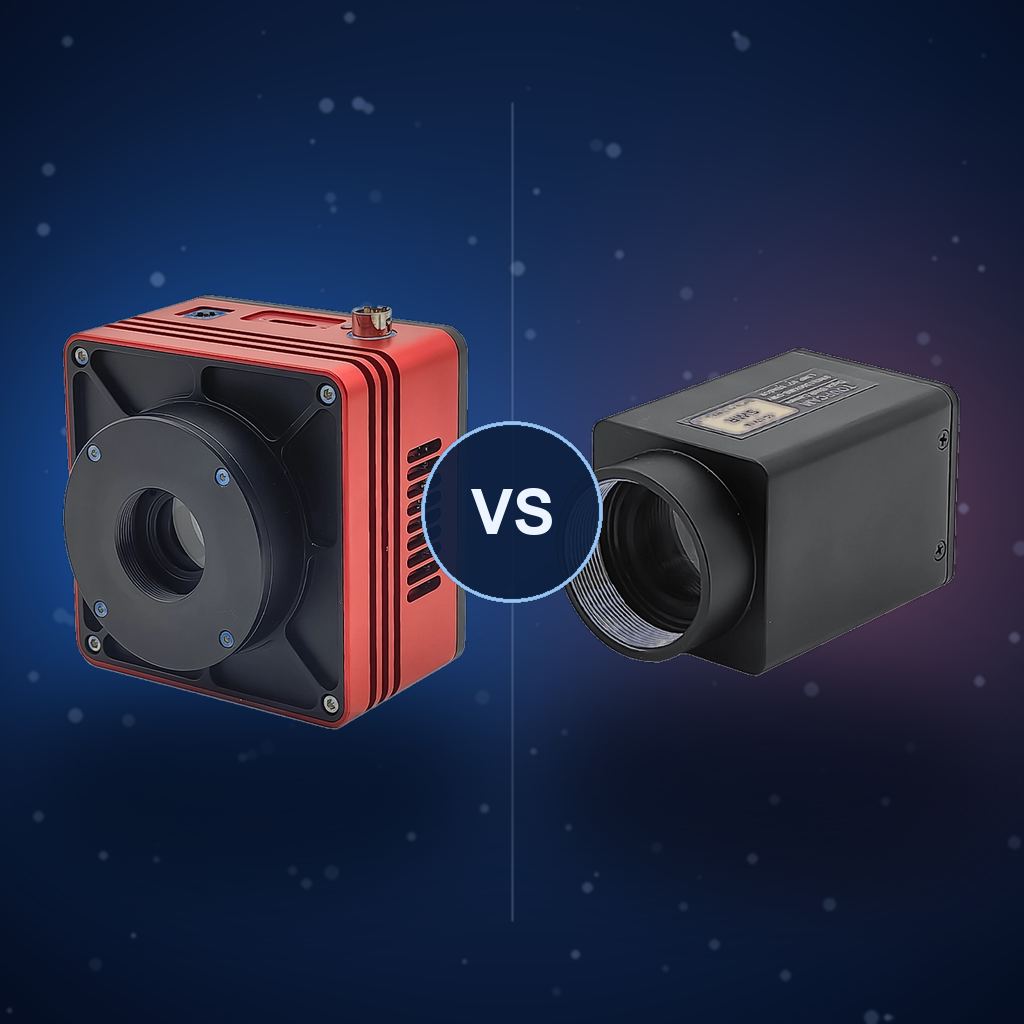
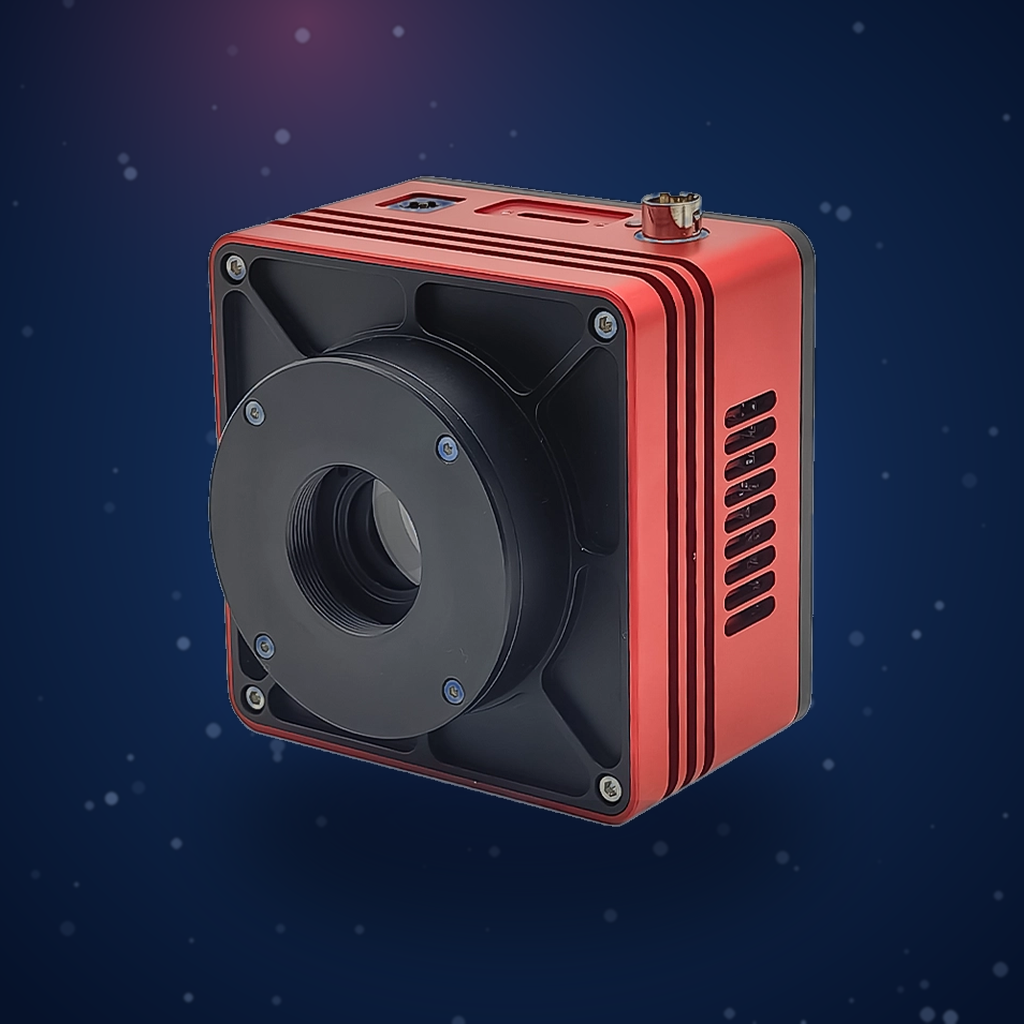
SWIR, MWIR and LWIR cameras do not compete on the same physics. SWIR (roughly 900–1700 nm) mostly records reflected light and delivers visible-like detail, MWIR (3–5 μm) reads radiation emitted by hot targets such as engines and exhaust plumes, and LWIR (8–14 μm) reads radiation emitted near ambient temperature, which makes it the default choice for people, buildings and electrical panels. Choose the band by target temperature first, then check atmosphere, optics and integration limits. MWIR cameras cost more and need cooled detectors, yet they detect hot objects at roughly 2.5× the range of LWIR. A SWIR camera stays the lowest-cost route to fine detail through glass, smoke and silicon.
Key Takeaways
- 900–1700 nm, 3–5 μm and 8–14 μm are not interchangeable. SWIR reads mostly reflected light, MWIR and LWIR read emitted heat, so no single band replaces the other two in a real inspection line.
- MWIR cameras reach hot targets at about 2.5× the range of LWIR under comparable conditions, which is why they win in long-range engine, exhaust and flare monitoring rather than in building surveys.
- SWIR is not a thermal band at room temperature. A SWIR camera resolves fine detail through glass, smoke and silicon, but it cannot replace LWIR for non-contact temperature measurement of 300 K scenes.
- Cooling drives system cost more than resolution does. MWIR needs cooled MCT, InSb or T2SL detectors, while many LWIR designs run uncooled VOx, cutting size, power draw and start-up time.
- Match the band to the target temperature first. LWIR peaks near ambient scenes, MWIR near 500–800 K targets, and SWIR suits reflected-light inspection, not heat measurement.
1. Definition and Range of the Three Core Infrared Bands
Most buyers meet infrared as a single word, but the spectrum splits into three working bands with different physics, different detectors and very different price tags. SWIR camera models in AttosTek’s line cover 400–1700 nm in the A-Series and 900–1700 nm in the B-Series, sitting just past visible red. MWIR (mid-wave infrared) covers 3–5 μm. LWIR (long-wave infrared) covers 8–14 μm, the atmospheric window where objects near ambient temperature radiate most strongly.
The dividing line is reflection versus emission. Below about 2 μm, a camera mostly records light that the sun, a lamp or a laser bounced off the target, so a SWIR camera produces images that look like sharp black-and-white photographs. Above roughly 3 μm, the signal is dominated by radiation the target emits by itself. Wien’s displacement law puts the peak of a 300 K scene near 10 μm and the peak of a 600 K target near 4.8 μm, which is exactly why MWIR cameras take over hot-target work while LWIR handles ambient scenes.
That one difference drives detector choice, cooling, lens material and budget. SWIR uses InGaAs, colloidal quantum dot (CQD) or MCT sensors and can run uncooled or cooled down to -80°C. MWIR needs cooled MCT, InSb or T2SL detectors, because at 3–5 μm a sensor at room temperature would drown in its own thermal noise. LWIR is the only band where uncooled VOx microbolometers work well, which makes it the cheapest entry into thermal imaging technology for security protection and building surveys. MWIR cameras sit between the two: cooled, costlier, and unmatched on hot targets at distance.
| Band | Wavelength | Detector options | Cooling | Signal source | Typical targets |
|---|---|---|---|---|---|
| SWIR | 400–1700 nm / 900–1700 nm / up to 900–2700 nm | InGaAs, CQD, MCT | Uncooled to -80°C | Mostly reflected light | Silicon wafers, moisture, inks, fill level, smoke-penetrating scenes |
| MWIR | 3–5 μm | MCT, InSb, T2SL | Cooled (Stirling) | Emitted radiation from hot objects | Engines, exhaust plumes, flares, long-range surveillance |
| LWIR | 8–14 μm | VOx uncooled, MCT, T2SL, HOT | Uncooled or cooled | Emitted radiation near 300 K | People, buildings, panels, fire search, night driving |
2. SWIR Thermal Camera: High-Resolution Imaging Technology Relying on Reflected Light
A SWIR camera behaves much more like a visible camera than like a heat sensor. Because photons in the 900–1700 nm range are still largely reflected by the target, image contrast comes from material reflectance, not from temperature. In practice this gives three advantages: familiar-looking images that operators read without training, much finer detail at the same pixel count, and the ability to see through materials that block visible light. Silicon becomes transparent above about 1100 nm, which is why 1150 nm emission imaging finds internal wafer defects, and why many building and PCB inspection solutions start with SWIR rather than with a thermal band. For that class of work, reflectance contrast usually tells you more than temperature does.
AttosTek’s SWIR line runs from 400–1700 nm A-Series models at 1280 × 1024 with 5 μm pixels, through 900–1700 nm B-Series models at 1024 × 1024 and 640 × 512 with 15 μm pixels, out to 900–2200 nm C-Series options for extended-range materials work. Building and PCB inspection solutions usually sit at the 5 μm pixel end of that range, while sorting and fill-level work runs at 15 μm. Detectors are InGaAs, CQD or MCT; cooling spans uncooled designs to deep-cooled -50°C and -80°C versions for low-light fluorescence and single-photon-adjacent work in the NIR-II window. Interfaces cover USB3, GigE, CoaXPress, CameraLink and MIPI, so a SWIR camera usually drops into an existing machine-vision rack without a new frame grabber.
The limits matter as much as the strengths. A SWIR camera needs some illumination, whether from the sun, a broadband lamp or a 1200–1550 nm LED ring, and it only becomes a true thermal sensor once targets exceed a few hundred degrees Celsius. Building and PCB inspection solutions therefore specify the lighting and the camera together, not one after the other. For room-temperature temperature measurement, LWIR stays the correct answer. Every unit ships with AttosView control software and an SDK, and all models are CE/FCC certified and 100% factory tested. AttosTek’s InGaAs and CQD SWIR cameras cover every one of those formats, from compact uncooled USB3 units to deep-cooled -80°C models.
3. MWIR Thermal Camera: Thermal Radiation Imaging Technology Focused on High-Temperature Targets
MWIR cameras read radiation from objects that are far hotter than the background, and they do it at distance. At 3–5 μm the atmosphere absorbs less than in parts of the long-wave band, hot targets produce far more signal per degree than they do at 10 μm, and shorter wavelengths allow smaller optics for the same angular resolution. AttosTek’s own comparison puts MWIR detection range at about 2.5× that of LWIR under the same conditions, which is the number that decides most long-range projects.
The trade-off is a cooled detector. A representative core, the MWIR1503TCL, uses a T2SL (type-II superlattice) detector at 640 × 512 with 15 μm pixels, sensitive from 3.7–4.8 μm, paired with a linear Stirling cooler. It reaches full operating temperature in about 7 minutes, holds NETD at ≤22 mK, draws under 12 W at steady state, weighs ≤420 g, keeps the bad-pixel rate below 0.3% and is rated for 10,000 h MTTF across -40 to +60°C. Output is CameraLink at 14-bit or 8-bit with RS422 serial control, and on-board processing covers AGC and bad-pixel replacement (BPR). AttosTek also lists MCT-based cores and higher resolutions up to 2048 × 2048 for programs that need more pixels across the same field; MWIR cameras at that pixel count suit wide-area surveillance and high-temperature process lines.
Typical MWIR cameras jobs are engine test stands, exhaust and flare monitoring, furnace and kiln imaging, long-range surveillance, unmanned payloads and traffic imaging through fog or smoke. The band is also less sensitive to humidity and atmospheric attenuation, which helps MWIR cameras hold calibration on coastal or desert sites. Compared with uncooled long-wave designs, this thermal imaging technology trades higher unit cost for range and contrast. Working across the full 1–14,000 nm spectrum, AttosTek lets engineering teams compare detector options side by side before committing to a build, from the 640 × 512 T2SL MWIR core up to complete cooled MWIR camera systems.
4. LWIR Thermal Camera: All-Purpose Thermal Imaging Technology for Ambient Temperature Scenarios
LWIR is the band most people mean when they say thermal camera, and it carries most of the thermal imaging technology deployed in industry today. A scene at 300 K radiates most strongly near 10 μm, so an 8–14 μm camera sees people, walls, roofs and electrical panels without any illumination at all. That makes it the default for non-contact temperature measurement, building energy diagnostics, fire search and rescue, medical screening, perimeter security protection and automotive night vision.
Cost is the second reason. Because VOx microbolometers work uncooled at these wavelengths, an LWIR engine can start in seconds, run on a few watts and fit inside a handheld housing. AttosTek’s LWIR line spans 640 × 512, 1024 × 768 and 1280 × 1024 resolutions with GigE, USB3.0, CameraLink and MIPI interfaces, plus cooled MCT, T2SL and HOT variants for users who need finer thermal resolution or longer integration times. The trade-offs are physical: long wavelengths need larger apertures for the same detail, lenses rely on special infrared materials with high-efficiency anti-reflection coatings, and heavy rain, fog or window glass will stop the signal completely. That is why security protection cameras, fire crews and maintenance teams all standardise on the same 8–14 μm window.
In practice, LWIR answers “how hot is it” while SWIR answers “what does it look like”. Facilities teams combine both: an LWIR survey finds the hot joint, then a visible or SWIR camera reads the label, the nameplate and the fine wiring detail around it. Mixed sites pair an LWIR engine for detection with a SWIR camera for identification, which is now the standard pattern in security protection projects. If your priority is reliable radiometry near room temperature rather than see-through-glass detail, start with an uncooled 640 × 512 VOx LWIR camera.
5. Comparison of Three Major Bandwidth Technologies and Selection Recommendations
Selection comes down to four questions in order: what is the target temperature, how far away is it, what sits between camera and target, and what can the platform carry in power and weight. Answer those and the band usually picks itself. MWIR cameras only pay off once the target is hot enough to stand out at 3–5 μm; below that, LWIR or SWIR will do the job for less money. The table below compresses the decision for the most common industrial and scientific jobs, including building and PCB inspection solutions where SWIR detail beats thermal contrast.
| Application | Recommended band | Why | AttosTek starting point |
|---|---|---|---|
| Building heat loss, damp, insulation survey | LWIR 8–14 μm | Peak emission at 300 K; no illumination needed; radiometric output | LWIR camera, 640 × 512 uncooled VOx |
| Perimeter and site security protection, night monitoring | LWIR, SWIR added for identification | LWIR detects people in total darkness; SWIR resolves faces and plates | LWIR camera plus SWIR camera on the same mast |
| Engine, exhaust, flare and kiln monitoring | MWIR 3–5 μm | High thermal contrast above 500 K; about 2.5× the range of LWIR | MWIR cameras, 640 × 512 T2SL core |
| Silicon wafer, solder and building and PCB inspection solutions | SWIR 900–1700 nm | Silicon transparent above ~1100 nm; sub-micron-class detail at 5 μm pixels | SWIR camera, 400–1700 nm A-Series |
| Moisture, fill level, sorting of same-colour materials | SWIR 900–1700 nm | Strong absorption bands for water and many polymers | SWIR camera, uncooled USB3 or GigE |
| Fire search,rescue and smoke-filled interiors | LWIR 8–14 μm | Sees body heat through smoke; uncooled start-up in seconds | LWIR camera, handheld or UAV mount |
Whichever band you land on, integration work decides whether the instrument earns its keep on the line. Check three things before ordering: that the interface (USB3, GigE, CoaXPress, CameraLink or MIPI) matches your host and cable length, that the lens covers the band as well as the sensor format, and that your software team can drive the camera on day one. Teams running building and PCB inspection solutions typically standardise on GigE for cable runs and USB3 for bench work. AttosView and the supplied SDK cover C/C++, C#/VB.NET, Python and Java, with third-party support for LabVIEW, MATLAB, Micro-Manager, DirectShow and TWAIN, so a thermal imaging technology upgrade rarely needs a new software stack.
AttosTek builds across the full 1–14,000 nm range, from SWIR and MWIR cameras to LWIR engines, lenses and optical systems, and every unit is 100% factory tested and CE/FCC certified with 7×24 engineering support. Security protection programmes that run around the clock usually mix cooled MWIR cameras on the perimeter with LWIR or SWIR units closer in. When a standard model does not match your target temperature, pixel count or mechanical envelope, the detector, cooling, interface and housing can all be re-specified; describe your scene to the AttosTek customization team and they will come back with a configuration and a CIF quotation.
Frequently Asked Questions
What does a CIF quotation include for SWIR and MWIR cameras?
A CIF quotation covers product cost, insurance and freight to the destination airport, but not destination-country duty, import tax, VAT or local charges. Logistics is a flat 50 USD per order within Asia and 100 USD elsewhere. Quotations are issued in CNY, USD or EUR, and shipments go out by DHL or FedEx once payment clears.
How long is the lead time, and do you accept small orders?
Standard models ship with the lead time shown on each product page and confirmed in your quotation; custom builds follow a four-step process of requirements analysis, solution design and quotation, development with testing, then delivery. Small-batch customization is supported, so a single prototype unit or a short pilot run is a normal order, not an exception.
Can detector, cooling, interface or housing be customized?
Yes. Camera customization covers sensor type, resolution, pixel size and format, spectral response across EUV to LWIR, frame rate, exposure, dynamic range and SNR, plus interfaces from USB3.0, GigE and CoaXPress to CameraLink, and housing size, material, cooling method and IP rating. Lens focal length, mount and optical system integration can be specified in the same project.
Are the cameras certified and tested before shipment?
Every AttosTek unit is 100% factory tested before shipment and carries CE and FCC certification. Cooled MWIR cores add measurable quality data, for example NETD ≤22 mK, bad-pixel rate below 0.3% and 10,000 h MTTF on the 640 × 512 T2SL core. After delivery, 7×24 expert support handles integration questions, calibration and spare-part planning.
Which software and SDK support comes with the cameras?
Each camera ships with AttosView acquisition and control software plus an SDK for C/C++, C#/VB.NET, Python and Java. Third-party environments including LabVIEW, MATLAB, Micro-Manager, DirectShow and TWAIN are supported, so existing machine-vision code usually transfers without a rewrite. Cooled MWIR cores output 14-bit or 8-bit CameraLink and accept RS422 serial control.