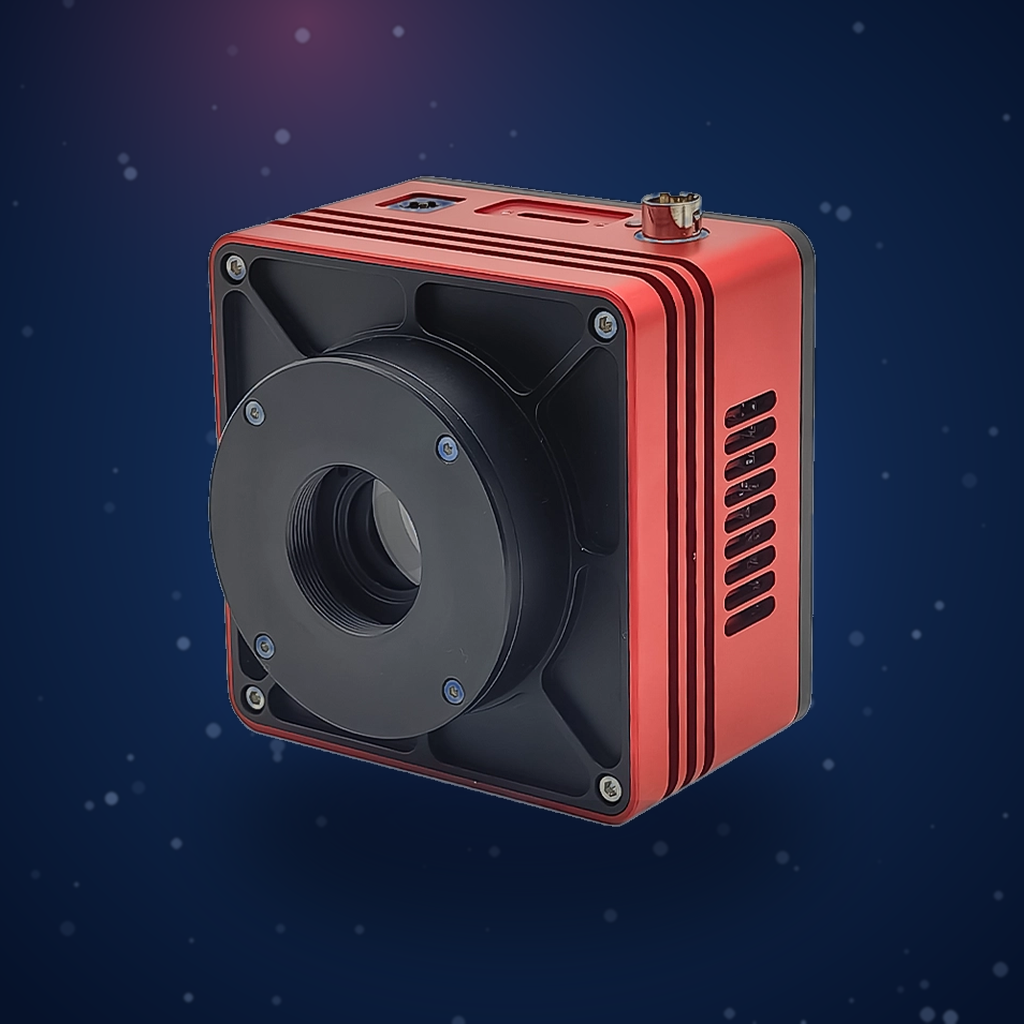
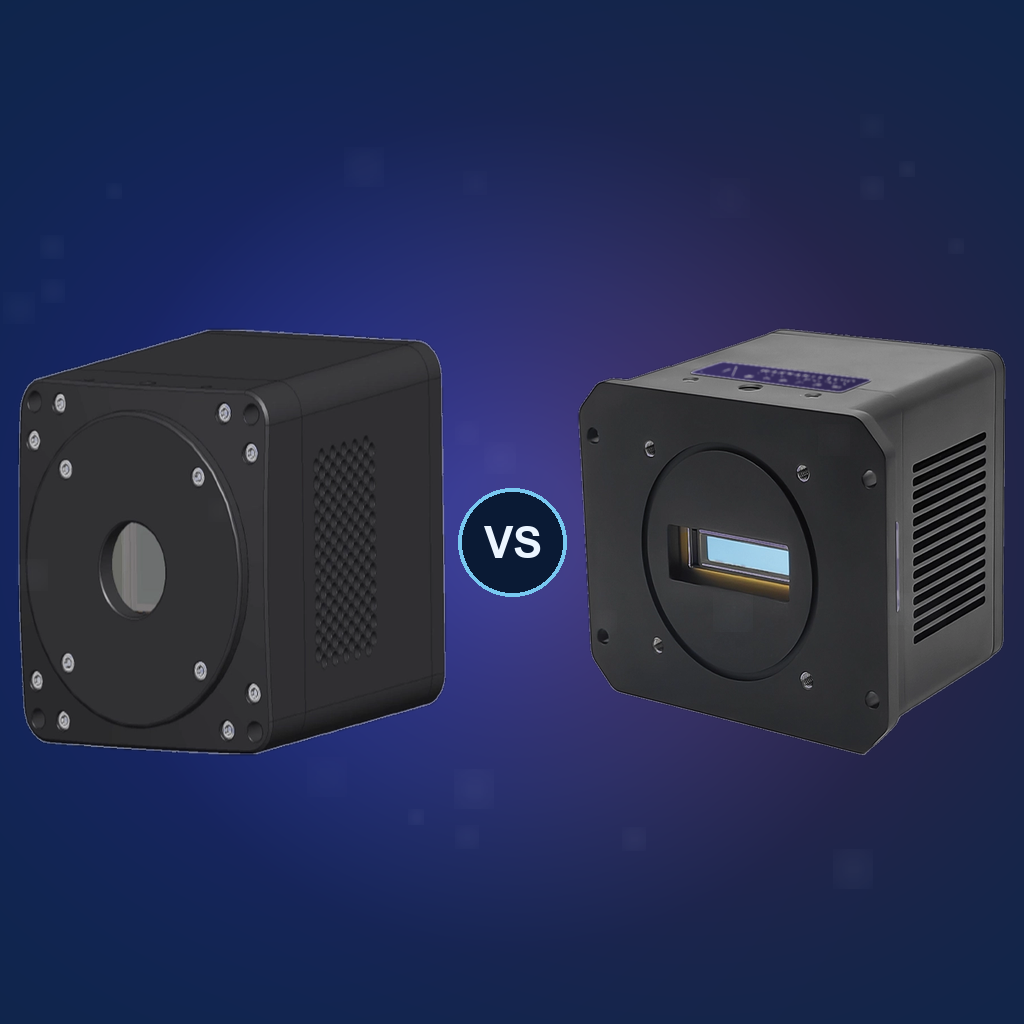
There is no single winner in the CCD versus CMOS debate, because the two sensor families optimise for different jobs. A CCD camera moves every pixel’s charge to one output and reads it through a single amplifier, which rewards uniformity and low noise. A CMOS camera converts light to voltage inside every pixel and reads columns in parallel, which rewards speed, low power and integration. Modern back-illuminated scientific CMOS has closed most of the historic gap: AttosTek’s flagship 4 MP 6.5 μm sCMOS camera pairs QE 95% at 450 nm with 0.72 e- read noise and 248 fps at 8-bit, so for most scientific and industrial work CMOS is now the faster and more flexible choice, while CCD sensors remain justified in a few specialised niches.
Key Takeaways
- One amplifier versus millions. A CCD camera drains charge through one output for uniformity, while CMOS reads every column in parallel, which is why it wins on speed and power.
- Modern sCMOS reached 0.72 e- read noise with 95% QE at 450 nm in AttosTek’s back-illuminated flagship, closing the noise gap that once kept scientific buyers on CCD.
- CCD still holds two real advantages: single-output charge-transfer uniformity for precision photometry, and deep-depletion silicon designs that keep useful near-infrared response alive beyond 900 nm.
- “Exmor” is a sensor family name, not a magic spec. It marks Sony’s CMOS designs with column-level conversion, and the camera around the sensor decides the result.
- Choice follows the workload, not the label. Slow, photon-starved precision favours CCD; anything needing frame rate, large formats or system integration favours a CMOS camera.
How CCD and CMOS Sensors Read an Image
Both sensor types convert photons into charge in the same silicon, so the difference is not detection but readout. In a CCD, the charge collected by every pixel is shifted bucket-by-bucket across the sensor to a single output node, where one amplifier converts it to voltage. That single path is the CCD’s superpower and its bottleneck at the same time: because every pixel passes through identical electronics, pixel-to-pixel differences stay small, but the whole frame must move in sequence, which limits frame rate and raises clocking complexity.
CMOS takes the opposite route. Each pixel, or each column, carries its own amplifier and converter, so the sensor reads in parallel like thousands of tiny cameras stitched together. Parallel conversion is why a CMOS camera reaches hundreds of frames per second, consumes a fraction of the power, and offers ROI readout, global shutter or rolling shutter options that a CCD architecture cannot match. The cost of that per-column electronics used to be noise and pattern differences between columns; modern scientific CMOS designs reduced column noise to levels where it no longer dominates the image, which is the single most important change of the last decade.
Where CCD Cameras Still Hold an Edge
CCD did not lose everywhere, and two strengths survive in current designs. The first is uniformity. Because charge from every pixel travels through the same output chain, CCD photometry is intrinsically even across the frame, and classic scientific CCDs remain respected for measurements where any column-level difference would be a systematic error. Spectroscopy is the classic case: a spectrograph projects a spectrum onto a narrow sensor strip, and a dedicated spectroscopy CCD reads that strip with exceptional consistency. AttosTek’s UV-VIS line still includes a 2048 × 264 spectroscopy CCD camera covering 200–1000 nm for exactly this reason.
The second strength is deep-depletion silicon. CCD architectures can thicken the silicon layer so that long-wavelength photons, which penetrate deeper, are still absorbed before they escape; this keeps useful response toward and beyond 900 nm where standard thin designs fade. Long-exposure applications also favour CCD behaviour, since the architecture tolerates slow, quiet reads without the per-column flicker a parallel design must calibrate out. If your experiment is a slow, photon-starved measurement where a single long exposure matters more than frame rate, a CCD camera remains a defensible pick.
What CMOS Cameras Do Better
Speed is the headline. Parallel column readout lets a modern scientific sCMOS camera sustain hundreds of frames per second while keeping read noise below 1 e-, a combination no CCD offers at the same price. That changes what is measurable: live-cell dynamics, high-throughput inspection and time-resolved fluorescence all need both sensitivity and frame rate, and they increasingly run on sCMOS.
The second advantage is integration and system cost. The CMOS sensor carries its timing, conversion and digitisation on the sensor board, which shrinks the camera, cuts power, removes external clock drivers, and makes interfaces such as USB3.2 and 10GigE practical. Formats scale faster too, because consumer manufacturing keeps pushing pixel counts; CMOS camera families now span 1.7 MP to 26 MP and beyond in the 200–1100 nm range, with pixel pitches from 2 μm to 13 μm and cooling from 0 down to -80°C. Add ROI readout, lower cost per megapixel and rolling or global shutter choices, and the practical case for CMOS in industrial and most laboratory work becomes hard to argue with.
What “Exmor CMOS” Actually Means
Exmor is the name Sony gave to its family of CMOS image sensors, and over the years it has become shorthand for CMOS designs with column-parallel conversion and low-noise on-sensor electronics rather than a specific performance figure. When a camera datasheet says “Exmor-type” or “Exmor CMOS”, it is telling you the sensor lineage, not guaranteeing a read noise number.
That distinction matters when comparing cameras. Two cameras can use similarly named sensors and behave very differently, because the camera maker controls the analogue front end, cooling, clocking and firmware that sit around the sensor. What you should compare are the camera-level specifications: read noise, quantum efficiency at your wavelength, dynamic range, frame rate at full and ROI resolution, and cooling depth. For reference, AttosTek’s flagship back-illuminated sCMOS camera is built on a 2048 × 2048, 6.5 μm sensor cooled to -35°C, delivering QE 95% at 450 nm, 0.72 e- read noise, 86 dB dynamic range and up to 248 fps at 8-bit over 10GigE. Judge any candidate, from any sensor family, against that kind of published camera-level data rather than the badge on the sensor.
CCD vs CMOS Camera: Side-by-Side Comparison
The table below condenses the comparison into the specifications buyers actually weigh. Treat it as a decision aid: the right column depends on which row matters most for your measurement.
| Aspect | CCD camera | CMOS camera | Back-illuminated sCMOS camera |
|---|---|---|---|
| Readout architecture | Single output, sequential charge transfer | Column-parallel conversion on sensor | Column-parallel with low-noise electronics, BSI stack |
| Read noise | Low but fixed by output chain | Historically higher, now low | Down to 0.9 e- (AttosTek flagship) |
| Frame rate | Slow, sequence-limited | High, ROI-capable | Up to 270 fps at 8-bit at full resolution |
| Quantum efficiency | Good, strongest with back-thinned designs | Good with microlens designs | Up to 95% at 450 nm |
| Uniformity | Excellent, single output path | Column-dependent, calibrated in firmware | Very good after calibration |
| Near-infrared option | Deep-depletion CCDs reach beyond 900 nm | Standard designs fade earlier | Depends on sensor selection |
| Power and size | Higher, complex clocking | Low, compact | Low, compact |
| Typical use | Spectroscopy, precision photometry, deep-depletion NIR | Machine vision, inspection, education | Low-light science, fluorescence, high-speed imaging |
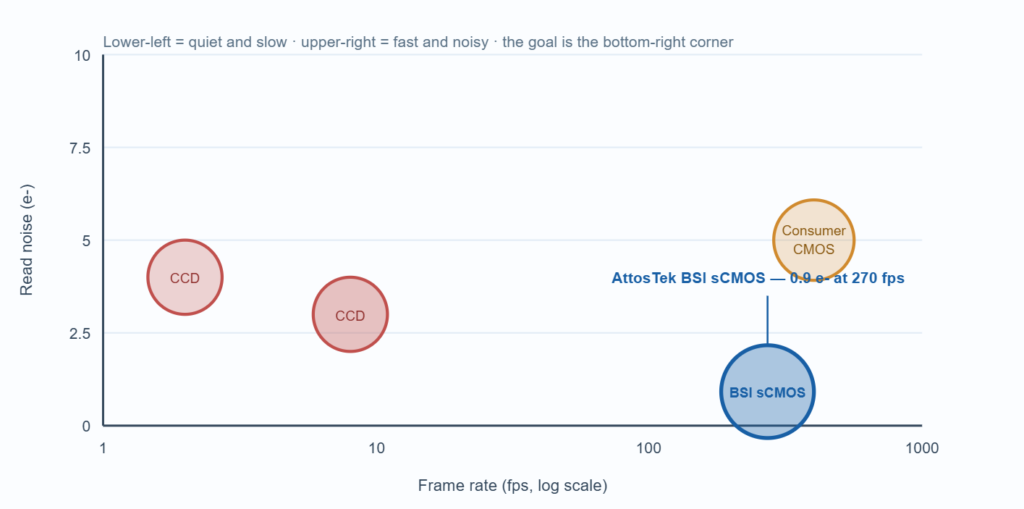
Figure 2 — Where each sensor family sits on read noise versus frame rate
Which One Should You Choose?
Start from the measurement, not the sensor label. If the job is a slow, single-exposure photometric measurement, a spectrograph strip readout, or deep-depletion near-infrared capture beyond 900 nm, a CCD camera still earns its place. If the job involves any of the following, the modern answer is a CMOS camera: frame rates above a few tens per second, fields larger than a few megapixels, live preview and ROI readout, compact enclosures, or interfaces that plug straight into a laptop or a 10GigE workstation. In practice that second list covers most of what laboratories and production lines ask for today.
AttosTek keeps both routes open in one range: high-sensitivity UV-VIS cameras span sCMOS, CMOS and CCD detectors from 200–1100 nm with 1 MP to 70 MP formats, cooling to -80°C, and interfaces from USB3 and GigE to CoaXPress and CameraLink. Every unit is 100% factory tested, CE/FCC certified, and ships with AttosView software plus an SDK for C/C++, C#/VB.NET, Python and Java, with LabVIEW, MATLAB, Micro-Manager, DirectShow and TWAIN support. If you are unsure which side of the debate your application lands on, send the exposure, wavelength and frame-rate requirements to the AttosTek customization team for a sensor recommendation and a CIF quotation.
Frequently Asked Questions
Is a CMOS camera better than a CCD camera for low-light imaging?
For most low-light work today, yes. A back-illuminated scientific CMOS camera reaches sub-electron read noise with 90%+ peak quantum efficiency, so it matches CCD sensitivity while adding frame rate. CCDs remain preferable only for very slow precision photometry or deep-depletion near-infrared measurements beyond 900 nm.
What does “Exmor CMOS” mean on a camera datasheet?
Exmor is Sony’s family name for its CMOS sensor designs with column-parallel conversion and low-noise on-sensor electronics. It identifies the sensor lineage rather than a performance guarantee. Compare camera-level specifications such as read noise, quantum efficiency, dynamic range and frame rate instead of relying on the sensor badge.
Can AttosTek supply both CCD and CMOS camera options?
Yes. The AttosTek UV-VIS range spans sCMOS, CMOS and CCD detectors across 200–1100 nm, from a 2048 × 264 spectroscopy CCD to a 4 MP back-illuminated sCMOS camera and 1.7–26 MP CMOS models, so one supplier can cover both sides of the debate within a single certified product family.
Which sensor should I choose for spectroscopy work?
A dedicated CCD is still the natural fit. A spectrograph projects the spectrum onto a narrow strip, and a CCD such as the 2048 × 264, 200–1000 nm spectroscopy camera reads that strip through a single output path with excellent pixel-to-pixel consistency, which keeps relative intensity measurements trustworthy across the frame.
How do I get a quotation and which interfaces are supported?
Send your wavelength range, exposure and frame-rate requirements, and AttosTek returns a configuration with a CIF quotation covering freight and insurance but excluding destination duty, import tax and VAT. Cameras ship with USB3, GigE, CoaXPress or CameraLink interfaces, 100% factory testing and CE/FCC certification, backed by 7×24 expert support.