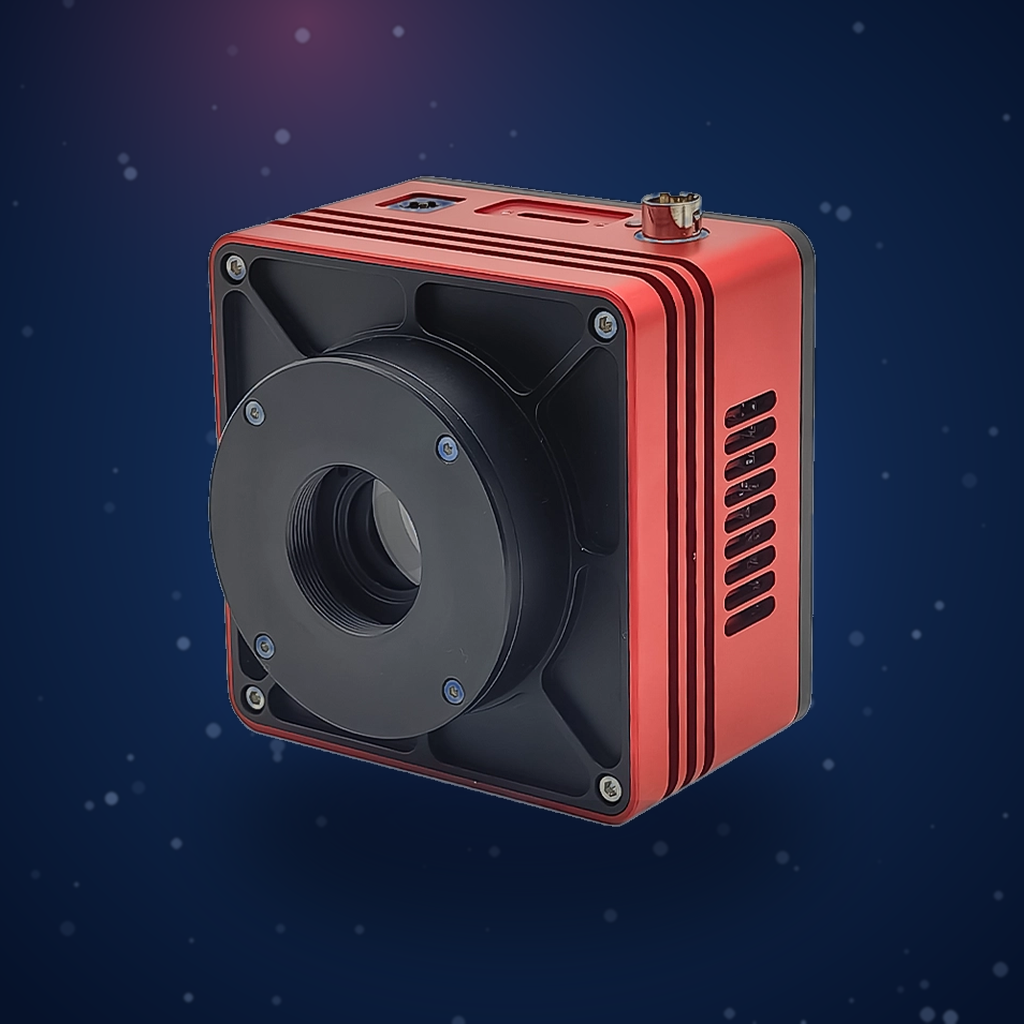
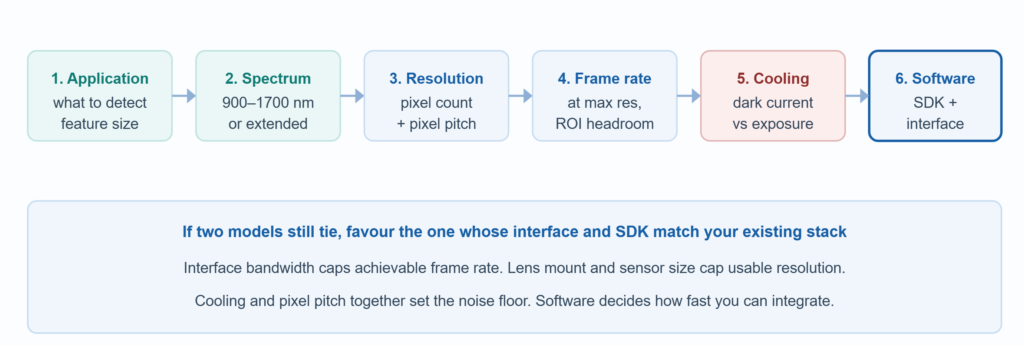
Choosing an InGaAs camera comes down to six decisions: what your application must detect, which spectral window it needs, how much resolution the target requires, what frame rate the line speed demands, whether dark current justifies cooling, and how the camera will talk to your software. InGaAs sensors cover 900–1700 nm with optional extension to 2200 or 2700 nm, and a modern InGaAs SWIR camera pairs that sensor with a silicon ROIC through indium bump bonds. This guide walks through each factor in order, with the datasheet numbers that separate one model from another.
Key Takeaways
- Start with the application, not the sensor. Moisture detection wants the 1450 nm water band, silicon inspection wants 1100–1300 nm, and general machine vision covers the full 900–1700 nm window.
- Pixel pitch sets the trade-off. A 5 μm pixel in a 1280×1024 InGaAs SWIR camera balances resolution against sensitivity, while 15 μm pixels favour faint signals over fine detail.
- Frame rate depends on resolution. Vendors quote maximum frame rate at maximum resolution, and readout bandwidth caps it; ROI readout can lift a 1.3 MP camera toward 8000 fps.
- Cooling is not always necessary. Uncooled InGaAs handles most production lines, but deep cooling to -50°C or -80°C is the difference between a usable signal and buried dark current in low-light science.
- The interface decides integration cost. USB3.0, GigE, CoaXPress and CameraLink are not interchangeable, so pick the one your frame grabber, cable runs and software stack already support.
What is an InGaAs Sensor?
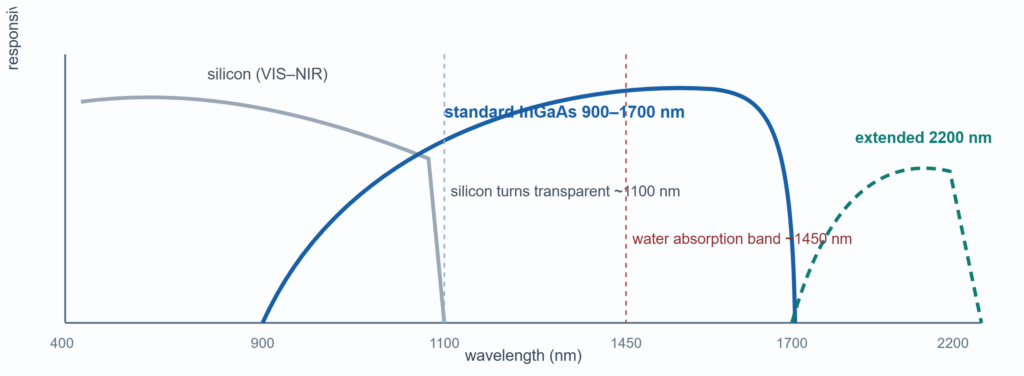
Indium gallium arsenide is a III-V compound semiconductor with the formula InxGa1-xAs. Its bandgap is set by the indium fraction, which is why a detector built from it can absorb light well beyond the reach of silicon. Standard silicon stops responding at roughly 1100 nm; InGaAs lattice-matched to an indium phosphide substrate responds from about 900 nm to 1700 nm, and raising the indium content pushes the cutoff to 2200 nm or 2700 nm at the cost of higher dark current.
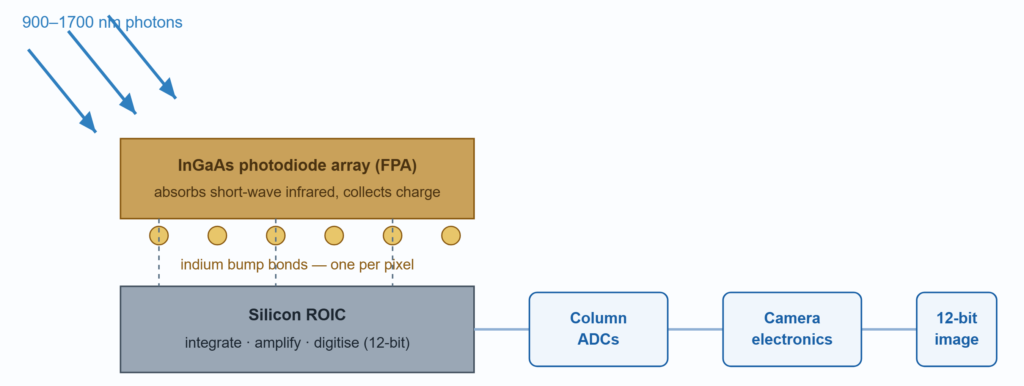
Inside an InGaAs camera, the sensor is not a single chip but a stack. The InGaAs layer is processed as a two-dimensional array of photodiodes, one per pixel, and each photodiode connects to a matching pixel in a silicon readout integrated circuit, the ROIC, through an indium bump bond. Light is absorbed in the InGaAs and the ROIC does the integrating, amplifying and digitising, so III-V material handles short-wave infrared photons while mature silicon CMOS handles fast, low-noise readout.
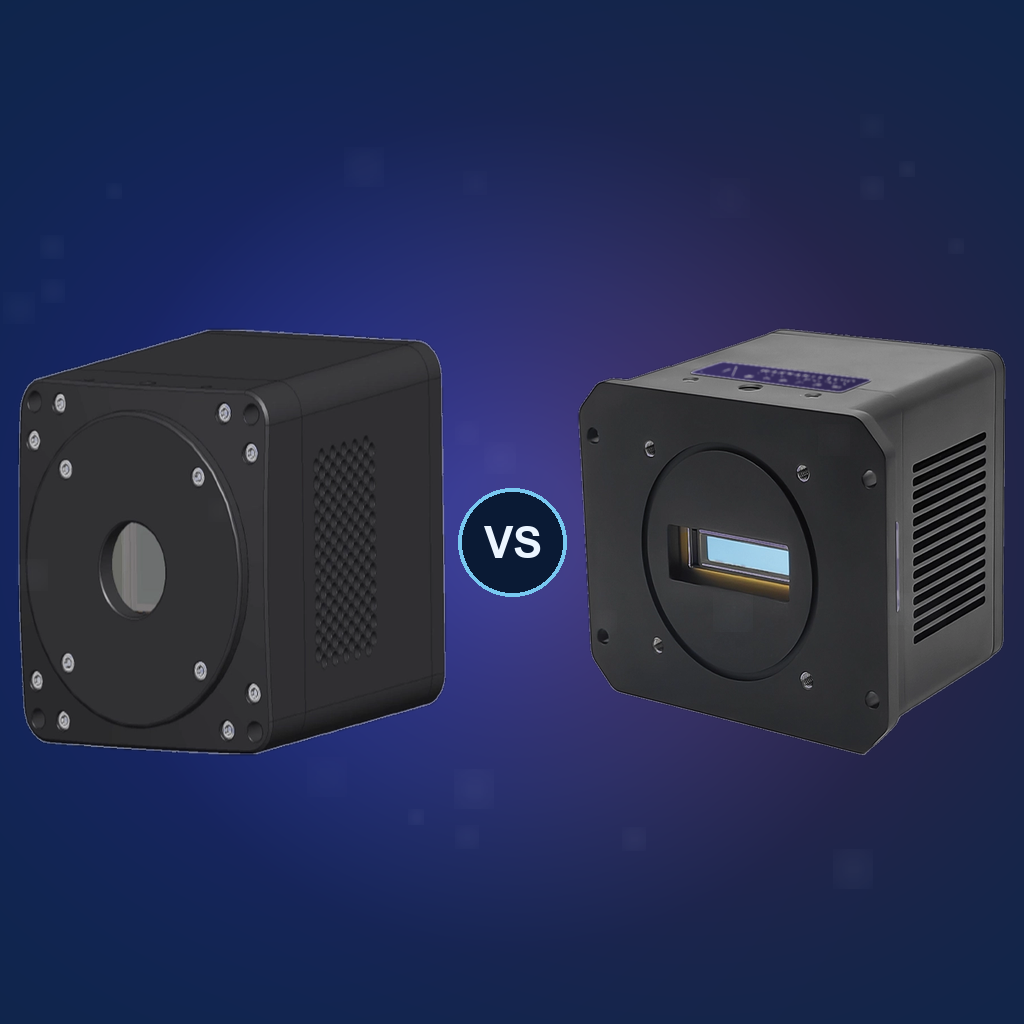
Factors to Consider When Choosing an InGaAs SWIR Camera
1. Understanding Your Application Requirements
Every other decision follows from this one. Silicon wafer and chip inspection needs wavelengths above about 1100 nm, where the material turns transparent, plus enough resolution to resolve die features. Moisture measurement lives at the 1450 nm water absorption band, where sensitivity matters more than pixel count. Food sorting and foreign-object detection are about material contrast, on a line where frame rate and interface dominate. Write down the target feature size, field of view, line speed and available lighting before comparing InGaAs camera models.
2. Spectral Sensitivity
Spectral range is the first hard filter. A standard InGaAs sensor covers 900–1700 nm, enough for silicon inspection, moisture detection and general machine vision. Extended-wavelength versions reach 2200 nm or 2700 nm for material identification where the absorption signature sits further out, but the longer cutoff raises dark current and usually needs more cooling. Sensitivity within the band is not flat either, since quantum efficiency and responsivity vary with wavelength. The optical filter in front of the sensor changes what reaches it: an InGaAs camera sold as 400–1700 nm may pass visible light as well, which is useful for comparing a visible and an infrared image of the same part, while a narrow filter trades that flexibility for higher contrast in one band.
3. Resolution
Choose resolution from the smallest feature you must detect, not the largest number on a spec sheet. Once field of view and feature size are known, the required pixel count follows, and so does the pixel pitch you can afford. The two pull in opposite directions: a 5 μm pixel in a 1280×1024 InGaAs camera gives a compact 1.3 MP format with fine sampling, while a 15 μm pixel in a 640×512 array collects more light per pixel and is easier to fill with a fast lens in low light. Larger pixels mean higher sensitivity; smaller pixels mean more detail but demand more light and a sharper lens. The lens must also match the sensor size, or you lose resolution to the corners.
4. Frame Rate
Frame rate is where datasheets most often mislead. The headline figure is usually the max frame rate at max resolution, and that is the number that matters on a production line, because it tells you how fast the full sensor can be read. Vendors also advertise the max frame rate after binning or region-of-interest readout, which can be far higher — one 1.3 MP model in this class reads out up to 8000 fps with a reduced ROI. If your inspection needs only a strip of the sensor, ROI mode gives you that speed without changing cameras. Interface bandwidth is the ceiling: USB3.0 and GigE top out far below CoaXPress or CameraLink, so a camera quoted at several hundred full-frame fps needs a matching frame grabber. Exposure time must fit inside each frame period, and a 15 µs to 60 s range covers both freeze-motion work and long integration.
5. Cooling Requirements
InGaAs photodiodes generate dark current that grows quickly with temperature, and dark current is what limits the faintest signal you can detect. For bright, short exposures on a production line, an uncooled or lightly cooled SWIR camera is enough. For long exposures and low-light work, thermoelectric cooling becomes essential, because it holds the sensor below ambient and stabilises the noise floor. One 1.3 MP InGaAs camera in this class reaches about 383 e/s of dark current at 0°C, and deep-cooled designs at -50°C or -80°C go further for photon-starved applications such as fluorescence imaging and NIR-II work. Consider cooling when exposure time climbs past a few milliseconds, or when the measurement depends on repeatable noise.
6. Software Compatibility and Integration
Software is the factor that quietly decides project cost. Confirm the camera ships with control software and a software development kit, and that the SDK supports the languages your team already uses — C/C++, C#/VB.NET, Python and Java cover most machine-vision stacks, while LabVIEW, MATLAB, Micro-Manager, DirectShow and TWAIN support removes the need to rewrite existing acquisition code. Check the operating systems too, from Windows through Linux to macOS and Android for embedded work. On the hardware side, verify the chosen interface matches your frame grabber, cable length and trigger wiring, and that the mounting and lens mount fit the fixture you already designed.
How InGaAs Compares with Other SWIR Sensor Technologies
Not every SWIR camera is built on InGaAs. Colloidal quantum dot sensors coat a quantum-dot layer directly onto a silicon ROIC, delivering an uncooled camera covering roughly 300–1700 nm at lower cost and lower sensitivity. Mercury cadmium telluride tunes its cutoff by composition, reaches further past 1700 nm and usually needs cooling. The real question is how faint your signal is and how far past 1700 nm you need to look.
| Sensor technology | Typical range | Cooling | Strength | Best fit |
|---|---|---|---|---|
| Standard InGaAs | 900–1700 nm (400–1700 nm with wideband filter) | Uncooled to TEC-cooled | High sensitivity, mature formats, deep-cooling options | Silicon inspection, moisture detection, low-light science |
| Extended InGaAs | up to 1900–2200 nm or 2700 nm | TEC or deep-cooled | Reaches bands beyond the standard cutoff | Material identification, special chemistry bands |
| Colloidal quantum dot (CQD) | 300–1700 nm | Uncooled | Lower cost, visible-plus-SWIR response, compact | Machine vision, OEM integration, education |
| MCT (mercury cadmium telluride) | extendable past 1700 nm | Usually cooled | Wide tunable range, high sensitivity | Specialty research and long-wavelength work |
How to Read an InGaAs Camera Datasheet
Once the shortlist is down to two or three models, compare them on the same eight lines rather than on marketing claims. The table below lists the parameters that change the outcome of a project, and representative figures from a 1.3 MP 5 μm InGaAs camera in AttosTek’s A-Series, the SWIR051A.
| Parameter | What it controls | Example (1.3 MP InGaAs, 5 μm) |
|---|---|---|
| Sensor | Wavelength coverage and detector generation | Sony IMX990 InGaAs, 400–1700 nm |
| Resolution | Feature detail at a given field of view | 1280 × 1024 (1.3 MP) |
| Pixel pitch | Sensitivity per pixel versus sampling density | 5.0 μm × 5.0 μm, 1/2″ sensor |
| Max frame rate at max resolution | Throughput on a production line at full frame | Check at full 1280 × 1024, not at ROI |
| Max frame rate (ROI) | Speed available when a window is read out | Up to 8000 fps with reduced ROI |
| Exposure time | Motion freeze versus long integration | 15 µs – 60 s, global shutter |
| ROIC / ADC | Charge handling, dynamic range and bit depth | Silicon ROIC, 12-bit, 58.7 dB dynamic range |
| Interface | Cable length, bandwidth ceiling, integration effort | USB3.0 / GigE / CoaXPress / CameraLink |
Building an InGaAs SWIR System with AttosTek
AttosTek covers the InGaAs range end to end. For high-resolution inspection and laser spot monitoring, the 1.3 MP 5 μm 400–1700 nm InGaAs camera pairs the Sony IMX990 sensor with -10°C TEC cooling at a 20°C ambient and a 15 µs–60 s exposure range, with four interface options. Where the signal is faint and the exposure long, deep-cooled 900–1700 nm SWIR cameras reach -50°C and -80°C to suppress dark current. For cost-sensitive lines, uncooled USB3.0 and GigE models from 0.33 to 5 MP remove the cooler entirely, and the wider SWIR camera range spans 300–2700 nm.
Every camera ships with AttosView acquisition software and an SDK for C/C++, C#/VB.NET, Python and Java, with LabVIEW, MATLAB, Micro-Manager, DirectShow and TWAIN support, and every unit is 100% factory tested and CE/FCC certified. If the standard formats do not fit, describe the target, wavelength, frame rate and interface you need to the AttosTek customization team for a SWIR camera configuration and a CIF quotation; small-batch customization is welcome.
Frequently Asked Questions
Should I choose standard or extended InGaAs for my SWIR camera?
Choose standard InGaAs for 900–1700 nm, which covers silicon inspection, moisture detection and general machine vision at the best sensitivity. Choose extended InGaAs only when your absorption signature sits beyond 1700 nm, up to 2200 nm or 2700 nm, and accept the higher dark current and cooling requirement that comes with the longer cutoff.
What is the difference between max frame rate and max frame rate at max resolution?
Max frame rate at max resolution is the full-sensor throughput and the figure that governs production-line speed. The higher max frame rate headline is usually measured with binning or a reduced region of interest, which reads fewer pixels. Ask for both numbers, plus the interface they were measured over, before comparing cameras.
Do I need a cooled InGaAs SWIR camera?
Not always. Uncooled cameras suit bright, short-exposure work such as production-line inspection and outdoor imaging. Cooling becomes necessary once exposure climbs past a few milliseconds or the signal is faint, because dark current scales with temperature. TEC cooling already cuts it substantially, and deep cooling to -50°C or -80°C serves the lowest-light applications.
Which interface should I pick for an InGaAs camera?
Pick the interface your system can actually support. USB3.0 is simplest for lab and desktop setups, GigE suits long cable runs on factory lines, CoaXPress provides the highest bandwidth for high-speed inspection, and CameraLink matches traditional vision systems and frame grabbers. Interface bandwidth caps achievable frame rate, so a high-speed model needs a matching capture card and cable.
How do I get a quotation for an InGaAs SWIR camera?
Send your target wavelength range, resolution, frame rate and interface to AttosTek, and the team returns a configuration with a CIF quotation that includes freight and insurance but excludes destination duty, import tax and VAT. Logistics is a flat 50 USD within Asia and 100 USD elsewhere, with dispatch by DHL or FedEx after 100% factory testing.