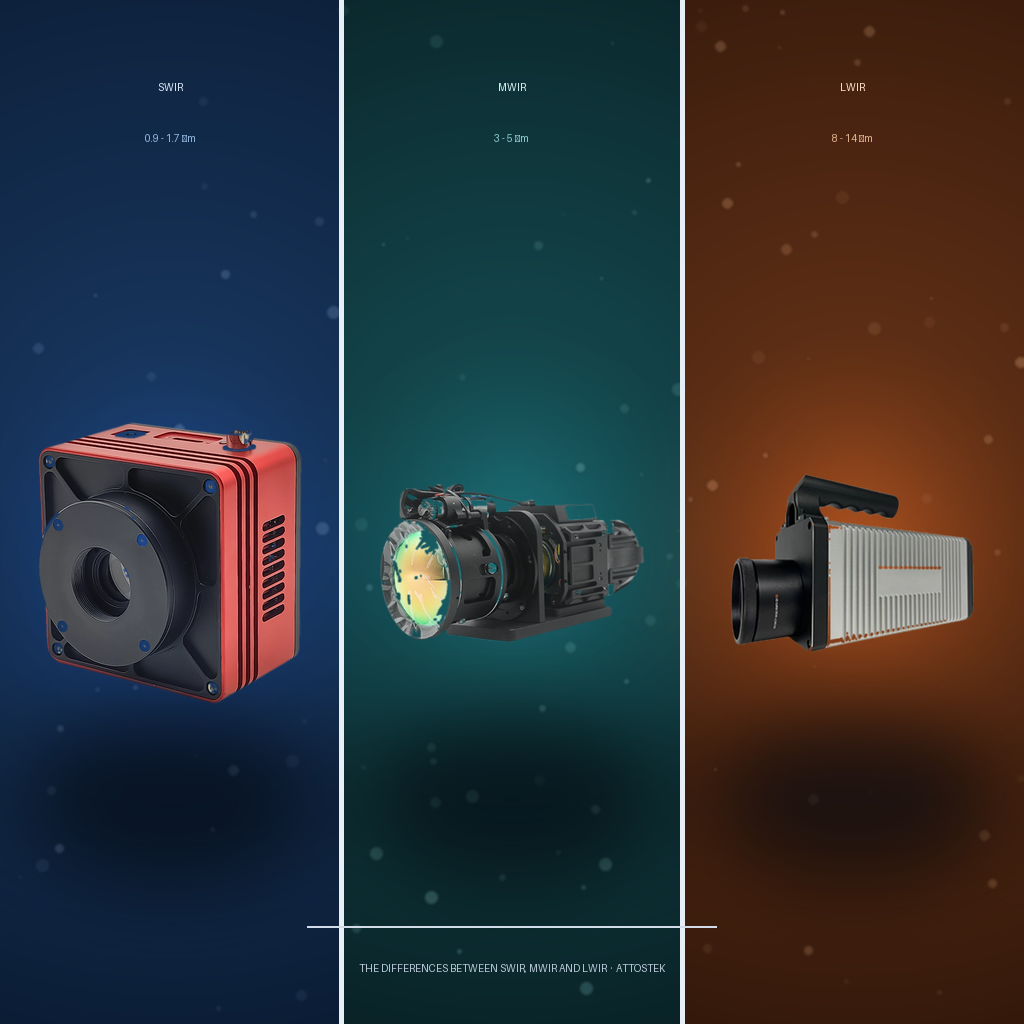
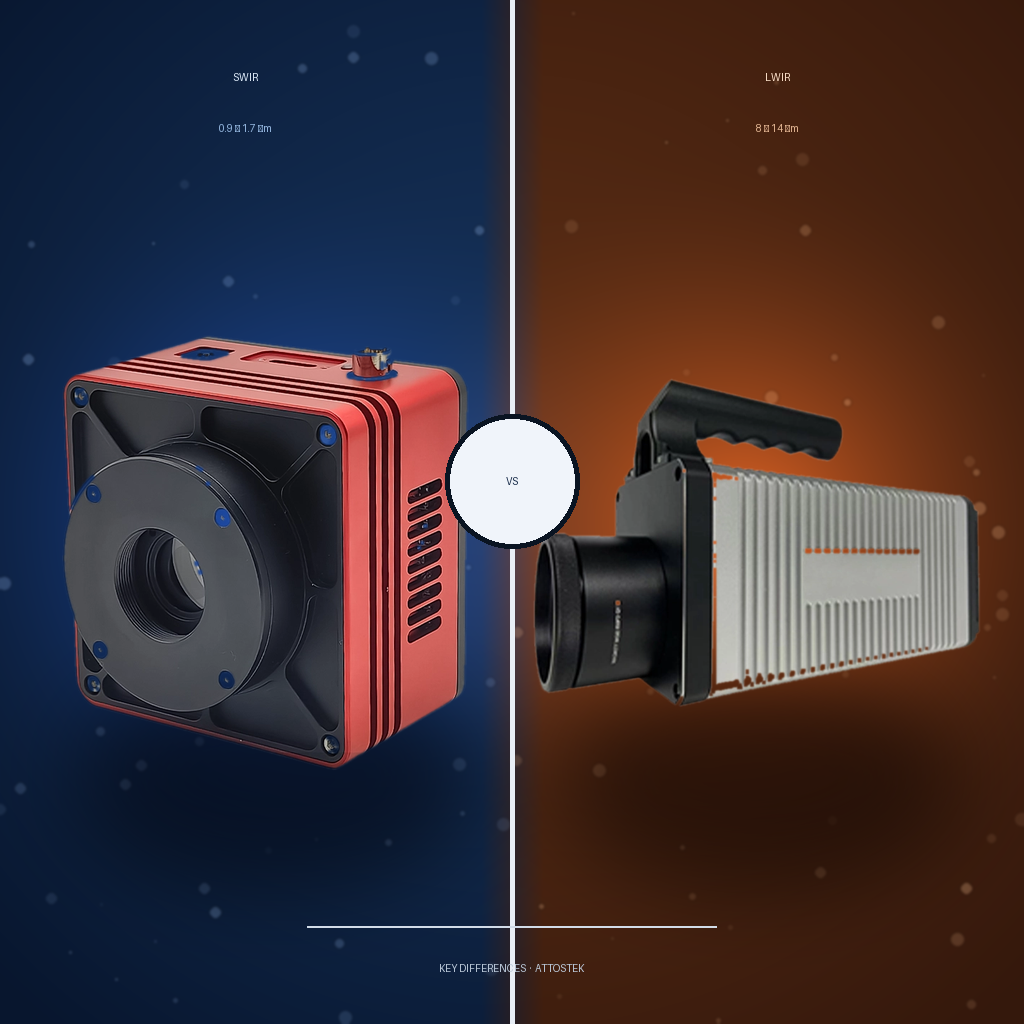
SWIR, MWIR and LWIR cameras image three separate windows of the infrared spectrum. SWIR cameras work from roughly 0.9 to 1.7 μm on reflected light; MWIR cameras work from 3 to 5 μm on radiation from hot targets; LWIR cameras work from 8 to 14 μm on the heat that room-temperature objects emit by themselves. The bands differ in physics, optics, cooling and cost: SWIR behaves like a high-resolution visible camera tuned to material contrast, MWIR pairs cooled photon detectors with the longest detection ranges, and LWIR delivers uncooled thermal imaging at the lowest cost of the three.
Key Takeaways
- Three bands, three physical signals. SWIR cameras read reflected photons at 0.9–1.7 μm, MWIR cameras read radiation from hot targets at 3–5 μm, and LWIR cameras read the self-emitted heat of room-temperature objects at 8–14 μm.
- Wavelength sets the resolution limit. Diffraction scales with wavelength, so a SWIR camera resolves finer point detail with smaller optics than a long-wave camera working at ten times the wavelength.
- Cooling requirements differ by band. SWIR cameras run from uncooled to deep-cooled designs; MWIR cameras typically need Stirling cryocoolers; most LWIR cameras need no cooler at all.
- MWIR detects hot targets farthest. Under the same conditions a cooled MWIR camera reaches about 2.5× the detection range of an LWIR camera, with noise-equivalent temperature differences as low as 22 mK.
- Cost follows cooling. Uncooled LWIR cameras are the least expensive, TEC-cooled SWIR cameras sit in the middle, and cryogenically cooled MWIR systems cost most and take minutes to reach operating temperature.
SWIR vs MWIR vs LWIR at a Glance
The three families answer different questions, and no single camera substitutes for another. Because the physical signals differ — reflected photons, hot-target radiation, ambient heat — the imaging capabilities that each band contributes to a system differ too. The table below puts the decisive parameters side by side, using representative figures from AttosTek’s product lines.
| Aspect | SWIR | MWIR | LWIR |
|---|---|---|---|
| Wavelength range | 0.9–1.7 μm (standard InGaAs); extended to 2.7 μm | 3–5 μm (e.g. 3.7–4.8 μm cores) | 8–14 μm |
| Signal imaged | Reflected photons; needs illumination | Radiation from hot targets | Heat emitted by room-temperature objects |
| Typical detector | InGaAs, CQD, extended MCT | MCT, InSb, T2SL | VOx microbolometer; cooled MCT / T2SL / HOT |
| Cooling | Uncooled to TEC; deep-cooled to −50 °C | Stirling cryocooler, ~7 min cooldown | None for VOx models |
| Typical resolution | 0.3–5 MP (e.g. 1280 × 1024 at 5 μm) | 640 × 512 to 2048 × 2048 | 640 × 512 to 1280 × 1024 |
| Speed | 200 fps full frame; ROI to 8000 fps | Video-rate thermal imaging | Video-rate thermal imaging |
| Lens material | Ordinary glass, C-mount | Germanium and other IR materials | Germanium or chalcogenide |
| Cost position | Mid to high | Highest | Lowest |
| Best for | Material contrast, silicon inspection, moisture | Hot targets at range: engines, flames, gas | Temperature mapping, night vision, low cost |
The Infrared Spectrum
Everything above 0.7 μm is infrared, but the region is not uniform — it is shaped by two curves. The first is the atmosphere, which absorbs most infrared wavelengths and leaves only a few transmission windows: the short-wave band around 0.9–1.7 μm, the mid-wave band at 3–5 μm and the long-wave band at 8–14 μm. Cameras are built into these windows because outside them there is almost nothing to see through air.
The second curve is thermal emission itself. Wien’s displacement law shifts an object’s radiation peak to shorter wavelengths as it gets hotter: a body near room temperature (300 K) radiates most strongly around 10 μm, inside the LWIR band, while a 1000 K engine part or a flame peaks near 3 μm, inside the MWIR band. That single fact organizes the whole market — LWIR cameras image objects at ordinary temperatures, MWIR cameras image hot targets against cool backgrounds, and SWIR cameras step away from thermal emission entirely and read reflected light, which is why a SWIR image looks like a photograph while MWIR and LWIR images look like heat maps.
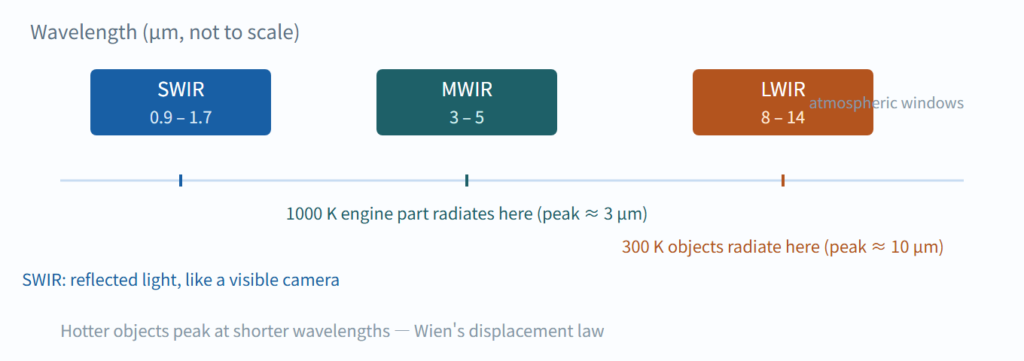
Each band exists because the atmosphere transmits there. Where an object’s heat radiates depends on its temperature: hot targets dominate the MWIR band, room-temperature targets dominate LWIR, and SWIR ignores thermal emission and images reflected photons instead.
SWIR Cameras
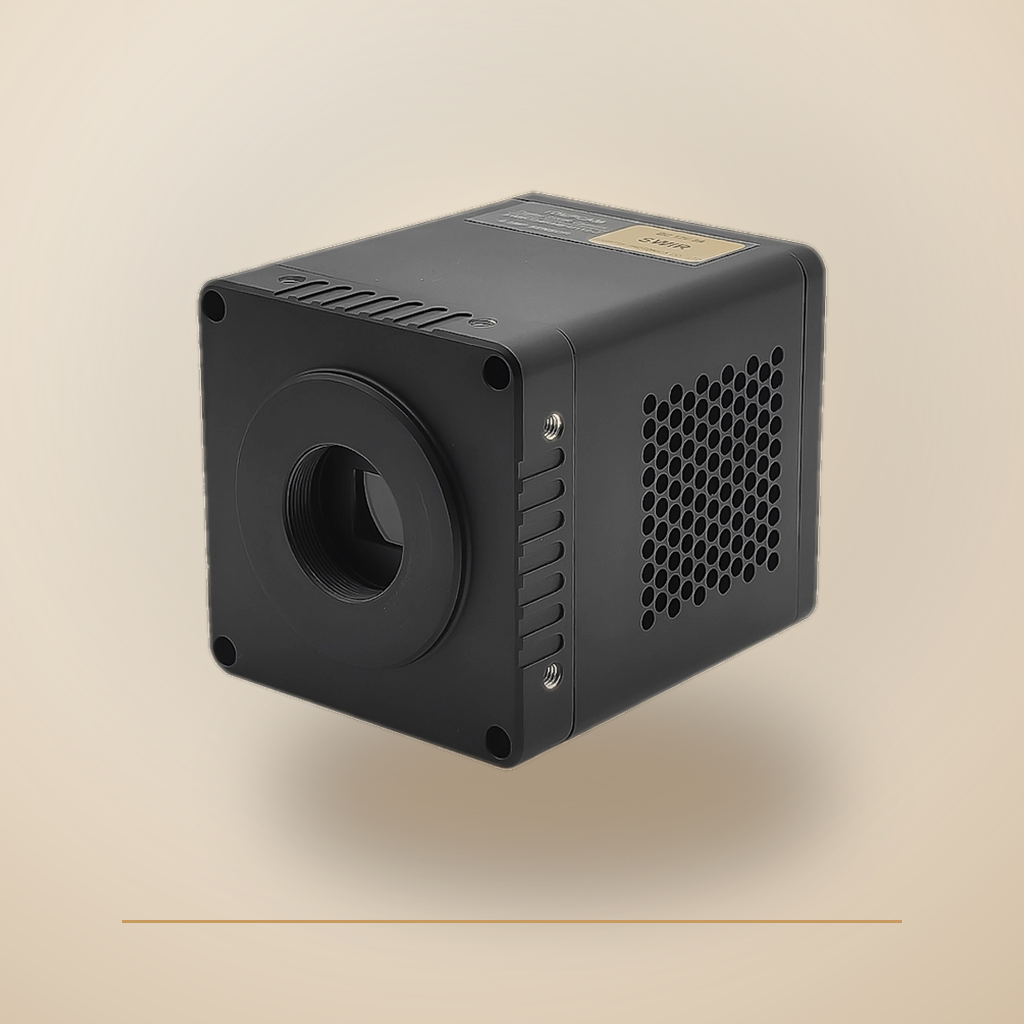
A SWIR camera is the infrared band’s “photograph”: it records photons that bounce off the scene, from ambient skylight, stars or an active LED or laser illuminator. The dominant detector is indium gallium arsenide, and because the band sits close to the visible, the imaging capabilities mirror those of a silicon machine-vision camera — small pixels, high resolution and fast readout, the qualities that adaptive optics benches and wavefront sensors also rely on at these wavelengths. A representative model, the 1.3 MP 5 μm TEC-cooled InGaAs SWIR camera, delivers 1280 × 1024 pixels at 200 fps across 400–1700 nm, and climbs to 8000 fps once the region of interest is cropped.
The value of the band is material contrast. Silicon turns transparent beyond 1.1 μm, so SWIR cameras inspect wafers, solar cells and packaged parts for internal defects; water absorbs near 1.45 μm, turning moisture into visible contrast for food and pharmaceutical inspection; the band also cuts through haze and smoke better than visible light. Ordinary glass passes SWIR, so standard C-mount lenses work. Cooling is optional in this band: a thermoelectric stage simply holds dark current steady when exposures stretch out, and uncooled compact designs cover bright-scene and portable uses. The same InGaAs arrays also serve scientific imaging — astronomy behind adaptive optics systems and other phase-sensitive measurements where stable, high-fill-factor detectors with fine point resolution matter more than video frame rates.
MWIR Cameras
MWIR cameras are built for hot targets. The 3–5 μm band is where a 1000 K engine, a flare stack or a missile plume radiates most strongly, and against a cool background the contrast is extreme — which is why the band dominates long-range surveillance, target tracking and gas-leak imaging. Detectors are photon-type semiconductors — mercury cadmium telluride, indium antimonide or type-II superlattice — whose narrow bandgaps only work when the array is held at cryogenic temperature, so a Stirling cryocooler is part of every classic MWIR camera.
The performance payoff justifies the cooling. A representative 0.33 MP T2SL MWIR camera core holds NETD at or below 22 mK, reaches full operating temperature in about 7 minutes, runs at under 12 W steady-state, weighs no more than 420 g and is rated for 10000 h cooler life, outputting 14-bit CameraLink with a −40 to +60 °C operating range. Resolutions in AttosTek’s MWIR camera systems span 640 × 512 to 2048 × 2048. Under the same conditions, a cooled MWIR camera detects a target at roughly 2.5× the range of a long-wave camera of similar aperture, because the shorter wavelength and the cold background give it far more signal to work with.
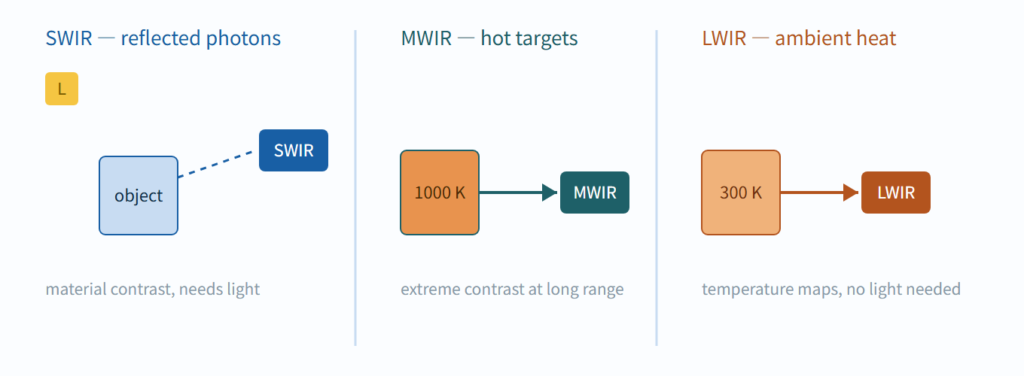
A SWIR camera photographs reflected photons; MWIR and LWIR cameras are radiometers pointed at emitted heat, split by target temperature — hot sources concentrate their energy in the 3–5 μm band, room-temperature objects in the 8–14 μm band.
LWIR Cameras
LWIR cameras image the world at its own temperature. Objects near 300 K radiate most of their energy in the 8–14 μm band, so the long-wave band needs no illumination and no hot target — it reads the heat map of whatever stands in front of it. The workhorse detector is the vanadium oxide microbolometer, an uncooled sensor whose pixels warm fractionally under incoming radiation; no cryocooler, no cool-down wait, instant start and low power. That is why uncooled VOx cameras are the least expensive infrared imaging devices on the market and appear everywhere from building diagnostics to firefighting, perimeter security and automotive night vision.
The trade-offs are optical and thermal rather than economic. Ordinary glass is opaque at these wavelengths, so LWIR optics are ground from germanium or chalcogenide glass; diffraction at ten times the wavelength limits the point resolution a long-wave optic can deliver; and the band saturates easily when targets are very hot, because the signal peaks elsewhere. Cooled long-wave designs using MCT, T2SL or high-operating-temperature detectors push sensitivity back up for long-range and low-contrast work, but they give back the cost advantage that makes the band popular. AttosTek’s uncooled and cooled LWIR cameras span VOx, MCT, T2SL and HOT detectors at resolutions from 640 × 512 to 1280 × 1024, with GigE, USB 3.0, CameraLink and MIPI interfaces.
How To Choose Your Infrared Camera
Choose the band by the signal, not the datasheet. If the information is in material composition — polymer sorting, moisture, silicon transparency, laser spots — a SWIR camera is the only band that sees it, and its resolution and speed come free with the physics. If the information is in temperature of hot objects at distance — engines, flares, bullets, gas plumes — MWIR cameras win on contrast and range despite their cost and cooldown. If the information is in the temperature of ordinary things — buildings, people, electronics above ambient — the long-wave band does the job at the lowest price, in darkness, with no illumination.
Then set the boundaries that survive procurement. Resolution and point resolution follow from diffraction, so shorter wavelengths win when detail matters; thermal sensitivity is compared through NETD; cooling decisions are really cost, power and readiness decisions — an uncooled camera is watching in one second, a Stirling-cooled MWIR camera needs seven minutes. Scientific programs add their own constraints: adaptive optics benches and other phase-sensitive instruments want stable, low-noise arrays and will accept the cooling that stability requires, while production lines want instant start and zero maintenance. When one band is not enough, AttosTek supplies SWIR, MWIR and LWIR cameras under one portfolio spanning 1 nm to 14,000 nm, and the AttosTek customization team configures sensor, interface, cooling and housing for small batches with CIF quotations.
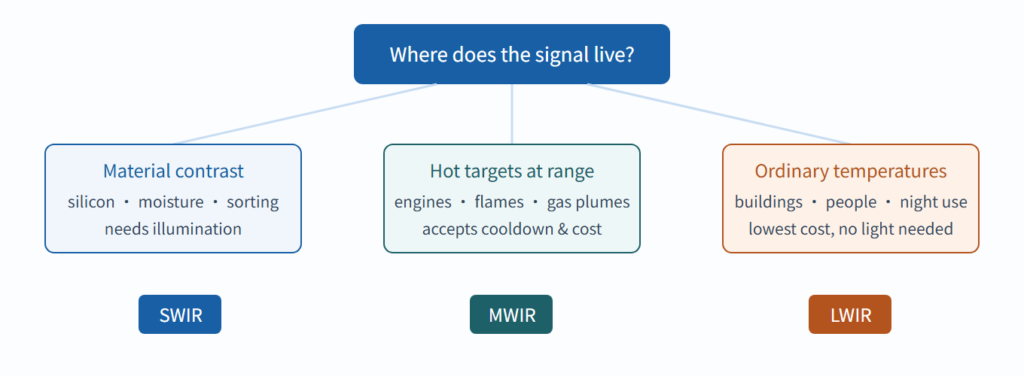
Most programs resolve in one step: material information points to SWIR, hot-target information to MWIR, and ambient-temperature mapping to LWIR. Programs that need several bands run them as one multi-camera system.
SWIR, MWIR and LWIR Cameras from AttosTek
The models below cover all three bands discussed in this article — high-resolution InGaAs SWIR cameras for material contrast, cooled MWIR cores for long-range thermal imaging, and uncooled LWIR modules for temperature mapping. Every camera ships with AttosView control software, a full SDK and CE/FCC certification.
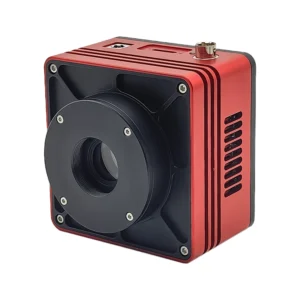
400–1700 nm · 1280 × 1024 @ 200 fps, ROI to 8000 fps · TEC cooling · USB3.0 / GigE / CoaXPress / CameraLink
|
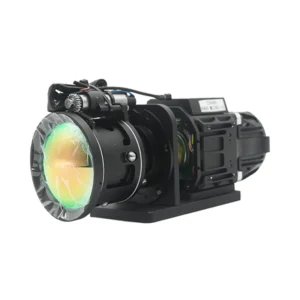
640 × 512 · NETD ≤ 22 mK · ~7 min cooldown · <12 W steady-state · 14-bit CameraLink · −40 to +60 °C
|
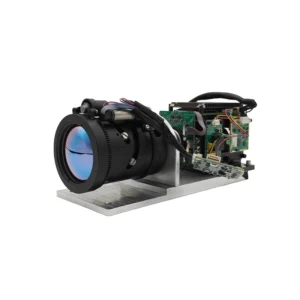
Mercury cadmium telluride detector with linear Stirling cooling · 640 × 512 format · long-range hot-target detection
|
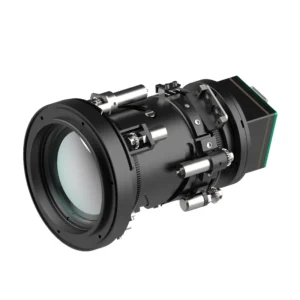
VOx microbolometer module for OEM integration · instant start, no cryocooler · GigE / USB3.0 / CameraLink / MIPI
|
Why Teams Buy Infrared Cameras from AttosTek
|
Complete Product Range
SWIR, MWIR and LWIR cameras and modules plus UV-VIS lines — every band from 1 nm to 14,000 nm under one supplier.
|
Quality Excellence
100% factory testing before shipment, with CE and FCC certification on every camera.
|
Flexible Customization
Detector, interface, cooling and housing options, accepted even for small-batch orders.
|
Timely Service
7 × 24 support across the full lifecycle, from band selection through integration.
|
Frequently Asked Questions
Which band is best for seeing hot machinery, engines or flames at a distance?
MWIR. Objects near 1000 K radiate most strongly in the 3–5 μm band, so a cooled MWIR camera sees them against a cool background with extreme contrast, detecting targets at roughly 2.5× the range of a comparable long-wave camera. For engines, flares and gas plumes, MWIR is the working answer.
Can one camera cover SWIR, MWIR and LWIR together?
No single detector spans all three bands — the wavelength ranges, detector materials and lens optics differ too much. The practical solution is a multi-camera system sharing one software platform; AttosTek supplies all three bands with the same AttosView interface and SDK, so a combined program stays manageable.
Do MWIR cameras always need cryogenic cooling?
Yes, classical MWIR cameras do. MCT, InSb and T2SL photon detectors have narrow bandgaps that only work at cryogenic temperatures, so a Stirling cooler is integral to the design. The trade is manageable: one 0.33 MP T2SL core reaches operating temperature in about 7 minutes, runs under 12 W and is rated for 10000 h of cooler life.
Why is a SWIR camera more expensive than an LWIR camera?
Detector manufacturing scale. InGaAs focal plane arrays are produced in far lower volumes than the VOx microbolometers inside uncooled LWIR cameras, which ship at consumer scale. SWIR earns the premium with material-contrast imaging capabilities that no thermal band can replicate, such as seeing through silicon and detecting moisture.
What should I send AttosTek to get a quotation for a multi-band system?
List the target or material, its temperature or wavelength, the working distance and the resolution and interface you need for each band. The team returns a configuration with a CIF quotation that includes freight and insurance but excludes destination duty, import tax and VAT; logistics is a flat 50 USD within Asia and 100 USD elsewhere.