SWIR stands for short-wave infrared: the band of the spectrum from roughly 900 to 1700 nm, extended by specialized sensors to 2200 nm or beyond. Unlike the thermal bands further out, infrared short wave light is reflected, not emitted, so a SWIR camera photographs a scene the way a visible camera does, under illumination, with comparable resolution and contrast. Because silicon sensors stop responding near 1100 nm, SWIR imaging requires other detector materials, mainly indium gallium arsenide (InGaAs) and, increasingly, colloidal quantum dot (CQD) films. What the band buys is a different kind of vision: silicon becomes transparent, water turns dark, and plastics that look identical in color separate cleanly. AttosTek builds SWIR cameras across 400–1700 nm in cooled, uncooled and extended-wavelength versions, inside a portfolio that spans 1–14,000 nm from EUV to LWIR.
Key Takeaways
- SWIR means short-wave infrared, and it is a reflected-light band, not a thermal one. Standard coverage is 900–1700 nm, and extended InGaAs reaches 1900, 2200 or 2700 nm for material identification.
- Silicon sensors end near 1100 nm. Every shortwave infrared camera therefore needs another detector material: InGaAs photodiodes bump-bonded to a silicon ROIC, or uncooled CQD films coated directly onto one.
- The band sees what visible light cannot. Silicon turns transparent past 1.1 µm, water absorbs strongly at 1450 nm, and same-colored plastics separate by composition, not by paint.
- SWIR resolution behaves like visible resolution. A 1.3 MP model delivers 1280 × 1024 at 5 µm pixels and 200 fps full-frame, or 8000 fps on a reduced region of interest.
- Not every infrared job is a SWIR job. Temperature measurement belongs to MWIR and LWIR; material contrast and through-fog detail belong to SWIR imaging.
What SWIR Stands For and What It Covers
SWIR is the acronym for short-wave infrared, sometimes written shortwave infrared, and it names the part of the infrared spectrum closest to visible light. The definition is not perfectly standardized across the industry: most sensors described as SWIR cover about 900–1700 nm, which matches the natural response of InGaAs, and the label is often stretched to include extended-response detectors reaching 1900, 2200 or 2700 nm. What all these windows share is position: short wavelengths for infrared, far longer than the eye can see, far shorter than the thermal bands.
The name distinguishes the band from its neighbors. Mid-wave infrared (MWIR, roughly 3–5 µm) and long-wave infrared (LWIR, 8–14 µm) are thermal bands where cameras read radiation that objects emit by themselves. The infrared short wave region works differently: a short wave infrared camera needs an external light source, sunlight, an LED bank or a laser, and records the photons that come back off the scene. That single fact drives everything else about SWIR applications: images look like photographs rather than heat maps, resolution is limited by optics and pixel count rather than by diffraction at ten-micron wavelengths, and contrast comes from how each material reflects or absorbs.
A short wave infrared camera, in practice, is a machine-vision camera that happens to answer to a different physics than the silicon camera next to it. For the sensor side of that story, how SWIR cameras work walks through the focal plane array, the ROIC and the illumination choices in detail.
Where SWIR Sits in the Infrared Spectrum
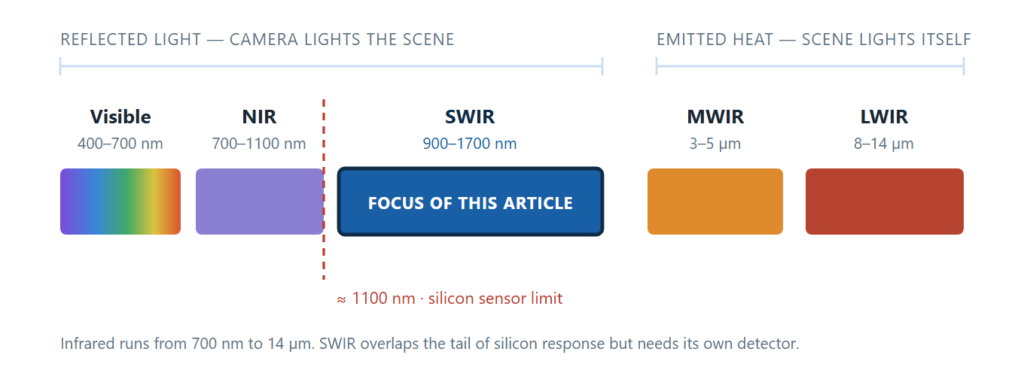
The useful map of the infrared runs from the visible edge at 700 nm out to 14,000 nm. Near infrared (NIR) hugs the visible band, and standard silicon covers it. SWIR follows, from roughly 900 nm to 1.7 µm, with extended sensors pushing to 2.2–2.7 µm. Then a gap, and the two thermal bands: MWIR around 3–5 µm, where hot objects and gas plumes radiate, and LWIR around 8–14 µm, where everything at room temperature glows faintly.
| Band | Approximate range | Light source | Typical detector | What it is for |
|---|---|---|---|---|
| Visible | 400–700 nm | Reflected (sun, lamps) | Silicon CMOS / CCD | Color imaging, general inspection |
| NIR | 700–1100 nm | Reflected | Silicon (deep-depletion extends to ~1.1 µm) | Extended visible work, some sorting |
| SWIR | 900–1700 nm, extended to 2700 nm | Reflected (sun, halogen, 1550 nm lasers) | InGaAs, or CQD on silicon | Material contrast, moisture, silicon inspection, imaging through haze |
| MWIR | 3–5 µm | Emitted by hot targets | Cooled T2SL / MCT / InSb | Hot-target detection, gas leaks, long-range thermal |
| LWIR | 8–14 µm | Emitted by all room-temperature objects | Uncooled VOx microbolometer, cooled MCT / T2SL | Thermography, night vision, building and PCB heat |
The boundaries matter less than the mechanism. SWIR imaging shares the illumination-and-reflection model of visible imaging, so lenses, filters and scene setup feel familiar to anyone from machine vision. The thermal bands share a radiometry model, calibrated temperature readout, no illuminator, diffraction-limited detail. Choosing between them is choosing which question the measurement answers: whether the comparison is SWIR vs NIR, SWIR vs MWIR or SWIR vs LWIR, it resolves to that one mechanism difference.
SWIR vs NIR: What Changes Above 1000 nm
NIR and SWIR are sometimes confused because both sit “just past visible”, but they are divided by a hard physical line: the silicon cutoff. Silicon photodiodes respond well to 700–950 nm, hold useful response to about 1000 nm, and stop near 1100 nm. Everything a silicon camera does in the near infrared happens below that line, on a sensor that is cheap, high-resolution and mass-produced.
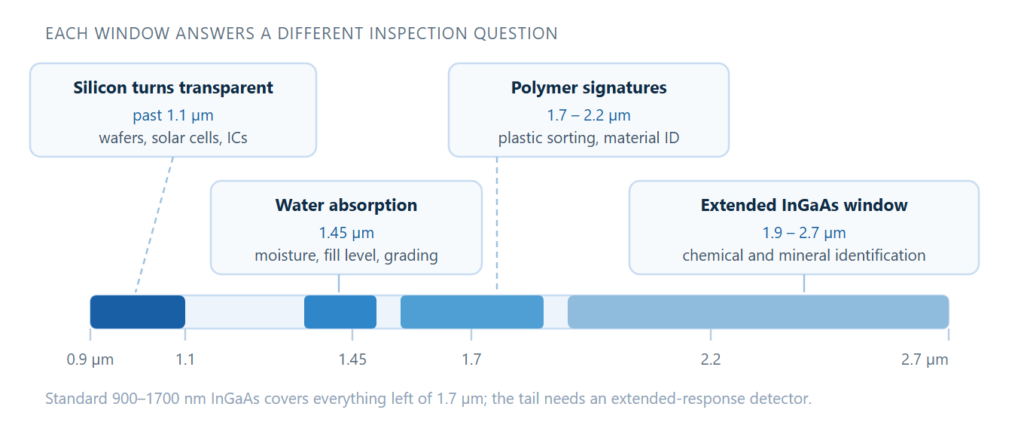
Above the line, the detector changes, and so does the picture. A short wave infrared camera begins where the silicon camera stops: InGaAs photodiodes cover 900–1700 nm with high quantum efficiency, and that range is where SWIR imaging earns its keep, because the material-contrast effects live there. Silicon turns transparent just past 1.1 µm, water absorbs hard at 1.45 µm, and many polymers develop distinct signatures between 1.7 and 2.2 µm. In SWIR vs NIR terms, NIR is an extension of visible imaging with silicon economics; SWIR is a new physics window that happens to need new sensors. That is also why a shortwave infrared camera costs more than a silicon one: InGaAs wafers are smaller, yields are lower, and volumes are a fraction of CMOS scale. CQD sensors narrow the gap by coating quantum-dot films directly onto silicon readout wafers, delivering uncooled cameras at lower cost across roughly 300–1700 nm, at some sacrifice in sensitivity and track record.
The 400–1700 nm cameras make the boundary practical rather than theoretical: with a suitable filter arrangement they capture visible and short-wave infrared frames of the same scene, so a sorting line can compare what silicon sees against what InGaAs sees in one pass.
How SWIR Cameras Work
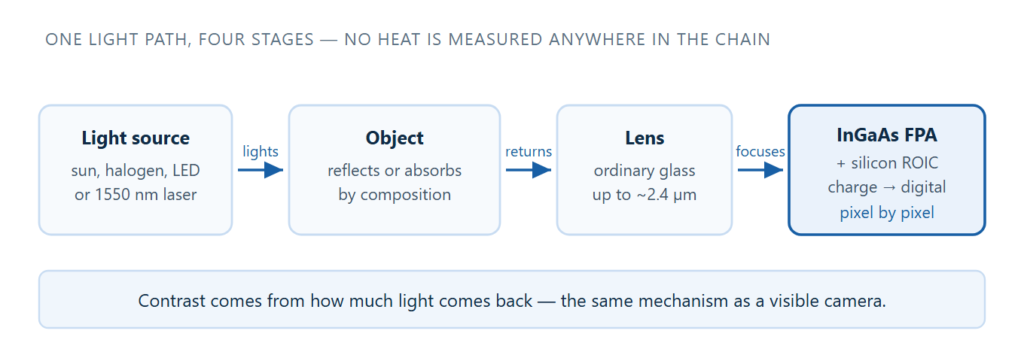
The SWIR imaging chain is straightforward. An illuminator, daylight, halogen, an LED array or a 1550 nm laser, lights the scene. Objects reflect and absorb according to their composition. The lens, ordinary glass up to about 2.4 µm, focuses the surviving photons onto the focal plane array, and the sensor converts them into an image. The detector is where the specialization lives: an InGaAs photodiode array, indium bump-bonded pixel by pixel onto a silicon readout integrated circuit that handles integration, amplification and digitization, or a CQD film processed monolithically on the readout wafer.
Cooling is the next design axis. InGaAs dark current roughly doubles with every ~10 °C of sensor temperature, so a shortwave infrared camera aimed at bright-line inspection with microsecond exposures runs uncooled, while faint-signal and long-exposure work uses thermoelectric cooling to hold the sensor tens of degrees below ambient, and deep-cooled designs reach -50 °C or -80 °C for photon-starved science. The full trade, noise against exposure time against imaging quality, is covered in the comparison of cooled and uncooled InGaAs cameras.
SWIR Applications
Most SWIR applications reduce to one of three effects: transparency, absorption or spectral signature. Silicon transparency past 1.1 µm makes SWIR imaging the standard tool for inspecting wafers, solar cells and packaged ICs for internal cracks and voids. Water absorption at 1.45 µm turns moisture content into image contrast for food grading and pharmaceutical drying, and lets a camera read fill levels through opaque plastic bottles. Spectral signatures separate clear plastics by resin type on recycling lines, grade fruit by internal condition, and support hyperspectral imaging and chemical sensing across the band.
Infrared short wave light also carries the band out of the factory: it penetrates haze, fog and smoke better than visible light, which is why the shortwave infrared camera appears in perimeter surveillance and transport imaging. Active illumination at eye-safe 1550 nm supports laser beam profiling and gated viewing. In research, the band covers laser characterization, spectroscopy and, at the deep-cooled end, NIR-II biological imaging. For a fuller map of SWIR applications, what SWIR cameras are used for collects the field reports, including a fruit-quality inspection run with a 1.3 MP InGaAs camera that sorts by internal condition rather than surface appearance.
Choosing a SWIR Camera
Selection starts with the band, because every other parameter follows from what your SWIR applications actually measure. Standard 400–1700 nm or 900–1700 nm coverage handles silicon inspection, moisture and most sorting; the infrared short wave region does not stop at 1700 nm, and if identification depends on signatures beyond that line, an extended-response camera reaching 1900, 2200 or 2700 nm is required, accepting higher dark current and, usually, cooling. Resolution comes next, set by the smallest feature that must be resolved, with 5 µm pixels in a 1280 × 1024 array on one end and 15 µm pixels on high-sensitivity designs at the other. Frame rate and interface follow the line speed, and cooling follows the exposure time. The selection logic is laid out step by step in the guide to choosing an InGaAs SWIR camera.
| Series | Detector | Wavelength coverage | Cooling | Typical use |
|---|---|---|---|---|
| A-series | InGaAs, 5 µm / 3.45 µm pixels, 0.33–5 MP | 400–1700 nm (visible + SWIR) | TEC-cooled | High-resolution inspection, 200 fps full-frame |
| B-series | InGaAs, 15 µm pixels | 900–1700 nm | Thermoelectric, deep-cooled to -50 / -80 °C | High sensitivity, long exposure, low light |
| C-series | Extended InGaAs, 15 µm pixels | 900–1900 / 2200 / 2700 nm | Cooled | Material identification past 1700 nm |
| Uncooled / Q-series | InGaAs or CQD, 15 µm pixels | 400–1700 nm or 300–1700 nm | Uncooled | Portable, embedded and OEM integration |
No single short wave infrared camera covers the whole span, so the AttosTek catalogue splits into series and concrete models anchor the options. The 1.3 MP 5 µm 400–1700 nm camera (SWIR051A, Sony IMX990) runs 200 fps at full 1280 × 1024 resolution and up to 8000 fps on a region of interest, with USB3.0, GigE, CoaXPress and CameraLink variants. The 5 MP 3.45 µm model pushes resolution to 2560 × 2048 over 10GigE. For size, weight and power constrained systems, the uncooled USB3.0 camera draws under 2.11 W, weighs 70 g and starts imaging the moment it is powered. The full set, including CQD and extended-wavelength versions, is under SWIR cameras at AttosTek, and requirements that fall between catalogue models go to the AttosTek customization team, which supports small-batch sensor, interface, cooling and housing changes.
SWIR Cameras from AttosTek
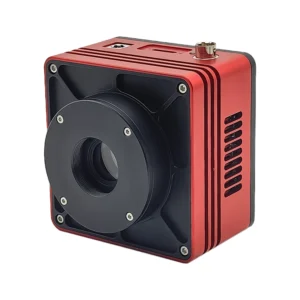
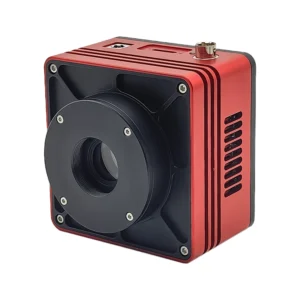 1.3 MP 5 μm InGaAs SWIR camera (SWIR051A) 1280 × 1024, 400–1700 nm, Sony IMX990
200 fps full-frame, 8000 fps ROI TEC-cooled, USB3.0 / GigE / CoaXPress / CameraLink |
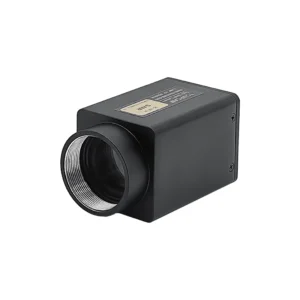
 5 MP 3.45 μm InGaAs SWIR camera 2560 × 2048, 400–1700 nm
High resolution for fine-feature inspection 10GigE interface |
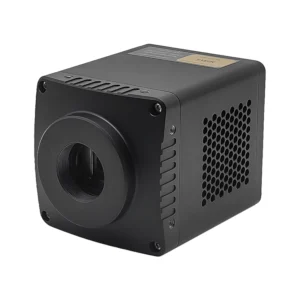
 0.33–5 MP uncooled USB3.0 SWIR camera 400–1700 nm, no cooler, instant start
Under 2.11 W bus power, 70 g, 33 × 33 × 38 mm Portable and OEM integration |
 0.33 MP 900–2200 nm extended SWIR camera Extended InGaAs, 15 μm pixels
Reaches signatures past 1700 nm Material and polymer identification |
Why Work with AttosTek
| Complete product range | Quality excellence | Flexible customization | Timely service |
|---|---|---|---|
| Cameras, lenses and optical systems from EUV to LWIR, 1–14,000 nm, so a multi-band program stays with one supplier. | Every unit is tested before it ships, with CE and FCC certification on the range. | Sensor, interface, cooling and housing changes are supported, including small quantities. | Technical support runs 7 × 24, with replacement and return handled by the same team. |
Frequently Asked Questions
What wavelength range do I need in a SWIR camera?
For silicon inspection, moisture detection and most sorting, 400–1700 nm or 900–1700 nm is enough. If identification depends on absorption signatures past 1700 nm, as in polymer or chemical identification, choose an extended-response camera covering 1900, 2200 or 2700 nm, and expect to pair it with cooling.
Does a SWIR camera need cooling?
Not always. Uncooled cameras suit bright scenes and short exposures on production lines, start instantly and draw under 2.11 W. Thermoelectric cooling becomes necessary when exposures stretch past milliseconds or the signal is weak, because InGaAs dark current falls sharply with sensor temperature. Deep cooling to -50 °C or -80 °C is reserved for photon-starved science.
Can AttosTek customize a SWIR camera for my system?
Yes. The customization process works through sensor, interface, cooling and housing changes, then software and validation, and supports small quantities. Wavelength coverage, frame rate, trigger wiring, form factor and lens mount can all be matched to an existing fixture, and the team returns a configuration with a CIF quotation.
What software and SDK support comes with AttosTek SWIR cameras?
Every camera ships with AttosView control software and an SDK supporting C/C++, C#/VB.NET, Python and Java, plus LabVIEW, MATLAB, Micro-Manager, DirectShow and TWAIN. Windows, Linux and macOS are covered, so existing acquisition code usually carries over to the new camera without rewriting, and third-party vision platforms integrate through DirectShow or the native SDK.
How do I get a quotation for a SWIR camera?
Send the application, wavelength range, resolution and frame rate, interface, cooling requirement and operating environment. Quotes are CIF, covering freight and insurance but excluding destination customs duty, import tax and VAT, with flat logistics of 50 USD inside Asia and 100 USD elsewhere, shipped by DHL or FedEx.


