SWIR Camera Industry
描述
聚焦公司最新动态,追踪光电行业前沿资讯。
Product Test: Dark Current of a SWIR Camera at Different Temperatures
I. Experimental Objective This experiment uses the AttosTek SWIR1503BU-DC deep-cooled SWIR camera to acquire dark-field images under unified test conditions. By comparing the imaging quality at different cooling temperatures, the suppression effect of cooling temperature on the camera's dark noise level is systematically evaluated, providing experimental evidence for the selection of SWIR imaging systems in low-light, high-sensitivity applications. II. Application Background and Experimental Principle Most mainstream SWIR cameras employ InGaAs sensors, which have a narrow bandgap. At room temperature, the thermal excitation carrier effect is significant, and the dark current is much higher than that of visible-light sensors, affecting the signal-to-noise ratio. Cooling technology can fundamentally suppress dark current and improve the signal-to-noise ratio. To visually observe the suppression effect of deep cooling on dark current, we selected a completely dark, no-light dark-field environment, kept the exposure time and other parameters constant, and captured dark-frame images of the camera under uncooled, –10°C cooling, –20°C cooling, and –50°C cooling conditions, directly presenting the noise differences at different cooling temperatures. III. Test Conditions and Test Results 3.1 Test Conditions ParameterSpecificationDeep-Cooled CameraSWIR1503BU-DCExposure Time1 sAmbient TemperatureRoom temperature 20°CCamera Temperature Settings20°C, –10°C, –20°C, –50°C 3.2 Test Results From the images, it can be observed that…
08/07/2026
How is the SWIR1503BU-DCL SWIR Camera can Achieve Deep Cooling to –80°C?
AttosTek's SWIR1503BU-DCL scientific-grade SWIR camera employs a four-stage TEC cooling system, combined with a vacuum-sealed chamber and water-cooling heat dissipation technology, enabling deep cooling to –80°C with temperature control accuracy of ±0.1°C. I. Four-Stage TEC Cooling The AttosTek SWIR1503BU-DCL camera is equipped with four-stage TEC cooling, achieving a temperature differential of up to 100°C, which provides the foundation for reaching the ultra-low temperature of –80°C at the chip level. The principle of TEC semiconductor cooling is based on the Peltier effect. A single-stage TEC can achieve a maximum temperature differential of only 50°C, which is insufficient to meet the demands of deep cooling. Therefore, the industry generally adopts multi-stage TEC cooling, utilizing a stacked series configuration to achieve stepwise temperature reduction. However, multi-stage TEC stacking can introduce thermal stress and reduce cooling efficiency. To address these issues, our company has selected Bi-Te-based semiconductor materials with high thermoelectric figure of merit to improve cooling efficiency. II. Fully Vacuum Metal Sealing To solve the problem of condensation due to cooling, the mainstream solutions are inert gas sealing and fully vacuum metal sealing. Since the SWIR1503BU-DCL is equipped with four-stage TEC cooling, the various cooling stages generate a significant temperature differential during operation, continuously producing thermal…
08/07/2026
Four High‑Speed High‑Sensitivity SWIR Cameras
High-Speed High-Sensitivity SWIR Cameras High-speed high-sensitivity SWIR cameras combine fast dynamic acquisition with low-light detection capability, enabling the capture of transient weak infrared signals. They are widely used in high-speed dynamic testing scenarios such as semiconductor photovoltaic inline inspection, pulsed laser spot monitoring, and plasma/combustion transient observation. SWIR Camera Core Parameters Below are four high-speed high-sensitivity SWIR cameras with frame rates exceeding 600 fps, with their core parameters, product advantages, and application scenarios summarized for quick reference: ModelAttostek SWIR1503BCL2Xenics Cheetah 640 TE1Teledyne SCION 640First Light Imaging C-RED2Spectral Range900nm – 1700nm900nm – 1700nm400nm – 1700nm900nm – 1700nmPixel Size15μm × 15μm20μm × 20μm10μm × 10μm15μm × 15μmResolution640 × 512640 × 512640 × 512640 × 512Full Frame Rate1000fps865fps700fps600fpsPeak QE75%@1350 nm80%@1550 nm85%@1300 nm80%@1550 nmReadout Noise16.55 e⁻120 e⁻30 e⁻30 e⁻InterfaceCamera LinkCamera LinkCamera Link / USB3.0Camera Link / USB3.0Dynamic Range69.2 dB60 dB70 dB93 dBAdvantagesUltra-high frame rate, low readout noiseLarge pixel size, high QEHigh QE, low readout noiseLow readout noise, extremely high dynamic rangeApplication ScenariosHigh-speed ballistic process recording, quantum precision measurementHigh-pressure fluid atomization tracking, plasma diagnosticsQuantum experiments, semiconductor defect inspectionLow-light combustion/flame analysis, high-dynamic-range industrial inspection
08/07/2026
Product Recommendation | SWIR1503BU-DC Deep‑Cooled SWIR Camera
I. Product Introduction The SWIR1503BU-DC is a deep‑cooled SWIR camera equipped with an InGaAs CMOS sensor, capable of achieving –50°C cooling (at 20°C ambient temperature). With a resolution of 0.33 MP, a pixel size of 15 µm, a USB3.0 interface, and a global shutter, the SWIR1503BU-DC is an ideal choice for research institutes, medical institutions, and high‑end industrial applications, thanks to its stable cooling system and exceptional scientific imaging performance. II. QE Curve III. Camera Specifications ParameterSpecificationModelSWIR1503BU-DCSensor TypeInGaAs CMOSSpectral Range900 nm – 1700 nmPixel Size15 µm × 15 µmSensor Format3/4″Frame Rate & Resolution300 fps @ 640 × 512Hardware Image Buffer512 MBConversion Gain0.96 e⁻/DN (HCG), 5.36 e⁻/DN (MCG), 145 e⁻/DN (LCG)Dynamic Range55.8 dB (HCG), 58.1 dB (MCG), 58.3 dB (LCG)Readout Noise22.8 e⁻ (HCG), 106 e⁻ (MCG), 2708 e⁻ (LCG)Full Well Capacity14 ke⁻ (HCG), 85 ke⁻ (MCG), 2216 ke⁻ (LCG)Maximum SNR41.5 dB (HCG), 49.3 dB (MCG), 63.4 dB (LCG)Dark CurrentMCG 193.909 e⁻/s/pixel, HCG 630.516 e⁻/s/pixel, LCG 131.561 e⁻/s/pixelExposure Time Range16 µs – 5 sShutter ModeGlobal shutterData InterfaceUSB3.0Digital I/O1 opto‑isolated input, 1 opto‑isolated output, 2 non‑isolated I/O portsData Format8‑bit / 16‑bitCooling Temperature–50°C (at 20°C ambient temperature)Optical InterfaceC‑mountPower Supply19 V 4.74 A DCPower Consumption8.4 W (TEC OFF) / <16 W (TEC ON)Dimensions137.8 mm ×…
08/07/2026
Product Recommendation | SWIR1503BU High‑Speed High‑Sensitivity SWIR Camera
I. Product Introduction The SWIR1503BU is a short-wave infrared (SWIR) industrial camera based on a high-performance InGaAs CMOS sensor, featuring 0.33 MP resolution and a pixel size of 15 µm. Equipped with a USB3.0 interface, the camera achieves a maximum frame rate of 724 fps and incorporates a TEC cooling module for precise temperature control of ≤ –25°C, ensuring image stability. With a global shutter, it eliminates image tearing in high-speed dynamic scenes. Leveraging its excellent imaging performance, stable temperature control system, and flexible integration options, the SWIR1503BU camera is suitable for applications such as high-speed sorting, process monitoring, laser imaging, and array-based deployment. II. QE Curve III. Optical Window Transmittance Curve IV. Camera Specifications ParameterSpecificationModelSWIR1503BUSensor TypeInGaAs CMOS image sensorSpectral Range900 nm – 1700 nmPixel Size15 µm × 15 µmSensor Format3/4″Frame Rate & Resolution8-bit: 724 fps @ 640 × 512Packet12: 724 fps @ 640 × 51214-bit: 579 fps @ 640 × 512Hardware Image Buffer512 MBPeak Quantum Efficiency75% @ 1350 nmConversion GainLG: 138.6 e⁻/ADU; MG: 5.54 e⁻/ADU; HG: 1.2 e⁻/ADUDynamic RangeLG: 70.59 dB; MG: 67.96 dB; HG: 47.98 dBReadout NoiseLG: 586.82 e⁻; MG: 35.05 e⁻; HG: 68.44 e⁻Full Well CapacityLG: 1,986,426.78 e⁻; MG: 87,649.83 e⁻; HG: 17,147.351 e⁻Maximum SNRLG: 62.98 dB;…
08/07/2026
1000 fps High‑Sensitivity SWIR Camera
High-speed industrial inspection, microscopic transient scientific experiments, and similar applications require capturing rapidly evolving dynamic processes, imposing stringent demands on the frame rate and sensitivity of imaging equipment. The frame rate of SWIR cameras is constrained by sensor readout speed and data transmission bandwidth. Currently, the full-frame frame rate of most SWIR cameras is maintained at 100–400 fps, making it difficult to meet the imaging requirements of ultra-high-speed dynamic scenes. The Attostek SWIR1503BCL2 SWIR camera achieves ultra-fast imaging at 1000 fps at 640 × 512 resolution, providing a reliable solution for high-speed vision applications. I. Attostek SWIR1503BCL2 Camera 1. CameraLink Data Interface To achieve the data throughput of 640 × 512 at 1000 fps, interface bandwidth is critical. The SWIR1503BCL2 camera employs a CameraLink interface, specifically designed for scenarios demanding extreme frame rates. The Full configuration delivers a transmission rate of up to 6.8 Gbps, providing a reliable channel for real-time, stable transmission of massive image data, thereby enabling 1000 fps at full resolution. 2. 15 μm Large Pixel Size High frame rates typically mean extremely short integration times. The SWIR1503BCL2 camera features a 15 μm large pixel size, capable of collecting more photons, directly enhancing the camera's sensitivity and…
08/07/2026
SWIR Camera Recommendations for Atomic Fluorescence Imaging
Atomic fluorescence imaging is an effective method for characterizing atomic spatial distribution and quantum state information in fields such as ultracold atoms and quantum simulation. Depending on the wavelength of atomic fluorescence radiation, this technique can be divided into visible-light atomic fluorescence imaging and short-wave infrared (SWIR) atomic fluorescence imaging. The former is suitable for atomic systems such as rubidium, potassium, and lithium, while the latter targets metastable helium, erbium, strontium, and other atomic systems. As research expands into metastable noble gases and rare-earth atomic systems, SWIR atomic fluorescence imaging is playing an increasingly indispensable role in cutting-edge directions such as cold atom trap observation and single-atom-resolved detection. At the same time, SWIR atomic fluorescence imaging presents several technical challenges. I. Technical Challenges of SWIR Atomic Fluorescence Imaging 1. Scarce Fluorescence Photon Count Fluorescence power is inversely proportional to the square of the wavelength, and the atomic spontaneous emission rate also decreases with increasing wavelength. Compared with rubidium atoms in the visible band, the number of fluorescence photons emitted per unit time by atoms in the SWIR band is significantly reduced, resulting in weak effective signals reaching the camera sensor. 2. Limited Observation Time Dynamic processes such as free expansion,…
08/07/2026
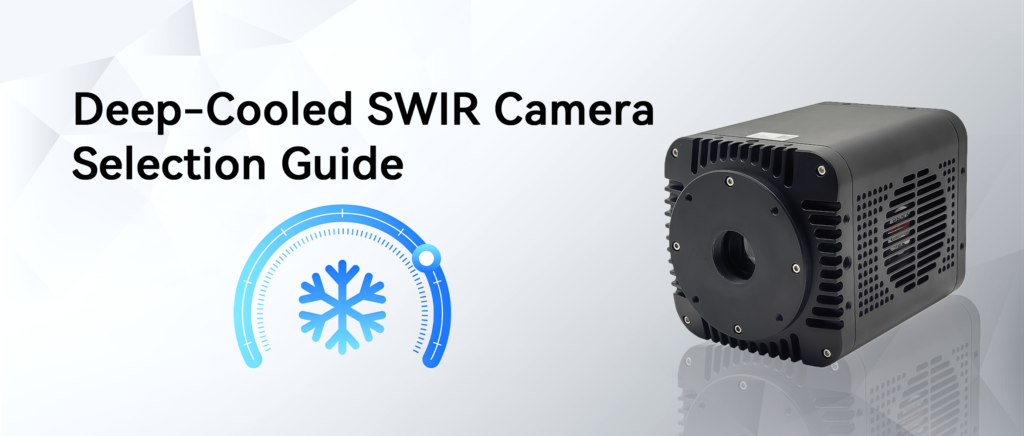
Deep-Cooled SWIR Camera Selection Guide
Deep-cooled SWIR cameras are scientific-grade imaging devices typically equipped with multi-stage TEC cooling modules that can lower the InGaAs detector temperature to well below ambient levels, effectively suppressing dark current. These cameras are widely used in life sciences, precision spectroscopy, astronomical observation, semiconductor industrial inspection, and other fields. Below we have selected several deep-cooled SWIR cameras and consolidated their key parameters, product advantages, and applicable scenarios, providing a quick reference for researchers and industrial users in their selection process: ProductAttosTek SWIR1503BU-DCXenics Cheetah-640CL-TE3Hamamatsu C12741-11Andor C-RED 2Teledyne NIRVANA HSDetector TypeInGaAs CMOSInGaAs FPAInGaAs FPAInGaAs Scientific FPAInGaAsResolution640 × 512640 × 512640 × 512640 × 512640 × 512Pixel Size15 μm × 15 μm20 μm × 20 μm20 μm × 20 μm15 μm × 15 μm20 μm × 20 μmSpectral Range900–1700 nm900–1700 nm950–1500 nm900–1700 nm900–1600 nmFrame Rate300 fps110 Hz7.2 fps600 fps250 fpsPeak Quantum Efficiency75% @ 1350 nm85% @ 1550 nm60% @ 1250 nm80% @ 1500 nm73% @ 1550 nmCooling Temperature–50°C–45°C–70°C–40°C–55°CReadout Noise22.8 e⁻35 e⁻<30 e⁻23 e⁻<60 e⁻Dark Current131.561 e⁻/s/pixel<1k e⁻/s/pixel130 e⁻/s/pixel30 fA @ 0.2 V500 e⁻/pixel/sExposure Range16 μs ~ 5 sMicrosecond-level short exposure16.7 ms ~ 1 s1 μs ~ 10 s2 μs ~ 1 minData InterfaceUSB 3.0Camera LinkCamera LinkUSB 3.0 / GigEUSB 3.0Key Advantages–50°C air cooling, no…
07/31/2026
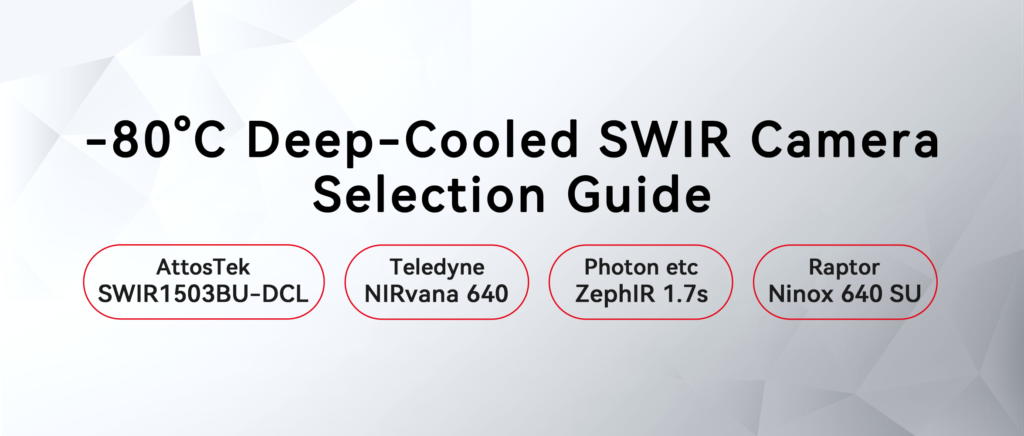
-80°C Deep-Cooled SWIR Camera Selection Guide
-80°C deep-cooled SWIR cameras stabilize the detector chip at ultra-low temperatures to effectively suppress dark current, making them a core choice for high-end applications such as scientific spectroscopy, semiconductor precision inspection, and life sciences imaging. Below we have selected several -80°C deep-cooled SWIR cameras and consolidated their key parameters, product advantages, and applicable scenarios, providing a quick reference for researchers and industrial users in their selection process: ProductAttosTek SWIR1503BU-DCLTeledyneNIRvana 640Photon etcZephIR 1.7sRaptorNinox 640 SUDetector TypeInGaAsInGaAsInGaAsInGaAsResolution640 × 512640 × 512640 × 512640 × 512Frame Rate300fps~ 30 fps250 fps100fpsPixel Size15 μm × 15 μm15 μm × 15 μm15 μm × 15 μm15 μm × 15 μmSpectral Range900-1700nm900-1700nm900-1700nm900-1700nmPeak QE75%@1300nm85%@1350nm80%80%@1500nmCooling Temperature-80℃-80℃-80℃-80℃Dark Current131.561 e⁻/s/pixel< 100 e⁻/pixel/s150 e⁻/pixel/s300 e⁻/pixel/sReadout Noise22.8 e⁻< 30 e⁻28 e⁻40 e⁻Dynamic Range58.3dB78dB51.1dB69dBData InterfaceUSB3.0USB 3.0/Camera LinkUSB 3.0 / Camera LinkUSB3.0/ Camera LinkKey FeaturesHigh speed, low dark current, low readout noiseLowest dark, best choice for long exposuresHigh speed, low readout noiseHigh dynamic range, drift-free long exposuresApplicable ScenariosQuantum optics, NIR-II in vivo imagingUltra-low-light spectroscopy, astronomical observationPhotovoltaic PL imaging, pharmaceutical molecular infrared imagingAstronomical observation, single-molecule infrared fluorescence imaging
07/31/2026
Five Cooling Temperature Grades for SWIR Cameras
Ⅰ、The Importance of Cooling for SWIR Cameras Signal-to-Noise Ratio (SNR) is a critical parameter that characterizes the imaging performance of SWIR cameras. SWIR cameras use InGaAs as the sensor material, with a typical dark current of 18.75 ke⁻/pixel/s. In comparison, silicon-based detectors at room temperature exhibit a dark current of only about 40 e⁻/pixel/s. Therefore, the SNR of SWIR cameras is largely dominated by the dark current level. Cooling the sensor chip can effectively suppress dark current, so the cooling temperature of a SWIR camera can serve as a reference indicator for its maximum SNR. Based on this, I have divided SWIR camera cooling temperatures into five levels: room temperature (20°C), –10°C, –20°C, –50°C, and –100°C, and for each level, representative products are listed. Ⅱ、Cooling Temperature Grades 2.1、20°C Room Temperature (Uncooled) The detector temperature varies with the ambient temperature, and there is no built-in cooling module. This type of camera offers the smallest size, lowest power consumption, lowest cost, and simplest integration; however, it has the highest dark current, which varies significantly with temperature. It is only suitable for basic industrial scenarios with sufficient lighting and high-speed production lines, and cannot meet the requirements of low-light and precision inspection. Representative…
07/21/2026